

Why Most Self-Help Fails Men (And What Philosophy Does Instead)

Most self-help written for men is not making them stronger. It is making them more anxious, more dependent on motivation, and more confused about what a competent adult actually looks like. The discipline you keep hearing about cannot be installed by a podcast. It has to be reasoned into existence.
That sounds like a small distinction. It is not. It is the difference between a man who runs on borrowed energy and a man who runs on a framework he understands well enough to defend.
The Promise the Industry Keeps Selling

Walk into any bookstore, scroll through any feed, and the message aimed at men is consistent. Wake up at 5 a.m. Take cold showers. Lift heavy. Read more. Hustle harder. Optimize your morning, your diet, your testosterone, your dopamine. Find a mentor. Build the side income. Then, presumably, you will become the man you suspect you should be.
This message became dominant for understandable reasons. A generation of men grew up with fewer rites of passage, less institutional guidance, and weaker apprenticeship structures than their grandfathers had. Fathers worked long hours or were absent. Schools optimized for compliance, not character. By the time many men reached their late twenties, they could feel a gap between who they were and who they sensed they should be, but no one had handed them a map.
Into that vacuum stepped a content economy that promised to fill the gap with tactics. The tactics are not always wrong. Lifting is good. Cold exposure has its uses. Reading beats scrolling. The problem is what sits underneath the tactics, which is usually nothing at all.
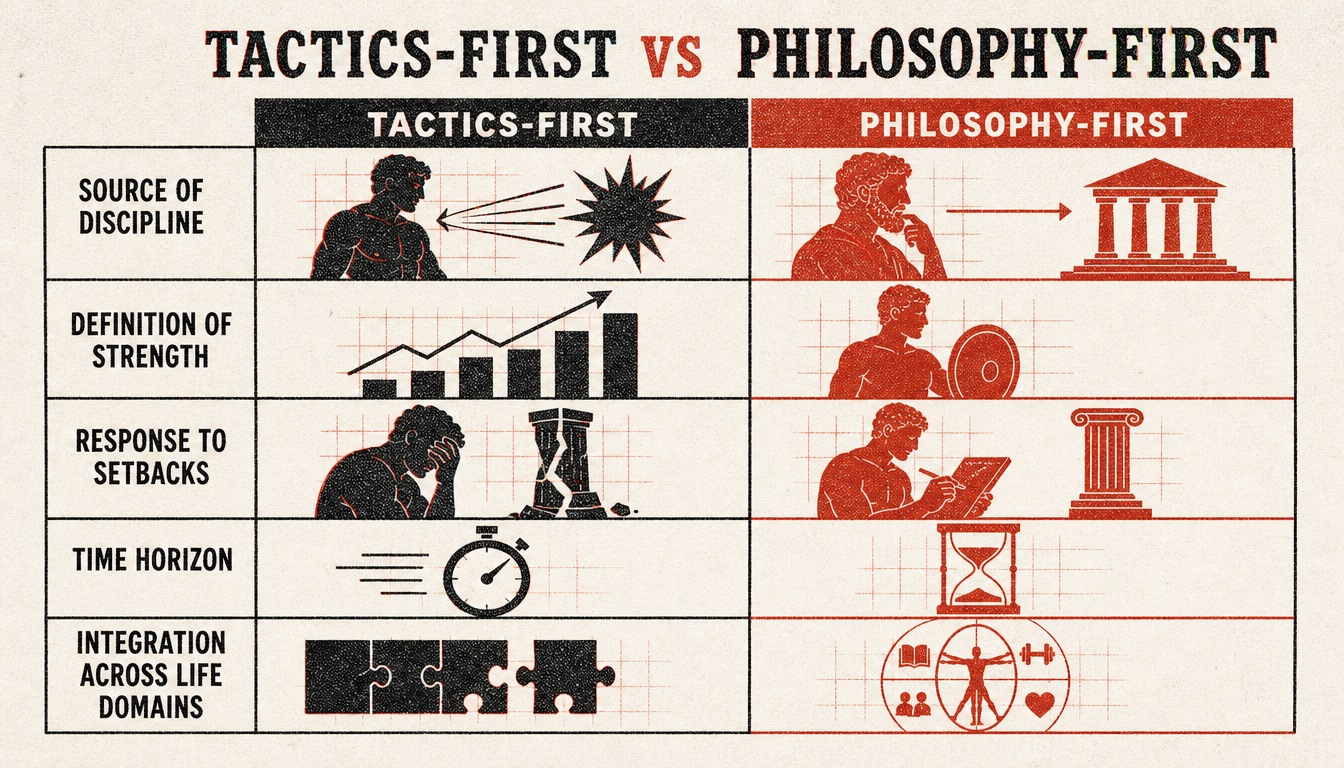
Tactics without a philosophy collapse the moment motivation runs out. And motivation always runs out.
Why the Tactics-First Model Breaks Down

Consider the typical arc. A man encounters a high-energy speaker or a book that fires him up. He builds a new routine. For two weeks, maybe three months, he feels like a different person. Then a stressful quarter at work hits, or a relationship cracks, or he gets sick for a week. The routine breaks. The discipline he thought he had turns out to have been borrowed from the content. When the content stops playing in his head, the behavior stops with it.
This is not a personal failing. It is a structural one. The tactics-first model treats discipline as an output of stimulation. Watch the right video, feel the right surge, do the work. But discipline that depends on stimulation is just a more sophisticated form of impulse. It looks productive while the chemistry holds and disappears the moment the chemistry fades.
The cost of this loop is not just wasted time. It is the slow erosion of a man's trust in himself. Every cycle of intense commitment followed by quiet collapse teaches him, at a level deeper than words, that he cannot rely on his own promises. After enough cycles, he stops making serious ones. He hedges. He performs interest in self-improvement instead of practicing it. He becomes, in the worst case, a connoisseur of frameworks he never actually uses.
There is a second cost that gets less attention. Tactics-first content tends to frame masculinity as a set of external signals. Physique, income, status with women, follower counts. A man who internalizes that frame and then fails to hit those markers in a given year concludes he is failing as a man. A man who hits them concludes he has arrived, which is its own kind of trap because the markers must keep climbing or the identity collapses. Either way, the inner life remains unbuilt.
What Philosophy Does Differently

Philosophy, in the older sense of the word, is not a set of beliefs. It is a trained way of evaluating situations and choosing responses. The Stoics in particular treated it as something closer to a martial art for the mind. You drill the principles, you test them against real circumstances, and over years you become someone who reacts to provocation, loss, temptation, and praise from a stable center.
That stable center is what the tactics-first model cannot manufacture. You can buy a gym membership. You cannot buy the disposition that gets you there on the morning your father has died. That disposition has to be built upstream, before the crisis, through practice that is intellectual and behavioral at the same time.
Three differences matter most.
Reasons That Survive Bad Days
A man who lifts because a podcaster told him to will quit when the podcaster falls out of favor. A man who lifts because he has reasoned through what a body is for, what aging does to the untrained, and what kind of presence he wants to carry into a room will not quit when his feed changes. The behavior is the same. The substrate is completely different.
Stoic practice insists on this upstream work. Before you commit to an action, you examine the principle behind it. Is this thing I am pursuing actually good, or does it only look good because everyone around me wants it? Is this fear I am avoiding actually dangerous, or am I just uncomfortable? Questions like these are not philosophical hobbies. They are load-bearing structures for behavior.
A Definition of Strength That Does Not Depend on Circumstance
Tactics-based masculinity defines strength by output. The number on the bar, the number in the bank, the number of people who respect you. Those numbers can vanish. A market crashes. An injury sidelines you. A reputation gets damaged by something you did not control. If your sense of yourself was built on those numbers, you crumble with them.
The older philosophical tradition defines strength by the quality of your response. Can you face a setback without lying to yourself about it? Can you accept a loss without becoming bitter? Can you absorb praise without inflating? These capacities are not visible from the outside, which is why the content economy ignores them. They are also the only capacities that hold up across a full life.
A Framework That Integrates the Domains
Most self-help content is siloed. There is fitness content, finance content, dating content, productivity content, mindset content. Each silo runs its own logic, and the man consuming it has to do the integration work himself, usually without realizing that is what he is doing. The result is incoherence. He optimizes his morning routine while neglecting his marriage. He builds a body while letting his temper go untrained. He earns money while spending it on things that humiliate him in private.
A philosophical framework forces integration because it asks one question across every domain: what kind of man is this making me, and is that the man I would respect? Fitness, work, relationships, and inner life all answer to the same standard. The silos collapse. The man becomes one thing instead of a collection of separately optimized parts.
The Anatomy of a Working System
If philosophy is the substrate, what does the practice actually look like in a week? It is less exotic than people expect. The Stoics were not mystics. They were practical men, many of them soldiers, politicians, merchants, and tutors, who treated character as something you build with daily reps the same way you build a body.
The core moves are these.
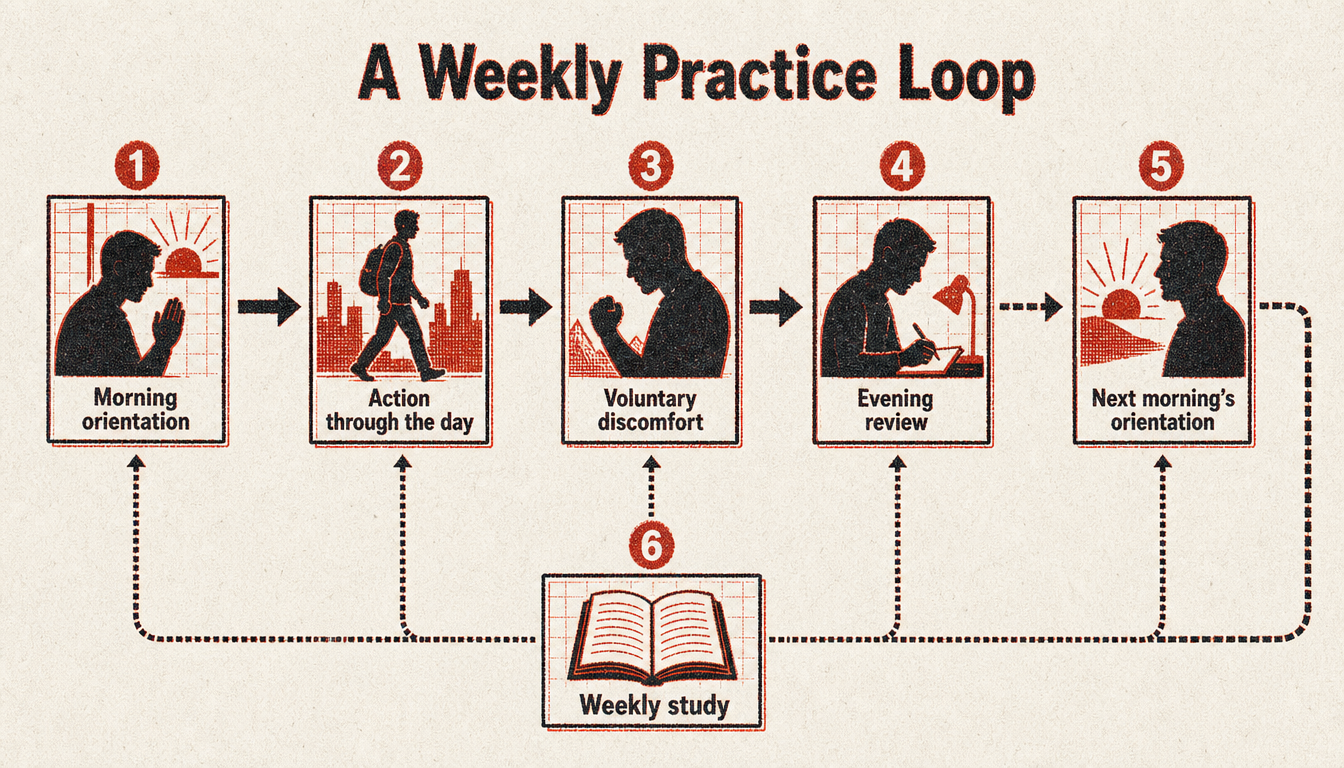
Morning orientation. Before the day starts pulling at you, spend a few minutes naming what is likely to happen and how you intend to meet it. Not a vision board exercise. A realistic preview. You will probably be cut off in traffic. You will probably get an email that irritates you. You will probably be tempted to skip the hard task in favor of the easy one. Decide now how you will respond when those moments arrive. This is not optimism. It is rehearsal.
Evening review. At the end of the day, walk through it honestly. Where did you act in line with what you said you valued? Where did you not? No flogging, no inflation. Just a clean accounting. The point is not to feel bad. The point is to make the gap between intention and behavior visible to yourself so it can close over time.
Voluntary discomfort, chosen for reasons. Cold exposure, fasting, hard training, public speaking, difficult conversations. The Stoics practiced these not as performances of toughness but as tests of the gap between what you fear and what is actually happening. You discover that hunger is uncomfortable but not dangerous. That the conversation you dreaded was survivable. That the cold passes. The fear of these things shrinks, and with it the territory in your life that fear can quietly govern.
Study, not consumption. Read primary texts slowly. Reread them. Mark them up. The point is not to accumulate quotes for social media. The point is to let a small number of ideas sink deep enough that they become reflexes. A man who has actually internalized a handful of principles will out-decide a man who has skimmed a hundred books.
Service to someone specific. A philosophy that points only inward turns into narcissism with better vocabulary. Pick people you are responsible for, name them, and orient real effort toward their wellbeing. This is not optional. It is the test that prevents self-development from becoming self-absorption.
Answering the Obvious Objections
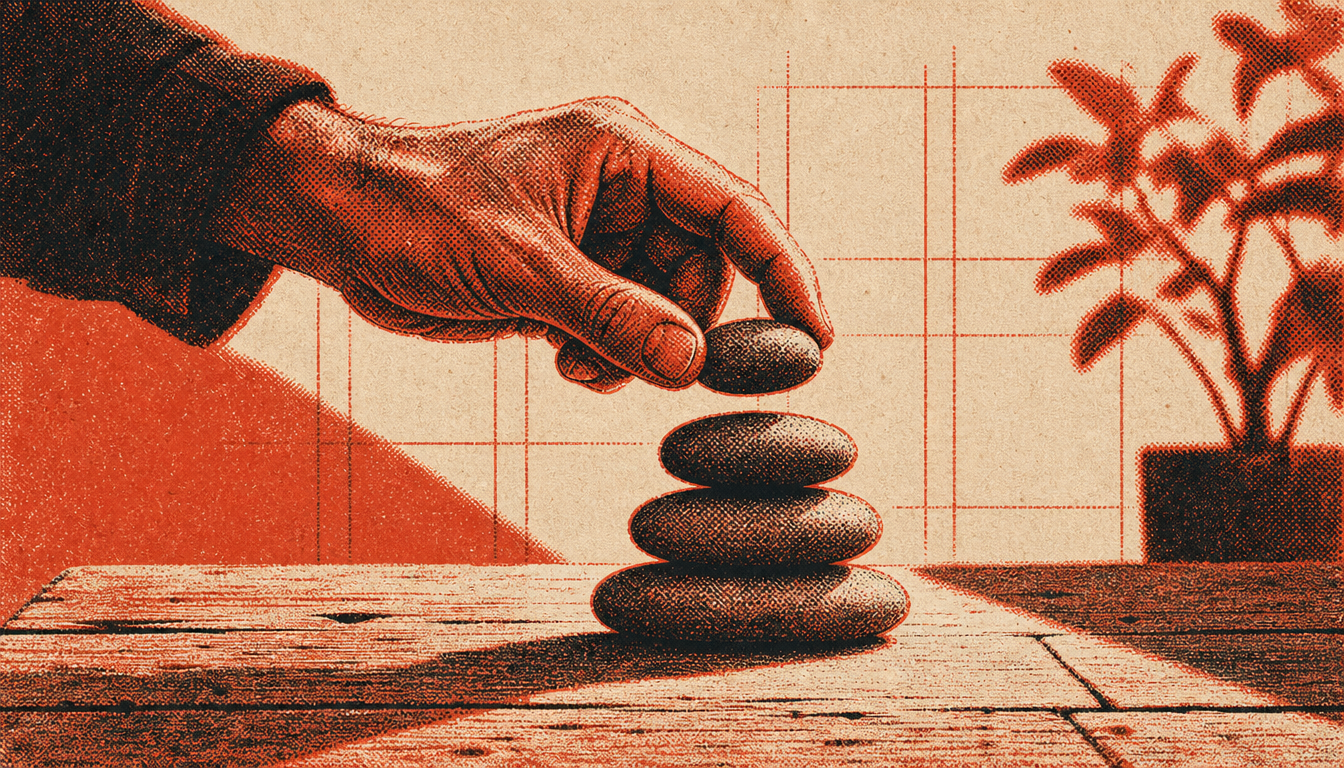
A few objections come up reliably when men hear this argument for the first time. They deserve direct answers.
Isn't this just intellectualizing? At some point you have to act. Yes, and the framework demands action constantly. The morning orientation is useless without the day that follows. The evening review is useless without tomorrow's adjustment. The difference is not action versus thought. It is action that is reasoned versus action that is reactive. Both involve doing things. Only one involves doing them with a steering wheel.
Stoicism sounds cold. Don't men already suppress too much? This is the most important objection and the most misunderstood. The Stoic position is not that emotions should be suppressed. It is that emotions should be examined before they are acted on. Anger that you have looked at honestly often turns out to be hurt, or fear, or shame. Acting on the anger without examining it produces damage. Examining it produces understanding and, often, a more accurate response. This is the opposite of suppression. It is closer to what good therapy aims at, arrived at through a different door.
Won't this make me passive? The world rewards aggression. The world rewards effectiveness, which is not the same as aggression. A man who has trained himself to respond rather than react is more effective in negotiations, more trusted by colleagues, more attractive to serious partners, and more durable through setbacks than a man who runs on adrenaline. The Stoics were not passive. They governed provinces, led armies, ran businesses. They simply did so without being jerked around by their own nervous systems.
How long does this take to work? Longer than a thirty-day challenge and shorter than you fear. The first noticeable shift, usually a reduction in reactive anger and a small increase in follow-through, tends to show up within a season of consistent practice. The deeper shifts, where the framework becomes who you are rather than something you are doing, take years. This is not a bug. It is the point. Anything that promises to remake you in a weekend is selling something that will not hold.
How to Make the Switch Without Burning It All Down
You do not need to throw out everything you are currently doing. The smarter move is to keep the behaviors that are working and put a different engine underneath them.
Start with one week of observation. Notice when you act and why. Notice the moments your discipline holds and the moments it slips. Do not try to change anything yet. Just look. Most men have never actually watched themselves with this kind of attention, and the data is more useful than any plan you could write in advance.
Then pick one principle to test. Not five. One. It could be as simple as: I will not respond to anything in anger today without waiting an hour first. Or: I will name one fear each morning and ask whether it is describing something real. Run the principle for two weeks. See what it changes.
Add structure slowly. Morning orientation, even three minutes, is enough to start. Evening review, even five minutes, is enough to start. The mistake is trying to install a full monastic schedule on a Monday and abandoning it by Thursday. You are not building a routine. You are building a relationship with yourself, and relationships move at the pace of trust.
Find at least one other man who is doing similar work. Not a guru. A peer. Someone who will tell you the truth about your behavior and let you tell him the truth about his. Isolated self-development almost always drifts toward self-flattery. A serious friend prevents the drift.
Read fewer things, more deeply. Pick a primary text and stay with it for a season. Re-reading the same passage in different moods, in different seasons of life, is how the words stop being decoration and start being structure.
Finally, accept that you will fail repeatedly and that failure is not a sign the framework is wrong. It is a sign the framework is in use. The man who never breaks his routine is usually the man whose routine asks nothing of him. The point is not to be perfect. The point is to keep returning, with more honesty each time, to a standard you have actually reasoned yourself into believing in.
The Question Worth Sitting With
The standard self-help model for men promises that if you do enough of the right things, you will become someone. The older philosophical model proposes something different. You already are someone, and most of the work is learning to see him clearly, train him patiently, and stop outsourcing his formation to people whose business is your attention.
That is not a softer claim. It is a harder one. It puts the responsibility back where it belongs and removes the comfort of believing the next book, the next program, the next mentor will finally do the work for you.
So the question is not whether you have enough information to change. You almost certainly do. The question is whether you are willing to stop being entertained by the idea of change and start practicing it, in small daily reps, on the days when no one is watching and nothing about it feels like a breakthrough. That is where the man you suspect you should be has been waiting the whole time.