
Motivation is a liar. Discipline is the truth you build with your own hands. If you have spent years collecting self-improvement insights but still find your behavior inconsistent, the gap is not knowledge. The gap is the operating system you run on, and motivation makes a poor one.
This matters now because the modern attention economy is engineered to sell you feelings about change rather than the structure of change. Videos that thrill you for ninety seconds leave you hollow by morning. The men who actually build something durable, in body, mind, work, and relationships, are not running on borrowed enthusiasm. They are running on a code. That code is discipline, and once you understand the mechanics, the false promise of motivation becomes obvious.
The Current State of the Motivation Industry

An entire economy exists to keep men in a permanent loop of inspiration without transformation. Short-form videos, hype reels, supplement ads dressed as philosophy, and creators yelling about grindset have created a strange phenomenon: men who can quote Marcus Aurelius but cannot keep a morning routine for three weeks.
The cultural assumption goes like this. If you feel motivated, you will act. If you do not act, you must not be motivated enough. So you consume more content to top up the tank. This framing is wrong at the root. It treats action as the output of an emotional state, when in reality, sustained action is the output of a system that is largely indifferent to how you feel.
Most men know this intellectually. They have read the books. They can recite the lines about consistency and process. Yet they still wake up some mornings, feel nothing, and use that absence of feeling as evidence that today is not the day. The flaw is not character. The flaw is the framework. They are still operating as if motivation were the engine, with discipline as a backup generator. The order needs to reverse.
What Motivation Actually Is, and Why It Lies
Motivation is an emotional response to stimulus. It rises when you watch a powerful speech, see a man you admire, hit a low point that scares you, or imagine a future version of yourself. It feels like fuel. It is not fuel. It is weather.
Weather changes. You cannot build a house and expect it to stay up because the sky was clear the day you poured the foundation. Yet that is exactly how most men approach their goals. They start when the emotional weather is favorable, and they stop when the clouds roll in. Then they blame themselves for lacking willpower, when the real issue is that they tied their behavior to something that was never designed to last.
Motivation lies because it promises permanence while delivering only a mood.
The Three Lies Motivation Tells
The first lie is that feeling ready is a prerequisite for acting. It is not. Action almost always precedes the feeling you were waiting for. Men who train at dawn rarely want to train at dawn. They train, and then the wanting catches up, sometimes mid-session, sometimes never. The work gets done either way.
The second lie is that intensity equals progress. A man can feel fiercely motivated for a weekend and produce nothing of lasting value. Another can feel flat for a month and complete a manuscript, build a business pipeline, or add measurable strength. Intensity of feeling and quality of output are weakly correlated at best.
The third lie is that motivation scales. It does not. Big emotional surges are followed by emotional debt. The bigger the high, the deeper the trough. Men who chase peak states end up spending more time recovering from them than producing in them.
What Discipline Actually Is, and Why It Holds
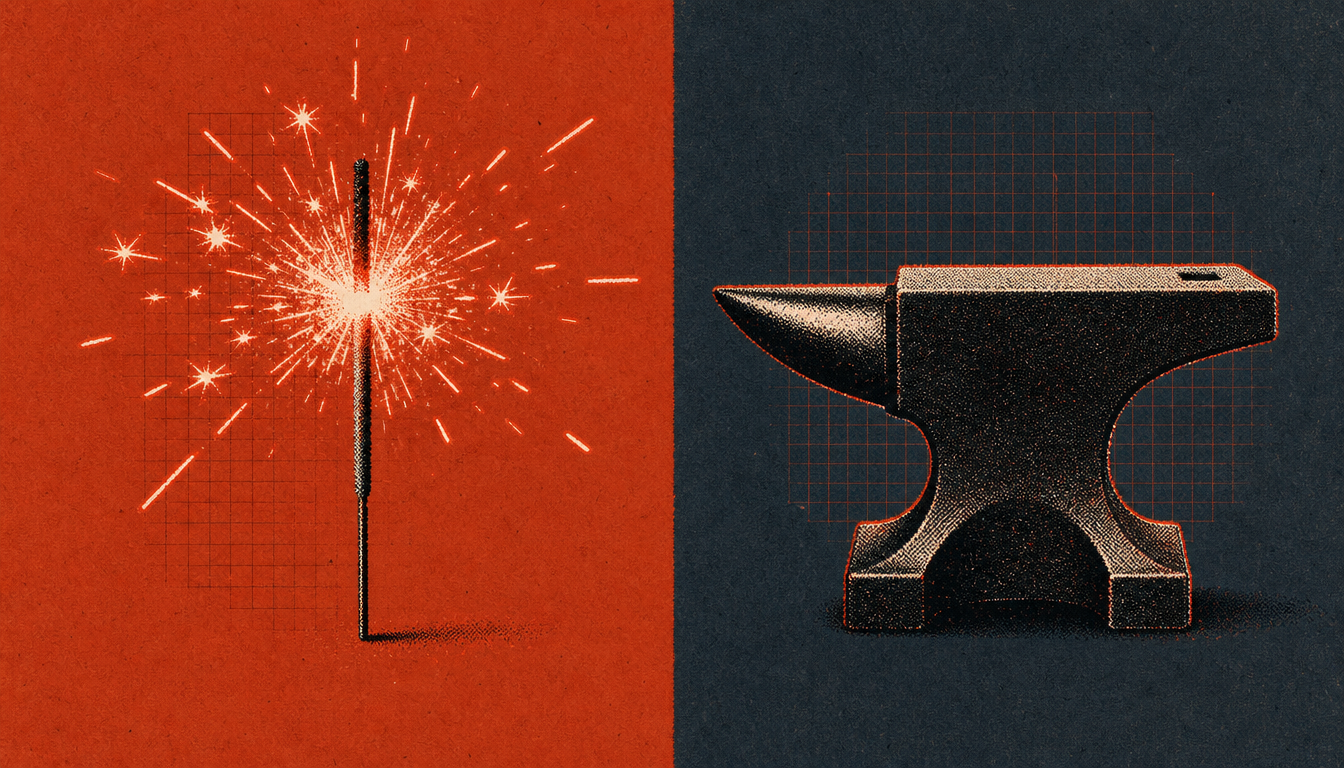
Discipline is not a feeling. It is an architecture. It is the set of commitments, routines, environments, and identity rules that produce correct action regardless of mood. When discipline is built well, the question of whether you feel like doing the work never comes up, because the structure has already answered it.
Stoic thought has a useful frame here. The Stoics distinguished between what is in your control and what is not. Your emotional state on any given morning is largely not in your control. Your prior commitments, your environment, and your response to circumstance are. Discipline operates entirely within the territory you actually own.
Consider the man who has decided he trains four times a week. He does not negotiate with himself on training mornings. The negotiation happened once, weeks or months ago, when he made the rule. The morning is simply execution. Compare him to the man who decides each morning based on how he feels. The first man will accumulate years of progress while the second accumulates years of starting over.
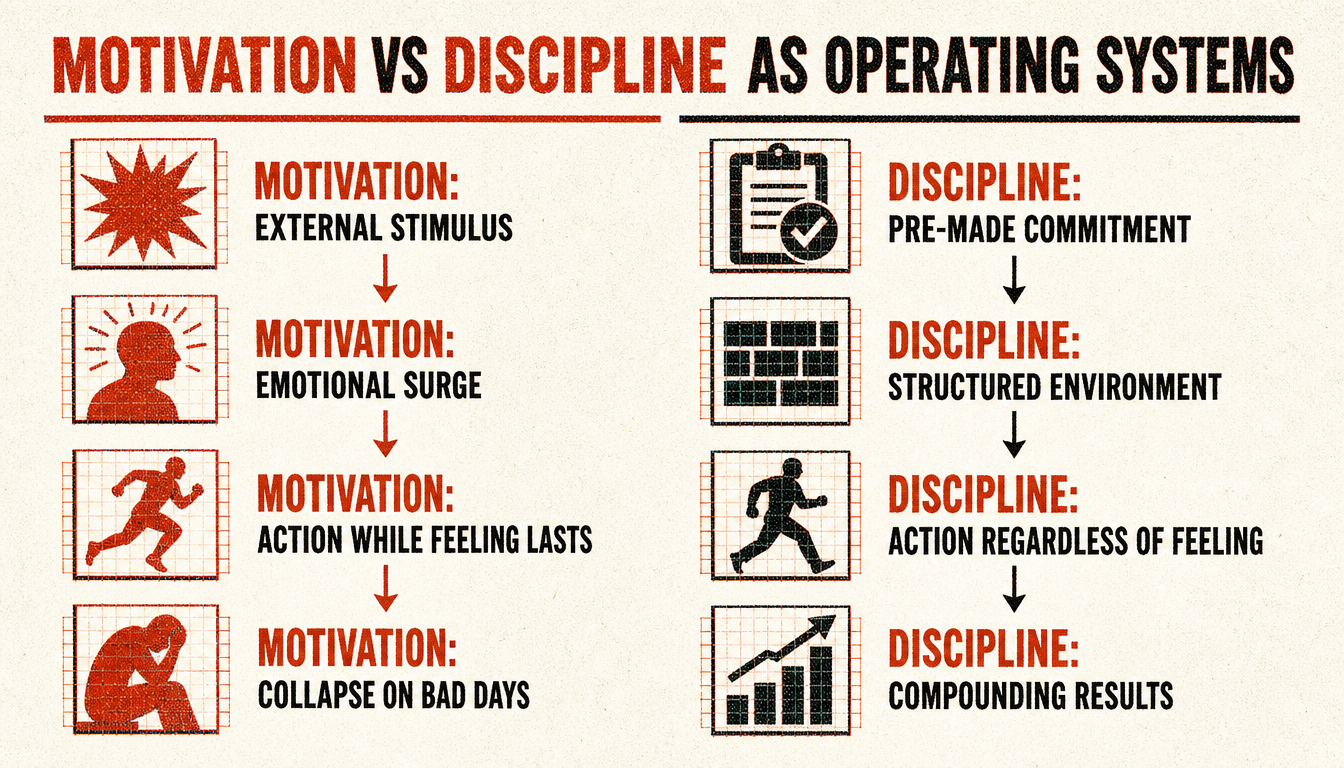
The diagram below contrasts how motivation and discipline operate as systems for sustained action.
Discipline as Identity, Not Effort
The deepest form of discipline is not gritted teeth. It is identity. When a behavior becomes who you are, it stops costing willpower. A man who identifies as someone who keeps his word does not strain to keep promises. He simply does, because breaking them would feel like ceasing to exist as himself.
This is where most self-improvement content fails. It sells men techniques without changing the underlying self-concept. Techniques applied to an unchanged identity always erode. Identity-level discipline is the only kind that compounds across decades.
Discipline vs Motivation: A Direct Comparison

Putting the two side by side makes the asymmetry obvious. They are not two flavors of the same thing. They are different categories of input, with different time horizons and different failure modes.
Dimension | Motivation | Discipline |
|---|---|---|
Source | External stimulus and emotion | Internal commitment and structure |
Duration | Hours to days | Years to decades |
Reliability | Volatile and mood-dependent | Stable and mood-independent |
Cost over time | Rises as novelty fades | Falls as behavior automates |
Failure mode | Burnout and shame cycles | Rigidity if unexamined |
Best use | Initial spark to begin | Sustained execution and identity |
Motivation is not worthless. It is a fine ignition. The error is treating ignition as engine. A car that needs to be hot-wired every morning is a broken car, even if the hot-wiring works each time.
The Honest Role of Motivation
Used correctly, motivation is a one-time tool. You feel inspired, and you use that window not to perform the work but to design the system that will perform the work regardless of how you feel later. You write the rule, set the schedule, remove the friction, recruit the accountability. Then you let the motivation pass, because you no longer need it.
Men who confuse this end up consuming motivation as a product, daily, like a cup of coffee, and wonder why they have nothing to show for years of consumption. The point of inspiration is to build a structure that outlives the inspiration itself.
The Common Objection: What About Passion?
A reasonable counterargument runs like this. Surely people who love what they do are simply more motivated, and motivation therefore works for them. The answer is that what looks like passion from the outside is almost always disciplined practice viewed at a distance.
Ask any man who has spent twenty years mastering a craft whether he loves every session. He will laugh. Loving the craft as an abstraction is easy. Showing up for the session you do not feel like doing is the actual work. The passion is real, but it is the result of sustained engagement, not the cause of it. Discipline produces the conditions in which passion can develop. Motivation alone never does.
This matters for younger men in particular, who often delay action while waiting to discover what they are passionate about. The passion will not arrive before the work. It arrives after enough work has been done to develop real competence and real stakes.
The Other Objection: Discipline Sounds Joyless
Critics of discipline often paint it as grim, monastic, or self-punishing. This is a caricature. A disciplined life is not a joyless one. It is the only kind of life in which deep joy becomes possible, because discipline is what allows you to build things worth being proud of.
The man who has trained his body for a decade enjoys his body in a way the inconsistent man never will. The man who has written every day for years enjoys his craft in a way the dabbler cannot access. The man who has kept his word to his family for twenty years has a marriage and children that no amount of weekend enthusiasm could produce. Discipline is the entry fee for the deeper goods.
Building Discipline: A Practical Framework
If motivation is weather and discipline is architecture, the question becomes how to build the architecture. The following framework is deliberately structural rather than emotional, because anything that depends on you feeling a certain way will eventually fail.
1. Reduce Decisions, Not Effort
Most discipline failures are decision failures, not effort failures. You did not fail to train because the training was too hard. You failed because you let the question of whether to train be open in the morning. Close the question in advance. Set the days, the times, the place. When the question is closed, the effort becomes manageable.
2. Engineer the Environment
Willpower is overrated. Environment is underrated. The food in your kitchen, the apps on your phone, the men in your circle, and the books on your desk shape your behavior more than your intentions do. A disciplined man curates his environment ruthlessly because he understands that he is not stronger than his surroundings over a long enough horizon.
3. Make Commitments Visible and Costly to Break
Private commitments are easy to renegotiate. Public commitments, financial stakes, and accountability with a respected peer raise the cost of breaking your word to yourself. This is not weakness. This is engineering. The strongest men in history built external structures to bind their future selves to their present commitments.
4. Track What You Do, Not How You Feel
Feelings lie about effort. Records do not. A simple log of sessions completed, words written, calls made, or weights lifted is more honest than any self-assessment. Men who track tend to act. Men who only reflect tend to drift.
5. Treat Setbacks as Data, Not Verdicts
You will miss days. You will break streaks. The disciplined man does not interpret a missed session as proof of his unworthiness. He interprets it as information about where the system needs adjustment. Then he returns to the work the next day without dramatizing the lapse.
The Future of the Disciplined Man
The trajectory ahead is clear. Attention will continue to fragment. Algorithmically optimized content will get better at producing intense, short-lived emotional states. Men who depend on motivation as their primary fuel will find themselves increasingly outpaced, not because they lack potential, but because their operating system is incompatible with the world they live in.
The men who will build serious lives over the next twenty years, in body, work, relationships, and legacy, will be the ones who have moved their behavior off the motivation grid entirely. They will treat inspiration as occasional weather, pleasant when it comes, irrelevant to the day's work. They will build identities, environments, and commitments that produce correct action by default.
If you take one action from this article, make it this. Pick one domain of your life where you have been waiting to feel ready. Stop waiting. Write the rule today. Decide the schedule, the place, the standard. Tell one man you respect what you have decided. Then execute it tomorrow, regardless of how you feel when the alarm goes off. The feeling is not the signal. The commitment is. Do this for a month and observe what happens to your relationship with the work, and to your relationship with yourself.
Beyond that, audit your information diet. Cut the creators whose content produces a feeling without changing your behavior. Replace them with denser, slower material, books, long-form essays, and conversations with men who are actually living the kind of life you want. The shift from consuming inspiration to studying mastery is one of the clearest markers of a man who has stopped playing.
Conclusion
Motivation is a liar because it promises sustained change while delivering only a mood. Discipline holds because it does not depend on mood. It is built once, refined continually, and executed regardless of how the morning feels. The men who understand this stop chasing the feeling and start building the structure.
You already know what you need to do. The knowledge gap closed years ago. What remains is the architecture gap, the distance between what you understand and what your system reliably produces. That gap will not close through more inspiration. It will close through commitments made coldly, environments engineered carefully, and identity built one kept promise at a time.
So the question to sit with is this. If you stopped waiting to feel motivated, and instead spent the next ninety days building the structure that would carry you whether you felt motivated or not, what would your life look like a year from now? And what is the cost of continuing to wait?