

Voluntary Discomfort: How to Train Resilience Like an Ancient Stoic

By the end of this article, you will own a structured, repeatable protocol for practicing voluntary discomfort, the same training method Seneca, Musonius Rufus, and Marcus Aurelius used to forge unshakeable men. You will know what to do, when to do it, and how to measure whether it is working.
Approximate read time: 16 minutes
Difficulty: Intermediate. Suitable for any man, but demands honest self-assessment.
What This Article Will Give You
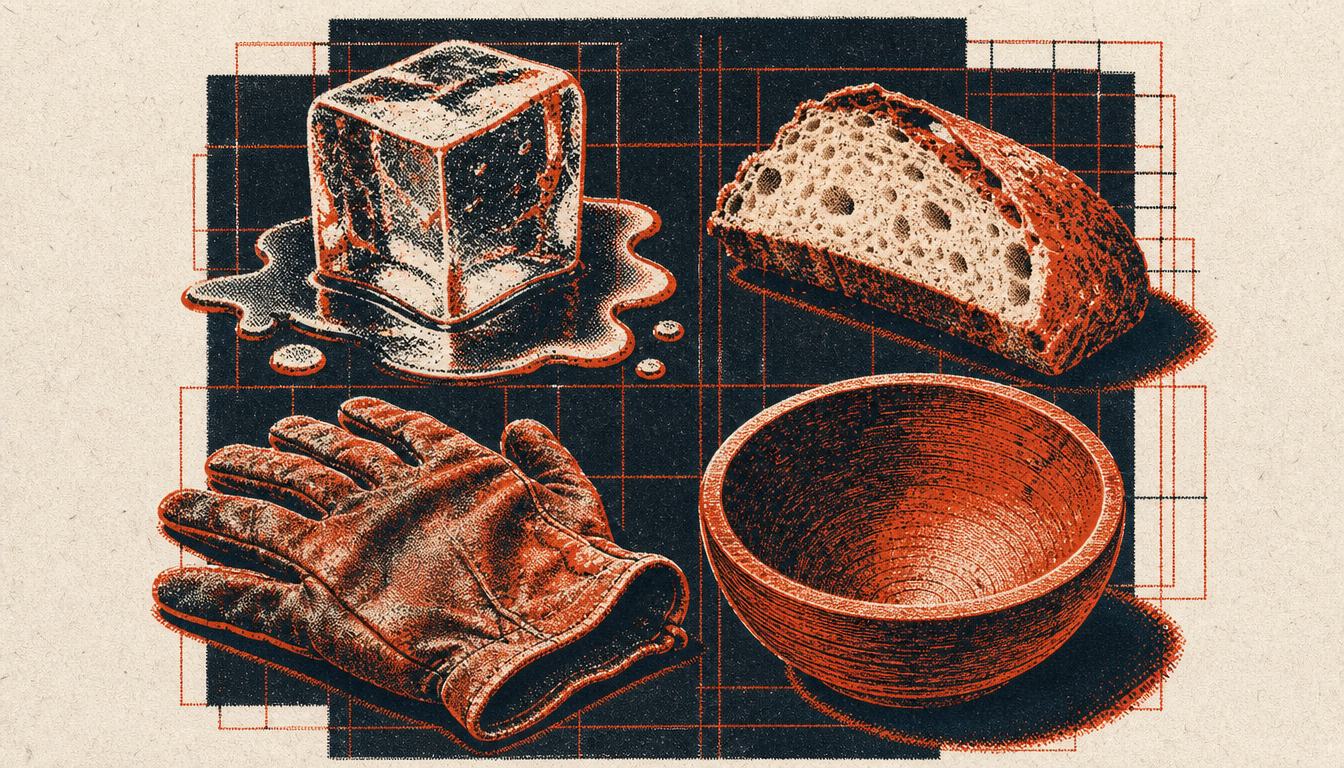
Most men who encounter Stoicism stop at the quotes. They screenshot Marcus, post Epictetus, and continue living a soft, frictionless life that their grandfathers would not recognize as adulthood. Voluntary discomfort is the bridge between knowing Stoic philosophy and embodying it.
The practice is straightforward in concept: deliberately expose yourself to hardship you could easily avoid, so that involuntary hardship loses its power over you. Cold instead of warm. Hunger instead of snacking. Silence instead of stimulation. Hard work instead of convenience. The catch is that simple does not mean easy, and a half-understood practice produces half-formed men.
This piece gives you the philosophical foundation, a graded protocol, common failure modes, and the metrics that tell you whether you are actually getting harder or just performing hardness for an audience.
Prerequisites and What You Need
What you need:
- A private space where you can train without spectators
- A notebook or simple journal for tracking sessions
- Basic medical clearance if you have cardiovascular, metabolic, or psychiatric conditions
- A 90-day window during which you commit to the practice
Assumed knowledge:
- Familiarity with the basic Stoic framework: the dichotomy of control, the role of judgment, and the four cardinal virtues
- Honest self-assessment of your current comfort baseline
- Willingness to do unglamorous work without an audience
The Stoic Origin of Voluntary Discomfort
Voluntary discomfort, what the Romans called praemeditatio malorum when practiced mentally and simply askesis when practiced physically, was not a fringe activity for the Stoics. It was the training floor of the philosophy.
Seneca wrote to Lucilius about setting aside days to eat the cheapest food, wear coarse clothing, and sleep on the ground, then asking himself, "Is this the condition I feared?" The point was not masochism. The point was reconnaissance. By practicing poverty, he removed poverty's ability to ambush him.
Musonius Rufus, the teacher of Epictetus, went further. He held that philosophy without physical training was incomplete, because the body and the soul both habituate to whatever you feed them. Feed them ease, they grow soft. Feed them controlled hardship, they grow capable.
Marcus Aurelius, despite being emperor of Rome, slept on a hard cot and rose before dawn. He did not need to. He chose to. He understood that the man who can rule himself in small voluntary trials retains the capacity to rule himself in large involuntary ones.
Why the Modern Man Needs It More
The ancients lived in a world where hardship was the default. Most of their voluntary practice was an additional layer of intentional friction on top of an already friction-rich life. Modern men live in something close to the opposite. Climate control, on-demand food, infinite entertainment, and algorithmic dopamine have removed almost all unscheduled difficulty from the day.
The result is a generation of men who are intellectually sharp, materially comfortable, and operationally fragile. They know what they should do. They cannot make themselves do it. Voluntary discomfort directly addresses the broken machinery between intention and action.
The Four Domains of Voluntary Discomfort

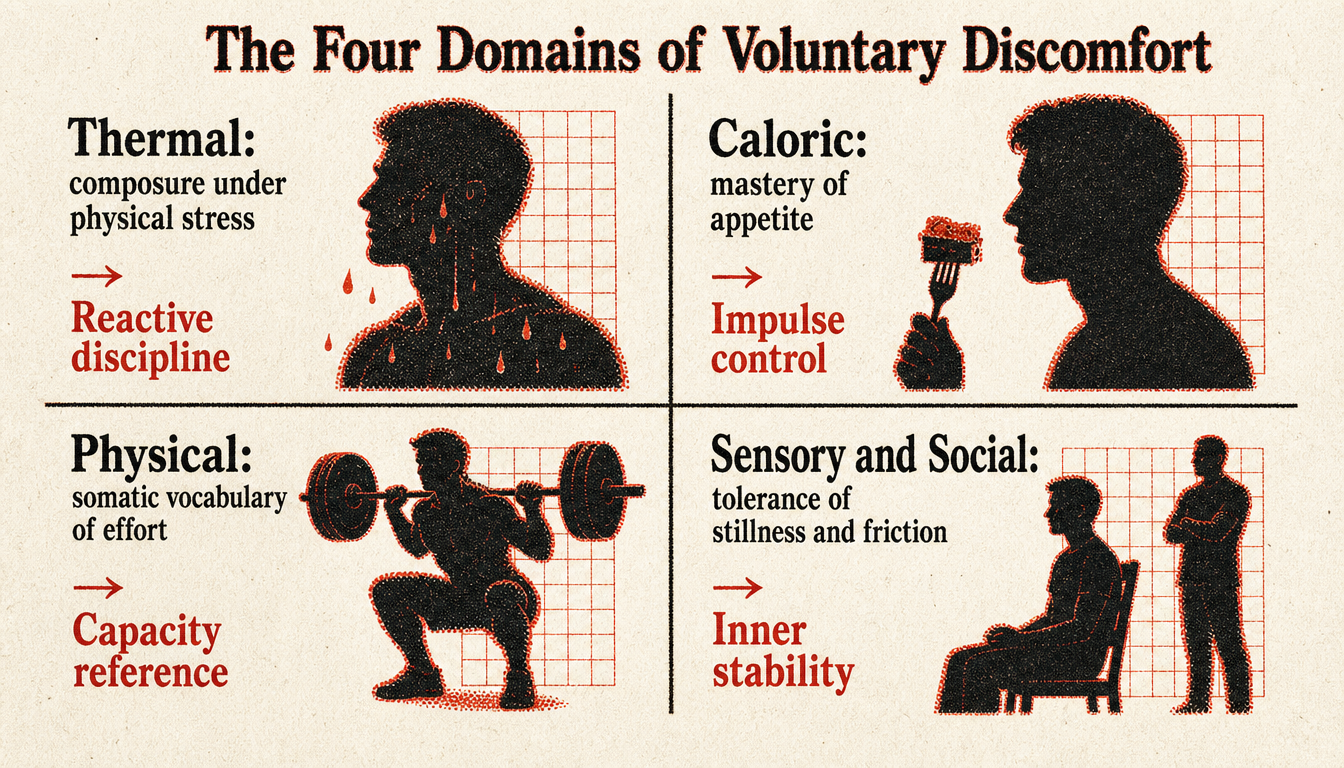
A serious practice is not random. It targets specific domains, each of which corresponds to a different weakness most modern men carry. The diagram below maps the four domains and the capacities each one builds.
1. Thermal Discomfort
Cold exposure is the most popular entry point, and for good reason: it is unambiguous, scalable, and immediately confronts the part of you that bargains. A cold shower does not negotiate. You either turn the handle or you don't. The mind that learns to turn the handle when every signal screams against it is the same mind that will, later, make the hard call at work, hold a boundary with family, or sit with grief without numbing it.
Heat exposure, through sauna or hard outdoor work in summer, trains a different but parallel capacity: the ability to remain composed while the body is in mild crisis.
2. Caloric Discomfort
Skipping meals deliberately, not as a diet protocol but as a philosophical exercise, severs the reflex that treats every minor hunger signal as an emergency. Seneca's instruction was to feel real hunger and then ask whether bread and water would have satisfied it. Almost always the answer is yes, which exposes most of our eating as appetite theater rather than need.
The goal here is not weight loss. It is the dismantling of the small tyrant in your stomach that has convinced you it speaks for the whole man.
3. Postural and Physical Discomfort
This is hard physical work without external reward. Carrying heavy things uphill. Long walks in bad weather. Sleeping on the floor for a week. Lifting until your hands tear. These practices restore the somatic vocabulary of effort that an office life erases.
A man who has never felt his lungs burn or his back ache from honest labor has no internal reference for what difficulty actually is. He overrates minor inconveniences and underrates his own capacity.
4. Sensory and Social Discomfort
This domain is the most overlooked and possibly the most important. It includes solitude without screens, silence without music, conversations you would rather avoid, and the deliberate refusal of cheap dopamine. Sitting alone with your own mind for an hour, with no input, is harder for most modern men than a cold plunge. That fact alone is diagnostic.
The 90-Day Protocol

Theory without structure produces inconsistent men. Below is a graded protocol that moves you from beginner exposure to integrated practice across all four domains. Each phase lasts 30 days. The progression is deliberately slow because the goal is permanent re-wiring, not a 30-day content series.
Step 1: Establish the Baseline (Days 1 to 30)
In the first phase, you pick one practice from each domain and execute it daily without modification. Resist the urge to optimize, stack, or escalate. The point is to prove to yourself that you do what you say you will do.
| Domain | Daily Practice | Duration |
|---|---|---|
| Thermal | Cold shower, finish under cold only | 2 minutes |
| Caloric | Skip one meal, drink only water | One meal per day |
| Physical | Walk outdoors regardless of weather | 30 minutes |
| Sensory | Sit in silence, no phone, no input | 15 minutes |
→ If you have completed all four practices on at least 25 of 30 days, you have passed Phase 1. If not, repeat. There is no shame in repeating, only in pretending.
Step 2: Increase the Load (Days 31 to 60)
Now the practices become harder, but you do not add new ones. Depth before breadth.
| Domain | Daily Practice | Duration |
|---|---|---|
| Thermal | Cold shower, full duration cold | 4 to 5 minutes |
| Caloric | Skip two meals, one day per week full fast | 16 to 24 hours |
| Physical | Weighted walk or hard manual task | 45 to 60 minutes |
| Sensory | Silent sitting, no entertainment after dark one day per week | 30 minutes |
→ The marker of Phase 2 success is not duration. It is the disappearance of internal protest. If you still negotiate with yourself before each session, you are not done with this phase.
Step 3: Integrate and Apply (Days 61 to 90)
In the final phase, the practice leaves the laboratory and enters the life. You begin choosing the harder option in ordinary moments: the stairs over the elevator, the difficult conversation over the avoided one, the early morning over the snooze button, the workout when tired rather than rested.
The structured daily practices continue, but their purpose shifts. They become the floor, not the ceiling. The real test is whether the disposition has generalized.
→ You have completed Phase 3 when other people begin to notice that you handle stress differently, and you no longer feel the need to explain why.
What Voluntary Discomfort Is Not
The practice is widely misunderstood, often by men who have read one book and posted ten videos. Clearing the misconceptions matters because the wrong frame produces the wrong man.
It Is Not Performance
If you film your cold plunge, you have already lost the exercise. The Stoic point of voluntary discomfort is the private cultivation of a self that does not need witnesses to act rightly. The moment an audience enters, vanity replaces virtue as the motive, and you are training a different muscle, the wrong one.
It Is Not Punishment
Some men confuse Stoicism with self-flagellation. This is a Christian inheritance, not a Stoic one. The Stoics did not believe the body or pleasure were evil. They believed dependence on pleasure made men weak. Voluntary discomfort is training, not penance. You are not paying for sins. You are building capacity.
It Is Not Extremism
Long fasts, ice baths in subzero rivers, ultra-endurance events, none of these are required. The Stoics warned against the showy ascetic as much as against the soft hedonist. Both make the same mistake: they treat the body's state as the goal rather than as the field on which character is trained.
A man who runs an ultramarathon but cannot tell his father he loves him has not become harder. He has only redirected his avoidance.
It Is Not a Substitute for Wisdom
Voluntary discomfort without philosophical grounding produces a strong fool, which is more dangerous than a weak one. The practice must be paired with reading, reflection, and honest self-examination, or you risk building a fortress around the same broken interior.
Common Errors and How to Correct Them
Most men who fail at this practice fail in predictable ways. The table below covers the patterns I see most often.
| Symptom | Underlying Cause | Correction |
|---|---|---|
| Quit within two weeks | Started at Phase 3 intensity on day one | Restart at Phase 1. Slow is the only fast that works. |
| Practice feels hollow after 30 days | No philosophical reading paired with action | Read one Stoic letter or meditation per week alongside practice |
| Need to tell others about it | Ego is borrowing the practice for status | Practice silently for 30 days. Tell no one. Notice the resistance. |
| Cannot maintain on stressful days | Treating the practice as a luxury rather than a baseline | The stressful day is exactly the day the practice was built for. Do it shorter, not zero. |
| Becoming irritable or rigid with family | Confusing hardness toward self with hardness toward others | Voluntary discomfort applies to you alone. Warmth toward others is the dividend. |
How to Measure Whether It Is Working
The trap of any self-development practice is mistaking activity for progress. You can run the protocol for 90 days and remain fundamentally the same man, if you are not paying attention to the right signals.
The Right Metrics
Do not measure water temperature or fast duration. Measure these instead:
- Latency between trigger and reaction. When something goes wrong, how long is the gap before you respond? It should be growing.
- Frequency of impulsive consumption. Snacking, scrolling, drinking, buying. The volume should be dropping without effort.
- Quality of difficult conversations. Are you having the ones you used to avoid? Are you holding ground without aggression?
- Sleep on hard days. A man whose nervous system is being trained sleeps better under stress, not worse.
- What you do when no one is watching. The clearest mirror. Compare it to what you did six months ago.
The Completed Form
After 90 days of honest practice, the change is not that you can endure cold or hunger. The change is that the part of you that used to flinch from minor friction has gone quiet. You stop noticing small inconveniences because they no longer register as worth a reaction. Your bandwidth for what actually matters expands.
If you have completed the protocol correctly, you should notice: easier mornings, calmer responses to small frustrations, a reduction in the inner monologue of complaint, and a quiet sense that you can be trusted, by yourself, to do what you said.
Beyond the Protocol: Building a Life of Useful Friction
The 90-day program is a starting structure, not a destination. The Stoic ideal is not a man who performs voluntary discomfort as a hobby. It is a man whose entire life has been quietly re-engineered to include the right friction in the right places.
Designing Your Environment
Once the daily practice is integrated, look at your life with fresh eyes. Where have you engineered out all difficulty? The thermostat set to perfection. The food that requires no preparation. The entertainment available within three seconds of boredom. The relationships that demand nothing of you. Each of these is a place where character is no longer being formed.
You do not need to live like a monk. You do need to ask whether your environment is producing the man you want to be at sixty, or merely the man who is most comfortable today.
The Legacy Dimension
Voluntary discomfort matters beyond your own life. The capacity you build is transmissible. Sons watch fathers who do hard things without complaint and learn what manhood looks like from the inside. Friends learn from you that complaint is optional and that composure is a choice. Communities benefit from men who can be counted on when things go wrong.
The Stoics called this the cosmopolitan duty: the recognition that you are not training yourself for yourself alone, but as a contributing member of a human order that needs capable, composed adults.
Final Notes Before You Begin
Start tonight. Not Monday, not next month, not after you finish reading more about it. Take a cold shower before bed and sit for ten minutes in silence afterward. The first session is the only one you cannot do later.
Track your sessions in writing. Memory will lie about consistency. Paper will not.
Do not tell anyone what you are doing for the first 30 days. Let the work be your own. If the practice cannot survive without an audience, it was never the practice that mattered to you.
Read alongside the practice. Choose one Stoic text, Seneca's letters are the most accessible, and read a few pages each week. The reading without the practice produces a clever weakling. The practice without the reading produces a hard fool. Together they produce something rarer: a man who knows what he is doing and why.
The next step after this article is to map your own four-domain baseline this week and begin Phase 1 within seven days. Anything later is a story you are telling yourself.