Stoicism is a school of practical philosophy that teaches you to govern your inner life by separating what you can control from what you cannot, and then living according to virtue regardless of circumstance. It is not a mood, a mindset hack, or a personality type. It is a discipline you practice until your default reactions change.
If you have read motivational books and watched the right podcasts but still flinch at small inconveniences, lose your temper in traffic, scroll when you should be working, or stay quiet when you should speak, you already know the gap between knowing and doing. Stoicism exists to close that gap. It is a system for becoming the man you already believe you should be.
The Core Definition and Origins of Stoicism
Stoicism originated in Athens around the early third century BCE, founded by Zeno of Citium after a shipwreck stranded him in the city. He began teaching at a public colonnade called the Stoa Poikile, which gave the school its name. Over the following centuries, the philosophy spread across the Greek and Roman worlds and reached its most famous voices in figures like Seneca, Epictetus, and the emperor Marcus Aurelius.
What separates Stoicism from most ancient philosophy is its insistence on application. The Stoics did not write to impress academic peers. They wrote to train themselves and their students for the friction of real life: betrayal, illness, public failure, loss, temptation, fear of death. The texts that survive read less like theory and more like field manuals for the human condition.
Item | Detail |
|---|---|
Formal Name | Stoicism |
Origin | Athens, early 3rd century BCE |
Founder | Zeno of Citium |
Category | Practical philosophy / ethics |
Key Concepts | Virtue, dichotomy of control, logos, apatheia |
Contrasted With | Hedonism, Epicureanism, fatalism |
Modern Relevance | High; influences cognitive psychology and self-development |
At its center, Stoicism rests on a single radical claim: the only true good is virtue, and the only true evil is vice. Everything else, wealth, status, health, reputation, even how long you live, falls into a category the Stoics called indifferents. You may prefer them, work for them, enjoy them when they come. But your character cannot depend on them, because they can be taken from you at any moment.
The Four Cardinal Virtues That Anchor the System

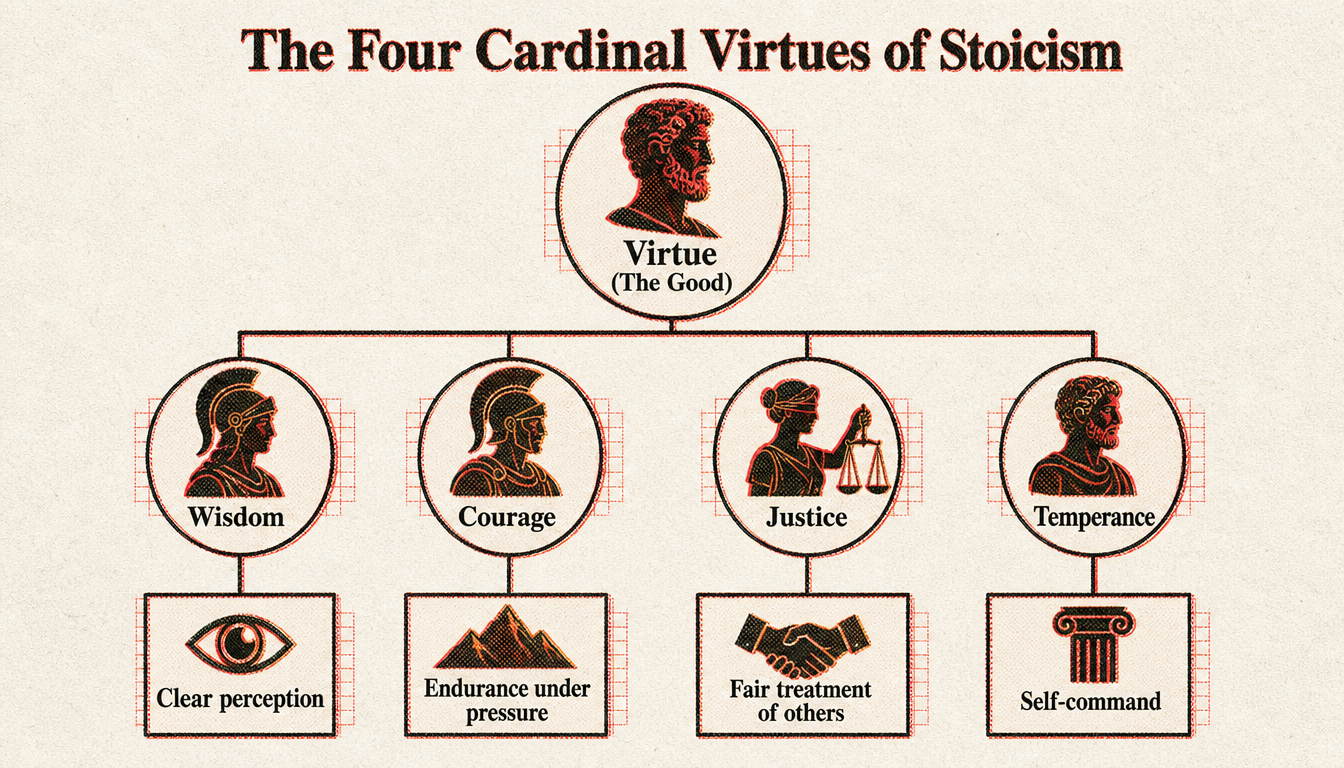
Stoic ethics is built on four virtues inherited from Socrates and Plato. They are not abstract ideals. They are practical orientations for action, and every Stoic exercise eventually traces back to one of them.
The diagram below shows how the four virtues relate to one another as a single integrated structure.
Wisdom
Wisdom is the ability to see clearly: to distinguish what matters from what does not, what is in your control from what is not, what is true from what merely flatters you. The Stoics treated most human suffering as a failure of perception. You do not suffer because of events. You suffer because of the judgments you stack on top of events. Wisdom is the discipline of pulling those judgments apart.
Courage
Courage in the Stoic sense is broader than physical bravery. It includes the willingness to face uncomfortable truths about yourself, to speak when speaking is costly, to do the hard work no one will witness, and to endure pain without theatrics. Marcus Aurelius wrote constantly about this kind of courage, the unglamorous endurance of duty.
Justice
Justice means treating others according to what they are owed, acting with fairness, honesty, and good faith. The Stoics considered justice the social virtue, the one that connects your private discipline to the wider community. A man who masters himself but mistreats the people around him has not understood Stoicism. He has built strength on a rotten foundation.
Temperance
Temperance is self-command: knowing when to stop, when to refuse, when enough is enough. It governs appetite, anger, ambition, and speech. In a world engineered to exploit your impulses, temperance is arguably the most countercultural of the virtues. It is the muscle that lets you close the tab, leave the second drink, end the argument, and walk away from the easy reaction.
The Dichotomy of Control: The Operating Principle

If you remember one Stoic idea, make it this one. Epictetus opens his Enchiridion with it, and the rest of the philosophy hangs from it.
Some things are up to you. Some things are not. What is up to you: your judgments, your intentions, your responses, your effort, your character. What is not up to you: other people's behavior, outcomes, reputation, the economy, the weather, your body's ultimate decline. Suffering happens when you reverse this. You try to control the outcomes and treat your own responses as automatic.
Most men spend their twenties and thirties doing precisely this. They obsess over how they are perceived, rage at traffic, ruminate on conversations from years ago, refresh metrics, and let other people's moods dictate their own. Stoicism asks you to pull your attention back inside the line you actually control, and to invest your discipline there.
Category | Up to You | Not Up to You |
|---|---|---|
Internal | Judgments, intentions, effort, attention | Spontaneous emotions, reflexes |
External | Your actions and words | How they are received |
Social | Your conduct toward others | Reputation, popularity, others' opinions |
Physical | Training habits, discipline | Aging, illness, genetics, death |
Material | Work ethic, choices | Market outcomes, luck, timing |
This is not passivity. The Stoic still acts, still pursues goals, still builds. But he treats outcomes as preferred, not required. He measures himself by the quality of his effort, not the verdict of fortune.
What Stoicism Actually Looks Like in Practice
Reading about Stoicism does almost nothing. The philosophy was designed as a set of repeated exercises that gradually rewire how you perceive and respond. Below are the practices that show up across the surviving texts.
The morning preview
Marcus Aurelius opened his day by reminding himself that he would encounter ungrateful, arrogant, dishonest, and envious people, and that he was bound to them by a shared rational nature. The point was not pessimism. It was inoculation. If you expect friction, you do not waste your morning being shocked by it.
The evening review
Seneca described a nightly examination of the day. Where did I act well? Where did I fall short? What did I learn? This is not journaling for journaling's sake. It is a deliberate audit that prevents the same mistake from running unchecked for months.
Negative visualization
The Stoics regularly imagined losing the things they valued: their work, their reputation, the people closest to them, their own lives. The exercise has two effects. It builds gratitude for what is present, and it dulls the shock when loss eventually comes. Done well, it is not morbid. It is sobering and clarifying.
Voluntary discomfort
Cold, hunger, hard physical work, plain food, silence. The Stoics practiced minor deprivations not because suffering is virtuous but because comfort makes you fragile. A man who has chosen to be uncomfortable on his own terms is harder to break when discomfort arrives uninvited.
The view from above
Marcus Aurelius repeatedly zoomed out, imagining his life and concerns from the perspective of the cosmos or of history. Most of what feels urgent today will be invisible in a year. This exercise puts proportion back into your reactions.
Common Misunderstandings About Stoicism
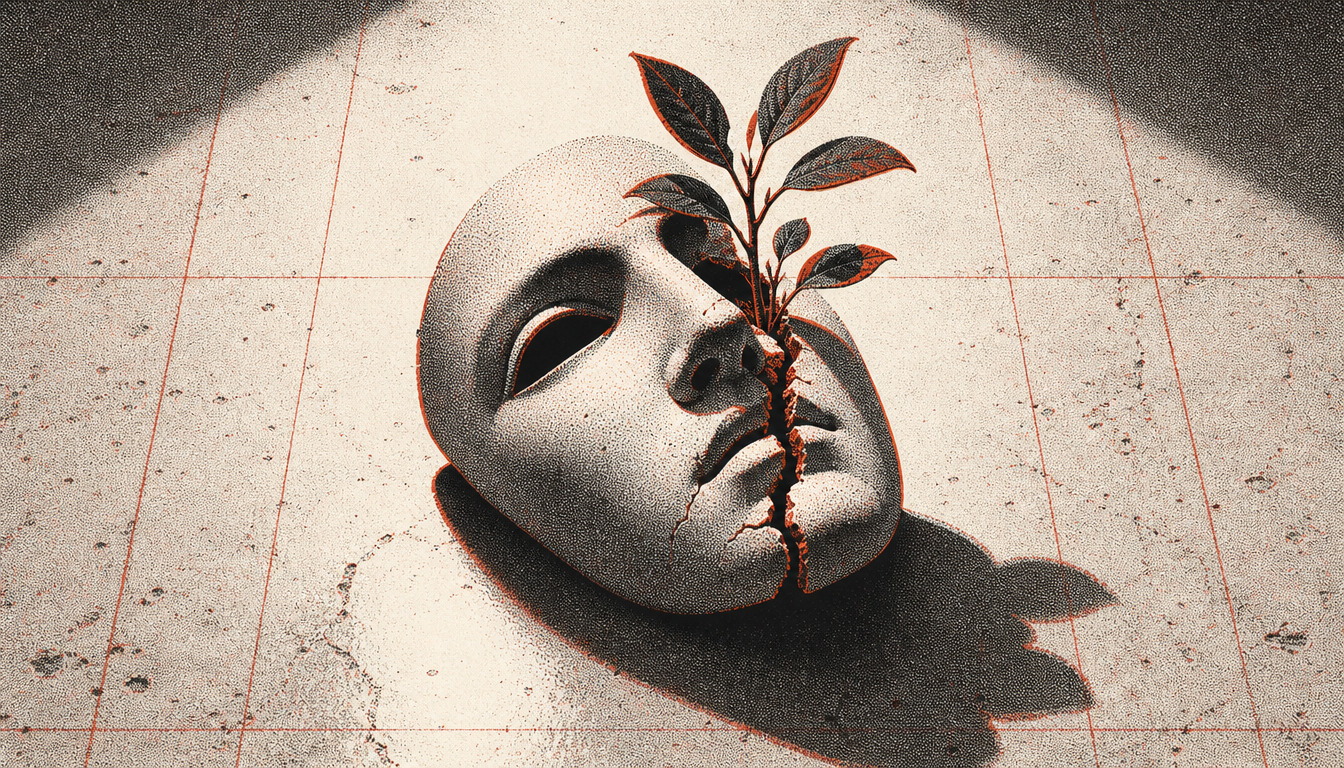
Stoicism has been misread for centuries, and the modern revival has not helped. The word stoic in everyday English now suggests a cold, emotionless man who endures everything in silence. That is a caricature, and it gets the philosophy almost exactly wrong.
The Misunderstanding | The Actual Position |
|---|---|
Stoics suppress emotion | Stoics examine emotion and refuse to be governed by impulse. They feel; they just do not let feeling dictate action. |
Stoicism is passive acceptance | Stoicism demands constant action in service of virtue. It accepts outcomes, not inaction. |
Stoicism is grim and joyless | The Stoics describe a deep, durable joy that does not depend on circumstance. Seneca writes extensively about it. |
Stoicism means not caring | Stoics care intensely about character and duty. They withdraw care from things outside their control. |
It is about being tough alone | Justice is a core virtue. Stoicism is built for life among other people, not in retreat from them. |
It is the same as being a hard ass | Hardness without wisdom and justice is not Stoicism. It is just a personality. |
The Stoic does not pretend not to feel anger, grief, fear, or desire. He notices them, questions the judgment underneath them, and decides whether to act on them. The work is internal, not performative. A man who is loudly stoic in public and emotionally chaotic in private has skipped the actual training.
How Stoicism Differs From Related Philosophies
Stoicism is often confused with other ancient and modern frameworks. Knowing the contrast sharpens your understanding of what it actually claims.
Framework | Core Claim | Difference From Stoicism |
|---|---|---|
Epicureanism | The good life is the absence of pain and the presence of tranquil pleasure. | Locates the good in pleasant feeling; Stoicism locates it in virtue regardless of feeling. |
Cynicism | Reject convention and live according to nature, often through extreme asceticism. | Shares roots with Stoicism but is more confrontational; Stoicism engages with society and duty. |
Buddhism | Suffering comes from craving; liberation comes from releasing attachment. | Aims at cessation of suffering; Stoicism aims at virtuous action, with peace as a byproduct. |
Nihilism | Nothing has inherent meaning or value. | Stoicism asserts that virtue is objectively good and that the cosmos has rational order. |
Modern positive thinking | Belief and visualization shape outcomes. | Stoicism focuses on character and response, not on bending reality through optimism. |
Cognitive Behavioral Therapy | Distorted thoughts cause distorted emotions; correct the thoughts. | CBT is a direct clinical descendant of Stoic logic, narrower in scope, and not concerned with virtue. |
The closest modern relative is cognitive behavioral therapy, which borrows directly from Epictetus. But CBT is a treatment protocol. Stoicism is a way of life with a moral center. It tells you not only how to think more accurately but what kind of man to become.
Putting Stoicism to Work in a Modern Man's Life
The reason Stoicism keeps resurfacing across centuries is that it answers the question most self-improvement content avoids: who are you trying to become, and by what standard? Productivity systems optimize the how. Stoicism gives you the why and the measure.
Here is how the philosophy translates into the four arenas most relevant to a modern man.
Masculinity
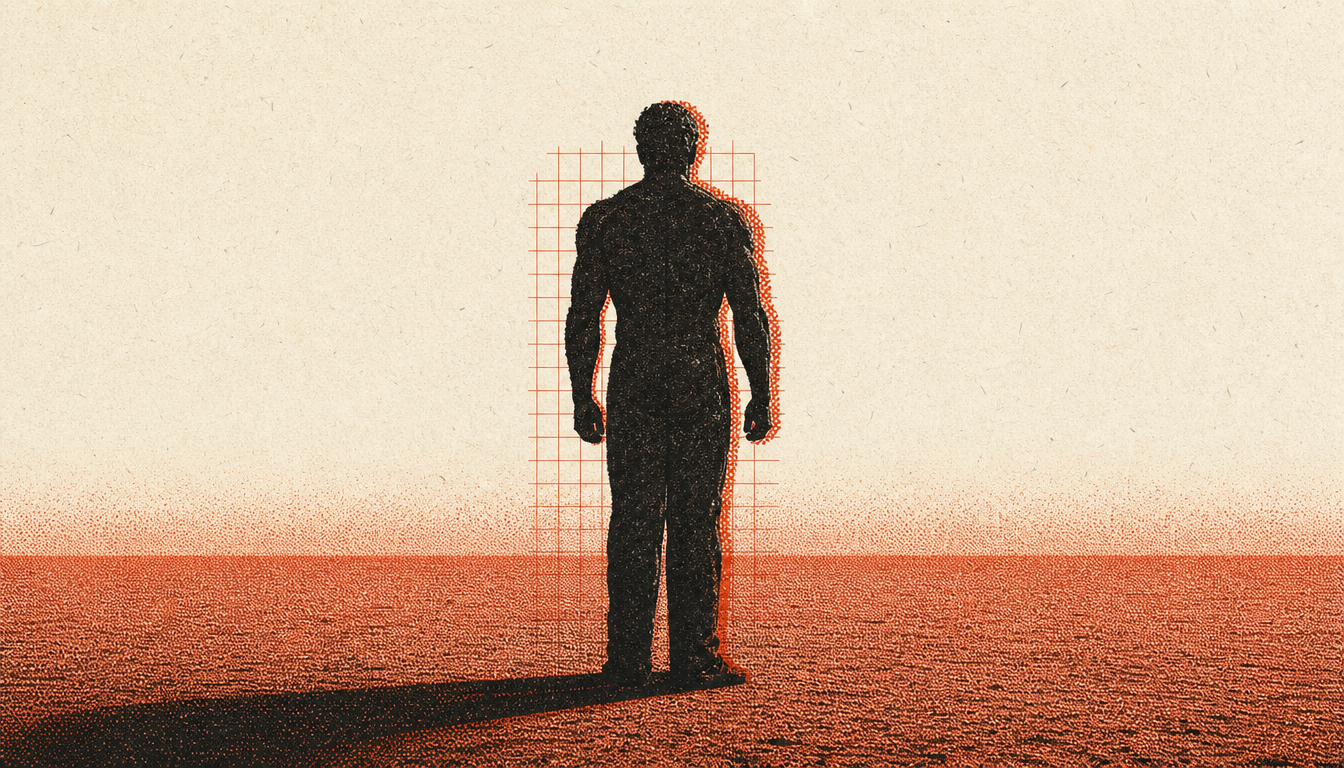
Stoicism offers a model of masculinity built on self-command rather than dominance display. The Stoic man is not loud, not reactive, not performing for the room. He governs himself first. He keeps his word. He absorbs provocation without breaking. He protects what he is responsible for. This is masculinity as duty, not as posture.
Mental toughness
Toughness in the Stoic sense is not the ability to suppress, it is the ability to respond well under pressure. You build it through deliberate friction: cold exposure, hard training, fasting, public discomfort, hard conversations you would rather avoid. Each repetition teaches your nervous system that discomfort is survivable, and that your character does not require comfort to function.
Social presence
A man anchored in virtue carries a different kind of weight in a room. He is not chasing approval, which makes him hard to manipulate. He is not afraid of silence, which makes him hard to interrupt. He listens because he has nothing to prove, and he speaks because he means it. Social presence in the Stoic sense is the byproduct of being internally settled, not a technique you perform.
Personal legacy
The Stoics thought constantly about death, not to be morbid but to clarify priorities. When you remember that your time is finite, you stop spending it on things you do not actually value. Legacy is not what people say at your funeral. It is the cumulative weight of how you treated your work, your word, your family, and your own character across the years no one was watching.
A starting protocol
If you want to move from reading about Stoicism to practicing it, begin with this minimum:
Each morning, take three minutes to name the friction you expect and the kind of man you intend to be inside it.
Carry the dichotomy of control through the day. When you notice frustration, ask whether it is aimed at something you actually control.
Choose one daily discomfort and accept it without complaint: a cold shower, a skipped meal, a hard set, a difficult conversation.
Each night, audit the day in writing. Where did you act according to virtue? Where did you fail? What will you do differently tomorrow?
Read a page of Marcus Aurelius, Epictetus, or Seneca before bed. Not for novelty. For repetition.
Do this for ninety days and the philosophy stops being something you have read about. It becomes the shape of your default responses.
Key Takeaways and Where to Go Next
Stoicism is not a vibe or a brand. It is a discipline, and it asks more of you than most modern frameworks dare to ask.
Stoicism teaches that virtue, wisdom, courage, justice, and temperance, is the only true good, and that everything else is preferred but not essential to a good life.
The dichotomy of control is the operating principle: invest your effort in what is yours, and release what is not.
The philosophy is practiced, not believed. Morning preview, evening review, negative visualization, voluntary discomfort, and the view from above are the core exercises.
Stoicism is not emotional suppression, passive acceptance, or grim endurance. It is clear-eyed action grounded in character.
Applied honestly, it reshapes masculinity, toughness, presence, and legacy from the inside out, not through performance.
From here, the natural next steps are to read the primary sources in order, the Enchiridion of Epictetus first, then Marcus Aurelius's Meditations, then the letters of Seneca, and to begin a daily practice rather than waiting until you feel ready. You will not feel ready. That is part of the point. The Stoic does not wait for conditions to improve before acting well. He acts well now, because that is the only place virtue is ever practiced.