

How to Stop Being Lazy and Undisciplined Without Forcing Motivation
You already know what to do. That's what makes the gap between your knowledge and your behavior so infuriating. You've read the books, watched the interviews, saved the frameworks. And yet Monday morning arrives and the version of you that shows up looks nothing like the version you designed in your head.
This guide gives you a working system to close that gap. Not a pep talk. Not a productivity hack. A structure grounded in Stoic practice and behavioral honesty that lets you act well on days when you feel like garbage. By the end, you'll have a repeatable protocol for stopping the drift and building discipline that doesn't depend on how motivated you happen to feel.
Estimated read time: 15 minutes
Difficulty: Intermediate. Requires willingness to observe yourself without flinching.
Prerequisites: What You Need Before You Start
Most men skip this part and wonder why the plan collapses in week two. Discipline is downstream of environment, clarity, and self-honesty. Fix those first.
What you need:
- A notebook or a plain text file. Nothing fancy. You'll use it daily.
- A calendar you actually look at. Digital is fine.
- A single, quiet 20-minute window each morning. Non-negotiable.
- One trusted person who will tell you the truth about your behavior.
Prerequisites of mind:
- Willingness to admit that laziness is often fear or ambiguity wearing a costume.
- Acceptance that motivation is a byproduct, not a fuel source.
- A tolerance for boredom. Discipline lives in unremarkable repetition.
If any of these feel out of reach, start there. Trying to build a system on top of denial is how men waste a decade rereading the same books.
Step 1: Diagnose Why You're Actually Stalling

Calling yourself lazy is lazy thinking. It's a label that ends the investigation before it starts. Underneath the word are usually three separate problems, and they each need a different response.
Identify which of the three is running your day
The diagram below maps the three most common causes of undisciplined behavior and the correct response for each.
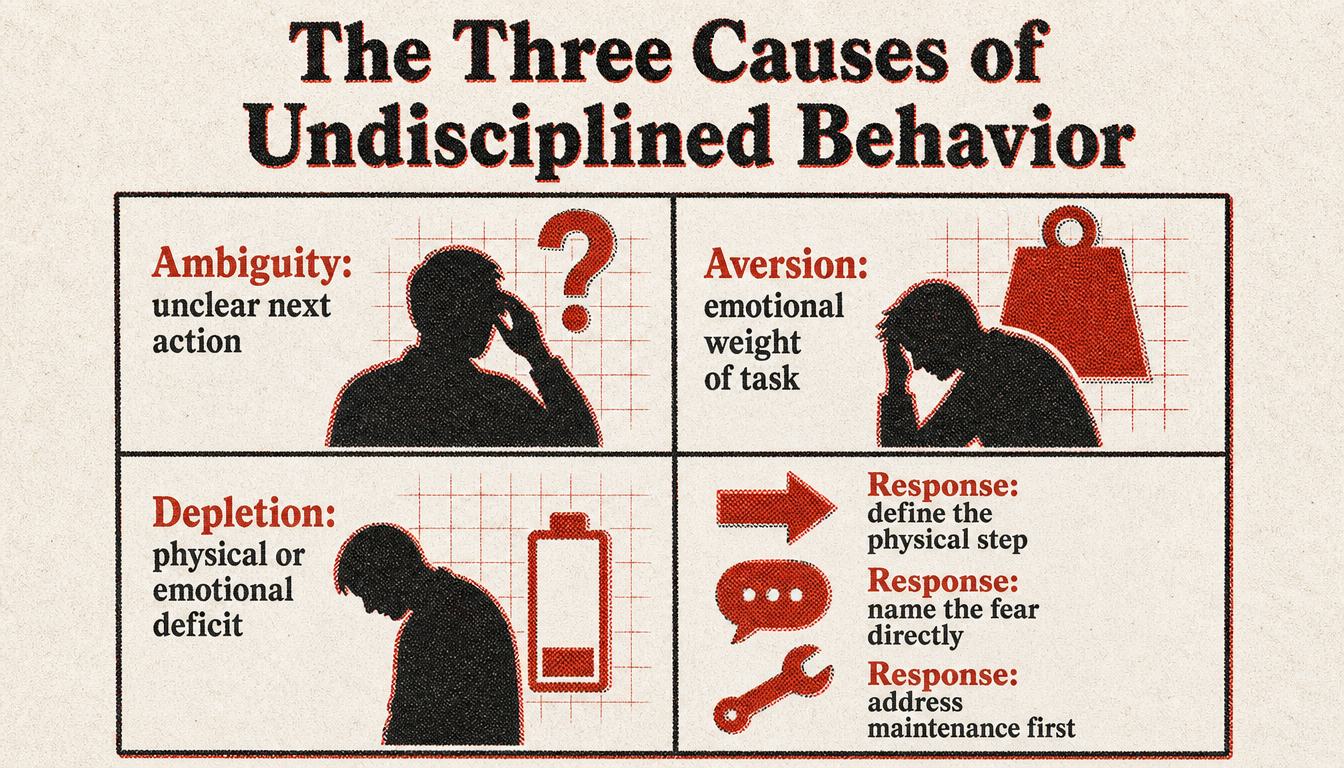
- Ambiguity. You don't actually know what the next physical action is. Your brain stalls because the task is a fog, not a step.
- Aversion. You know the action, but it carries emotional weight. Fear of judgment, fear of failure, fear of what the result will reveal about you.
- Depletion. You are genuinely under-slept, under-fed, over-stimulated, or grieving something you haven't named. This is not a discipline problem. This is a maintenance problem.
Open your notebook. Write the task you keep avoiding. Then write which of the three is actually operating. Be specific. "I'm avoiding writing the proposal because I don't know if the pricing will be rejected" is aversion, not laziness.
You cannot solve a problem you've misnamed.
Confirm the diagnosis with a body check
Sit for sixty seconds. Where is the resistance located? Ambiguity feels like mental static behind the eyes. Aversion feels like tightness in the chest or gut. Depletion feels like heaviness in the limbs and a dull, low-grade fog. Your body is a more honest reporter than your inner monologue.
→ You know you've completed this step when you can name the task, the cause, and the felt sensation in one sentence.
Step 2: Shrink the First Action Until Refusal Is Absurd

Once you've diagnosed the cause, the next move depends on which one you named. But there is one universal principle that applies across all three: the first action must be small enough that refusing it makes you look ridiculous to yourself.
Apply the two-minute floor
Take the task you're avoiding and identify a version of it that takes two minutes or less. Not the whole task. The doorway.
| Task You're Avoiding | The Doorway Action |
|---|---|
| Write the report | Open the document and type the section headings |
| Go to the gym | Put on shoes and step outside |
| Have the hard conversation | Draft the opening sentence in your notes |
| Fix your finances | Log into one account and read the balance aloud |
| Start the business | Write one sentence describing what you'd sell |
The doorway is not the work. The doorway is the thing that makes the work possible. Most men fail because they try to force themselves through the whole task and negotiate with a wall. You don't negotiate with the wall. You open the door.
Commit to the doorway, not the outcome
This is where Stoic discipline diverges from motivational thinking. Marcus Aurelius did not write about feeling ready. He wrote about doing the work of a man because that is what a man does. You commit to the action within your control. The outcome is not yours.
→ You've completed this step when you have a doorway action written down that you could execute in the next ten minutes without ceremony.
Step 3: Build a Daily Structure That Does the Deciding for You

Willpower is a finite resource that gets worse as the day goes on. Every man who has built anything durable eventually figures out that the solution is to remove decisions, not to make better ones. Your structure should decide for you what a disciplined day looks like, so that you're executing rather than negotiating.
Design the three anchors
You need three fixed points in your day. Not fifteen habits. Three. Everything else can flex around them.
- Morning anchor. A twenty-minute block that begins the same way every day. Cold water, ten minutes of writing, or a short walk. The content matters less than the invariance. This is where you set the frame.
- Work anchor. A single, protected block of ninety minutes for your most important work. Phone in another room. No exceptions for the first four weeks.
- Evening anchor. A twenty-minute review before sleep. What did I do well? Where did I drift? What is tomorrow's doorway action?
These three anchors are the skeleton. Everything else, the meetings, the workouts, the social obligations, hangs off them. When the day goes sideways, and it will, you return to the anchors instead of restarting from zero.
Write the anchors into your calendar as appointments
If it's not on the calendar, it doesn't exist. Treat these blocks with the same respect you'd give a meeting with someone you're trying to impress. Because that is exactly what they are.
→ You've completed this step when your next seven days show three anchor blocks each, and you have not moved them for convenience.

Step 4: Install a Friction System for Distractions

You will not out-discipline your phone. You will not out-willpower an environment designed by professionals to hijack your attention. The men who appear disciplined have quietly rigged their surroundings so that the lazy option is the good one.
Audit your top three leaks
List the three things that most often pull you off track. Be specific. Not "my phone" but "Instagram after 9 p.m." Not "snacks" but "the kitchen at 3 p.m. when I'm bored."
Add friction to each
For every leak, add a physical or procedural obstacle. The goal is not to make it impossible. The goal is to make it inconvenient enough that the animal part of your brain gives up.
| Leak | Low-Friction Response | Higher-Friction Response |
|---|---|---|
| Phone during work | Silent mode, face down | Phone in a drawer in another room |
| Social media doomscroll | App timer | Delete the app, use browser only |
| Late-night snacking | Close the kitchen after dinner | Do not buy the snack in the first place |
| Skipping the gym | Pack the bag the night before | Sleep in gym clothes |
Pick the highest-friction response you can tolerate for two weeks. You will feel a small, satisfying loss when you cut off the easy access. That feeling is the correct one. It means the system is working.
Design the environment for the man you're becoming
Look at your desk, your bedroom, your phone home screen. Ask a blunt question: does this environment belong to a man who is building something, or to a man who is being entertained by something? Move objects accordingly. The book on the nightstand. The guitar out of the case. The vegetables at eye level. Environment is a slower argument than willpower, but it wins over time.
→ You've completed this step when at least one of your top three leaks has visible, physical friction attached to it.
Step 5: Adopt the Stoic Discipline of Review
Discipline without reflection is just compliance. Compliance breaks the moment it stops being observed. The Stoics wrote every night not to record their day but to interrogate it. This is the practice that separates men who improve from men who repeat.
Run the evening review in three questions
Twenty minutes before sleep. Notebook open. Answer these three questions honestly. If your answers are flattering, you're not being honest.
- Where did I act as the man I want to be? Name the specific moment. Not "I worked hard" but "I stayed with the difficult email for twenty minutes instead of switching tabs."
- Where did I drift? Name the specific moment. Not "I wasted time" but "I opened the phone at 2:14 p.m. and lost forty minutes to nothing."
- What is tomorrow's doorway action? One task. One first move. Written down before you sleep so morning-you does not have to decide.
Refuse the twin traps of shame and self-congratulation
The review is not a courtroom and it is not a highlight reel. Both distort the record. Shame collapses into self-hatred, which is just laziness in a black turtleneck. Self-congratulation inflates minor wins and hides the drift. You want the flat, honest register of a man taking inventory. Nothing more.
Epictetus described this practice as examining the day the way a strict but fair teacher examines a student. Not cruel. Not indulgent. Accurate.
→ You've completed this step when you have run the review for seven consecutive nights, even the nights you didn't want to.
Step 6: Handle the Bad Days Without Losing the System
You will have bad days. You will miss the morning anchor. You will scroll for an hour. You will eat the thing, skip the workout, dodge the call. The question is not whether this happens. It happens to everyone who has ever built anything. The question is what you do the next morning.
Apply the never-two-in-a-row rule
One missed day is data. Two missed days is a new pattern. The single most important rule in this entire system is that you do not miss twice. Not the perfect day. Not the impressive comeback. Just the refusal to let a slip become a slide.
When you miss, you do not add extra work to compensate. You do not lecture yourself. You return to the anchors the next day exactly as written. The system is designed to absorb failure. That is its point.
Separate the event from the identity
You are not a lazy man who had a disciplined day. You are a disciplined man who had a lazy day. This is not a semantic game. Your brain builds identity from the story you tell about your behavior. When you slip, name it as an event, not a verdict. "I skipped the gym today" is an event. "I'm the kind of guy who can't stay consistent" is a verdict you're issuing against yourself, and the verdict will become true if you keep issuing it.
Return to first principles when the system feels heavy
Every few weeks the whole structure will feel like a burden. This is normal. It means you've stopped seeing the point and started seeing the mechanics. Reread step one. Ask what you're building and why it matters. The answer should be heavier than the discomfort of the practice. If it isn't, either the answer needs to grow up or the practice needs to be simplified. Usually the answer.
→ You've completed this step when you have missed a day, returned the next morning without ceremony, and understood that this is the actual skill.
Confirming the System Is Working
After four weeks of running this protocol, you should notice specific changes. Not a personality transformation. Something quieter and more useful.
- You start tasks without a long negotiation.
- Your morning does not depend on how you feel when you wake up.
- You have a shorter gap between deciding and doing.
- You describe yourself with fewer excuses and less commentary.
- You are bored more often, and less anxious.
That last one confuses men who expected discipline to feel triumphant. It doesn't. It feels flat, competent, and quietly free. The drama of the undisciplined life, the highs of motivation and the lows of self-loathing, is replaced by a steadier register. That register is where real work gets done.
Common Failures and How to Fix Them
| Symptom | Cause | Fix |
|---|---|---|
| You quit in week two | Anchors were too ambitious | Cut each anchor in half. A ten-minute morning beats a skipped one. |
| You review the day dishonestly | You're afraid of what accurate self-observation will surface | Write the review as if a mentor you respect will read it. Not to impress him. To not lie to him. |
| You keep restarting on Mondays | You're treating discipline as a mood you have to summon | Return to the anchors mid-week. There is no restart. There is only the next block. |
| The doorway action still feels heavy | The doorway is not small enough | Halve it again. The correct size is the one you'd feel foolish refusing. |
| You feel numb, not disciplined | You skipped the diagnosis in step one. This may be depletion, not laziness. | Address sleep, food, and unnamed grief before adding more structure. |
Advanced: Making the Practice a Way of Life
Once the basic system runs on its own, you can start layering the deeper Stoic disciplines onto it. Voluntary discomfort. Weekly review of virtues. A quarterly examination of where your time actually went versus where you claimed it went. These are not techniques. They are the ongoing practice of a man who has decided that his own conduct is his primary responsibility.
The point of stopping being lazy and undisciplined is not to become a productivity machine. It is to become someone whose word to himself carries weight. Everything else, the work, the body, the relationships, the legacy, follows from that single restored trust.
Closing the Gap
You will not stop being lazy by finding the right quote. You will stop being lazy by diagnosing the cause honestly, shrinking the first action until refusal is absurd, building three anchors that decide for you, adding friction to your leaks, reviewing the day without flinching, and returning the morning after a slip without ceremony. That is the whole protocol.
Start tonight. Write down the task you've been avoiding. Name the cause. Set the doorway. Put tomorrow's morning anchor on the calendar. Then close the notebook and go to sleep. The man who runs this system for ninety days is not the same man who started it, and the change will not feel dramatic from the inside. It will feel like finally being on your own side.