

Legacy vs. Ambition: What Stoics Knew About Long-Term Vision

Ambition without legacy is a fire that burns hot and leaves nothing behind. The Stoics understood this nearly two thousand years before modern self-help discovered the phrase "long-term thinking," and their distinction between what you chase and what you leave is the most useful frame any man can carry into the second half of his life.
Most men confuse the two. They assume that if they accumulate enough, achieve enough, and outwork enough, a meaningful personal legacy will assemble itself from the wreckage of their effort. It will not. Ambition and legacy operate on different timescales, answer to different masters, and demand different virtues. Knowing which one you are actually building, on any given Tuesday morning, is the difference between a life that compounds and a life that simply expires.
The Current State of Ambition in Modern Men

Look at how ambition is sold today. Performance metrics, follower counts, revenue milestones, optimized morning routines, physiques sculpted for the camera. The vocabulary is relentless and the timeframes are short. Quarterly. Monthly. Daily. The man who is not visibly winning right now is treated as a man who is losing.
This is not new in kind, only in volume. Roman aristocrats also competed for visible status, public office, military glory, and the approval of their peers. What is new is the speed and the saturation. A modern man receives more status signals before breakfast than a Roman senator received in a week. Every signal whispers the same thing: produce more, faster, or fall behind.
The result is a generation of men who are intellectually fluent in self-improvement and operationally exhausted by it. They have read the books. They know the frameworks. They can quote Marcus Aurelius on the way to a workout. And yet many of them feel hollow, because they have mistaken motion for direction and ambition for purpose. Ambition asks, what can I get? Legacy asks, what will remain?
The Stoics had a word for the man who confuses these: distracted. Not lazy, not weak, distracted. He is pulled in a hundred urgent directions and arrives at the end of his life having never asked the only question that mattered.
What the Stoics Actually Meant by Long-Term Vision
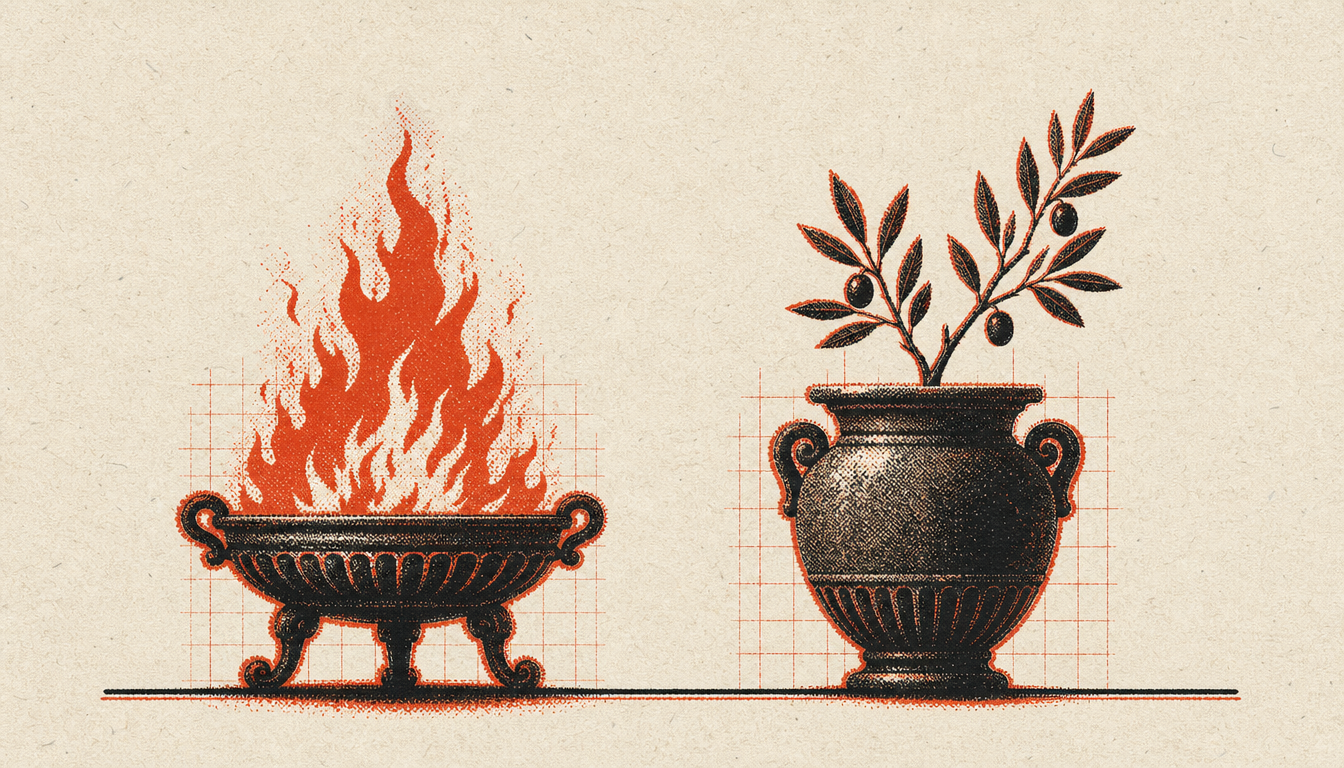
The Stoic concept of long-term vision is not a five-year plan. It is not a vision board. It is the practice of viewing your present actions from the perspective of your own death, and from the perspective of the generations that will follow you.
Marcus Aurelius wrote his private notebook, the Meditations, as a working emperor at the edge of a contested empire. He did not write it for publication. He wrote it to discipline himself, day after day, against the temptations of vanity, anger, and short-term thinking. The book survived, accidentally, and now shapes men he could never have imagined. That is legacy. He was not optimizing for it. He was practicing the virtues that produce it.
Seneca, in his letters to Lucilius, repeatedly returned to one idea: most men squander time because they treat it as infinite. They postpone the work of becoming who they intend to be. They tell themselves they will start when the conditions are right. Seneca's response was blunt. The conditions are never right. The man who waits to begin is the man who never begins.
Epictetus, born a slave, taught that the only territory a man truly governs is his own judgment and his own response. Everything else, including reputation, wealth, and how he will be remembered, lies partly outside his control. The Stoic move is to pour effort into the governable and accept the rest. Paradoxically, this is what produces a legacy worth remembering: a man who acted with integrity regardless of outcome.
The Three Stoic Questions for Long-Term Vision
Strip the philosophy down and three questions remain. The diagram below maps how these questions interact to shape a coherent vision.
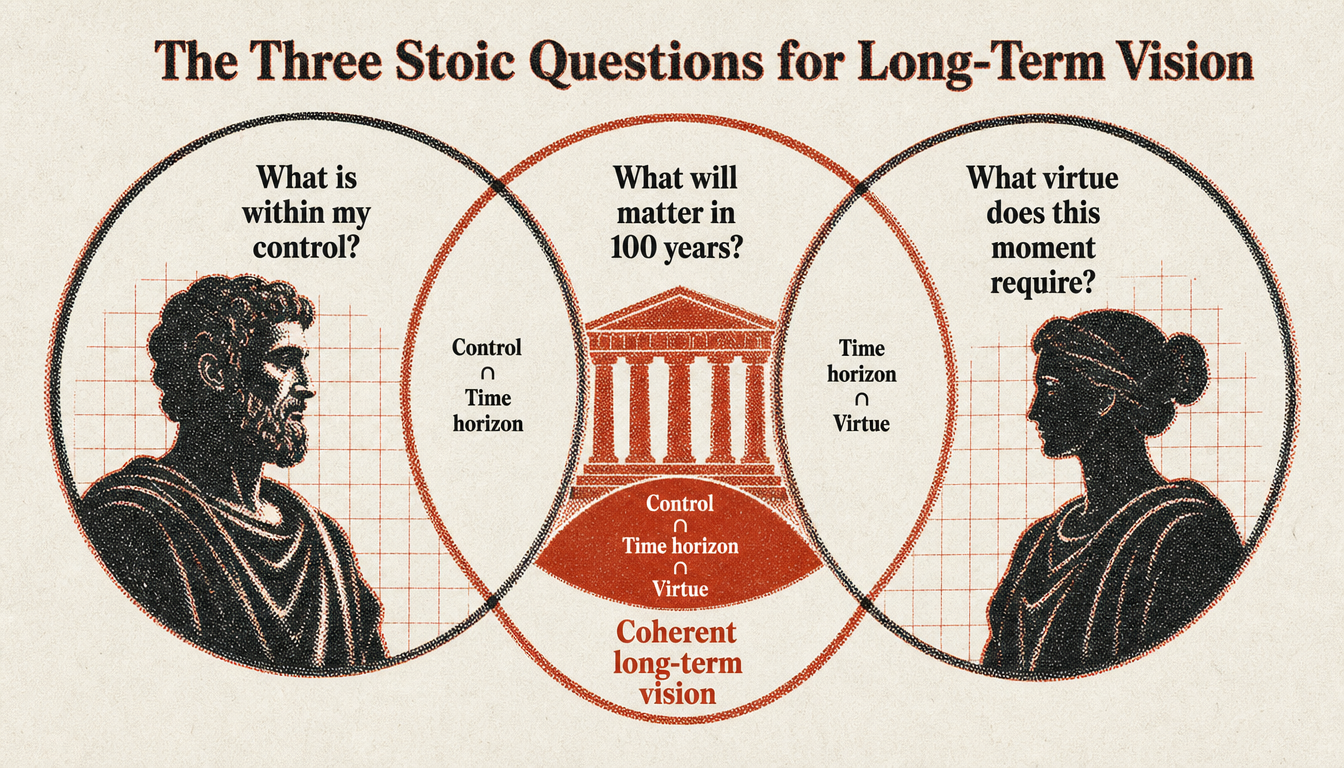
- What is within my control? Effort, judgment, character, response. Build here.
- What will matter in one hundred years? Almost nothing you are currently anxious about. Strip it away.
- What virtue does this moment require? Courage, justice, wisdom, or temperance. Act accordingly.
These questions do not produce a roadmap. They produce a compass. The difference matters, because roadmaps assume the terrain is fixed, and the terrain of a human life never is.
Ambition and Legacy Are Not the Same Thing

The most common mistake is to treat legacy as the long-term version of ambition. It is not. They are different orientations toward time, value, and self. Understanding the distinction is the first practical move.
| Dimension | Ambition | Legacy |
|---|---|---|
| Timeframe | This quarter, this year, this decade | Beyond your lifetime |
| Measured by | Visible outcomes and status | Lasting influence on people and institutions |
| Primary virtue | Drive and discipline | Wisdom and integrity |
| Failure mode | Burnout, hollowness, status anxiety | Passivity, abstraction, never starting |
| Audience | Peers, competitors, the present | People you will never meet |
| Stoic alignment | Useful servant, dangerous master | Aligned with virtue and long time |
Read the table carefully. Ambition is not the enemy. Ambition is the engine. The problem is when ambition becomes the driver and chooses the destination. A man whose ambition selects his goals will optimize for what he can show others now. A man whose legacy selects his goals will optimize for what he can become, build, and leave.
An honest objection: legacy thinking can become an excuse for inaction. Men sit around contemplating their grand contribution while failing to do this week's work. This is real. The Stoics anticipated it. Their answer was that legacy is not built by thinking about legacy. It is built by performing the duties of each role, each day, with the virtues each role demands. Father, husband, professional, citizen, friend. The legacy is the residue of the practice.
Why Most Men Build Ambition and Call It Legacy

If the distinction is clear, why do so many capable men get it wrong? Three reasons, each worth examining honestly.
The Feedback Problem
Ambition produces fast feedback. You hit a number. You get the promotion. You see the physique in the mirror. The brain rewards this with dopamine, and the behavior reinforces itself. Legacy produces almost no feedback during the years you are building it. A father raising sons well receives no quarterly report. A craftsman training apprentices does not see the cathedral his work will eventually enable. The man oriented toward legacy must act on faith, or more precisely, on principle, because the signals he would normally use to navigate are absent.
The Comparison Problem
Ambition is comparative by design. You are ahead, you are behind, you are catching up. Legacy is non-comparative. Two men can both leave magnificent legacies in entirely different domains, and there is no scoreboard that ranks them. Modern men are trained from adolescence to evaluate themselves comparatively, so when the comparative framework dissolves they often feel unmoored rather than free. They sprint back to ambition because at least ambition tells them where they stand.
The Identity Problem
Ambition lets you build an identity others can recognize and validate. Founder. Executive. Athlete. Operator. Legacy demands an identity that may not be legible to the people around you, because much of it is invisible until long after you are gone. The man who orients toward legacy must be willing to be misunderstood, underestimated, and at times invisible, because the work he is doing does not photograph well.
The Stoics would say: good. The opinion of the crowd was never a reliable guide. Marcus reminded himself constantly that the applause of his contemporaries would die with them. So would the criticism. Only the act remains, and only the character that produced the act.
Building a Long-Term Vision Without Falling for Fantasy

A long-term vision is useless if it remains a fantasy. The Stoics were ferociously practical, and any framework drawn from them must convert into specific weekly behavior or it has failed the test.
The following structure is one way to do it. It is not the only way, but it forces the right questions.
1. Define the Roles, Not the Outcomes
Outcomes are partly outside your control. Roles are not. List the roles that matter most to you, perhaps four to six, and define what excellence looks like in each. Father. Husband. Professional. Citizen. Friend. Student. The list is yours, but be honest about which roles you are actually living and which you are merely claiming.
2. Identify the Virtues Each Role Requires
Different roles call on different virtues at different times. Being a father at three in the morning with a sick child calls on patience. Being a professional in a contested negotiation calls on courage and temperance. Map the virtues to the roles. This is your operating manual.
3. Establish Practices, Not Goals
Goals end. Practices continue. A man who sets a goal to read fifty books in a year and hits it has accomplished something, but a man who establishes a practice of reading for forty-five minutes every morning has built an engine that will run for decades. Legacy is built by engines, not by milestones.
4. Audit Weekly, Not Daily
Daily audits collapse into self-flagellation or self-congratulation, both useless. Weekly audits are long enough to reveal patterns and short enough to correct course. Ask three questions each week. Where did I act in accordance with my values? Where did I drift? What does next week require?
5. Accept That Most of It Will Be Invisible
The bulk of what builds a meaningful legacy will never be seen by anyone. The hour you did not lose your temper. The deal you walked away from because it was beneath your standards. The conversation you had with your son that he will not remember consciously but that will shape how he treats his own children. None of this photographs. All of it matters.
What This Means for the Next Decade of Your Life
Predictions about culture are usually wrong, but a few directions are stable enough to plan around. The pace of status signaling will continue to accelerate. The cost of attention will continue to rise. The men who win the next decade will not be the men who consume the most content or chase the most trends. They will be the men who have decided, with brutal clarity, what they are building and what they are refusing to build.
If you take the Stoic frame seriously, a few practical commitments follow.
- Choose a smaller set of pursuits and go deeper. The man with five priorities has no priorities. Pick two or three domains and accept that you will be mediocre at everything else. Mediocrity in non-essential domains is not failure. It is focus.
- Build relationships you intend to honor for thirty years. Most modern relationships are transactional and shallow because they are optimized for present utility. The relationships that produce legacy are the ones you tend long after they have stopped being useful in any immediate sense.
- Invest in capabilities, not credentials. Credentials decay. Capabilities compound. The man who can think clearly, write precisely, lead under pressure, and remain calm in chaos will be valuable in any economy.
- Write things down. Marcus Aurelius did not become Marcus Aurelius because he had unusual thoughts. He became Marcus Aurelius because he wrote them down and read them back to himself. The practice of articulating your principles in your own words, regularly, is one of the highest-leverage disciplines available to any man.
- Practice the view from above. Periodically zoom out. See your life from a hundred years on. See your worries from the perspective of a man on his deathbed. Most of what consumes you will look trivial. Some small fraction will look enormous. Reorganize accordingly.
None of this is complicated. All of it is hard, because it requires you to act on principles when the feedback loops are pulling you toward ambition. The Stoics knew this. That is why they wrote, practiced, and reminded themselves constantly. They did not assume the philosophy would hold without daily reinforcement. Neither should you.
Conclusion: The Question Worth Carrying
Ambition is the engine. Legacy is the direction. Run the engine without the direction and you will arrive somewhere expensive and meaningless. Set the direction without the engine and you will arrive nowhere at all. The Stoics understood that long-term vision is not a substitute for daily effort, it is the only thing that gives daily effort coherence.
The question worth carrying is not how much will I achieve. It is what will remain of me, in the people and institutions I have touched, when the noise of my striving has gone silent. Answer that question honestly and most of your other decisions get simpler. Refuse to answer it, and you will spend the next ten years confusing motion for meaning.
Which are you building this week? And if you are not sure, what would change if you were?