

Stoic Journaling vs. Gratitude Journaling: Which Builds Stronger Men?

If you want to sharpen judgment, harden discipline, and confront your own weaknesses without flinching, stoic journaling is the practice built for you. If you want to reset a chronically negative mind, repair your relationship with what you already have, and stabilize mood, gratitude journaling is the better tool. Most men who chase strength assume these are interchangeable. They are not.
The distinction matters because journaling is one of the few self-development practices that actually survives contact with a busy life, but only if the practice matches the man. Choose wrong and you will quit within three weeks, convinced that writing about yourself is a waste of time. Choose right and it becomes the daily forge where your character is hammered into shape.
This is a full comparison, evaluated on the axes that matter for men serious about becoming stronger: mental toughness, decision quality, emotional regulation, action orientation, and long-term legacy. No motivational sludge. Just a direct look at what each practice does, what it fails to do, and which one earns a place in your morning.
The Two Practices at a Glance
Before the comparison, the two practices need to be defined precisely. Most men who claim they have tried journaling have actually tried a diluted version of one of these, given up, and blamed the practice. Confusion at the definition level poisons everything that follows.
Stoic journaling descends from the private notebooks of men like Marcus Aurelius and the letters of Seneca. It is a rigorous, sometimes uncomfortable practice built around examining your day, your reactions, your virtues, and your failures against a philosophical standard. It asks hard questions and expects honest answers.
Gratitude journaling is a modern practice with roots in positive psychology. It asks you to list what you are thankful for, savor what is good, and train your attention toward abundance rather than scarcity. It is gentler, easier to start, and easier to sustain.
| Stoic Journaling | Gratitude Journaling | |
|---|---|---|
| Origin | Ancient Stoic philosophy | Modern positive psychology |
| Core aim | Self-examination and virtue development | Attention shift toward what is good |
| Emotional register | Confrontational, honest | Warm, appreciative |
| Typical duration | 15 to 30 minutes | 3 to 10 minutes |
| Difficulty | High | Low |
| Category | Character discipline | Cognitive reframing |
Both practices work. They just do different jobs. Confusing them is like confusing a barbell with a foam roller. The comparison below shows the practical trade-offs.
Head-to-Head Comparison

The table below summarizes the head-to-head across the axes that actually matter for a man building himself. Each axis is examined in detail in the sections that follow.
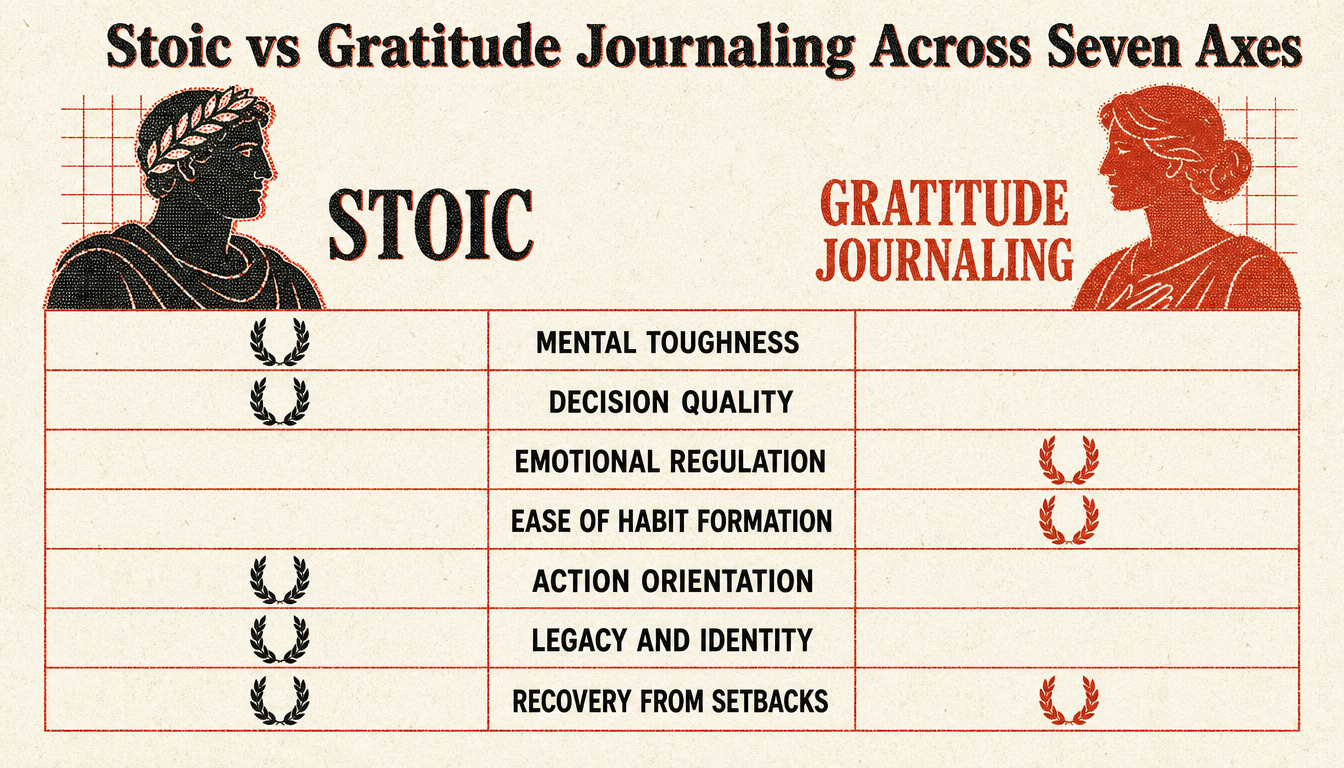
| Evaluation Axis | Stoic Journaling | Gratitude Journaling | Advantage |
|---|---|---|---|
| Mental toughness | Directly trains it through discomfort | Indirect, through stability | Stoic |
| Decision quality | Sharpens judgment via review | Minimal effect | Stoic |
| Emotional regulation | Slow but deep | Fast and reliable | Gratitude |
| Ease of habit formation | Demanding | Very easy | Gratitude |
| Action orientation | High, produces commitments | Low, mostly reflective | Stoic |
| Legacy and identity | Builds a lasting record of character | Builds appreciation, not identity | Stoic |
| Recovery from setbacks | Reframes through reason | Reframes through appreciation | Tie |
The scoreboard favors stoic journaling for the man whose primary target is character and capacity. Gratitude journaling wins on accessibility and mood. Neither result is surprising once you look at what each practice was designed to do.
Detailed Comparison Across the Axes

Mental Toughness
Stoic journaling builds mental toughness by making you sit with your own failures in ink. When you write down that you lost your temper with your wife, that you scrolled for an hour instead of training, that you avoided a difficult conversation at work, you cannot pretend it did not happen. The page holds you accountable in a way memory does not. Over months, this daily confrontation with your gap between ideal and reality produces a specific kind of resilience: the ability to look at your own flaws without collapse or denial.
Gratitude journaling builds a different kind of toughness, more like ballast than armor. Men who practice it consistently report less reactivity to minor stressors and a broader baseline mood. That stability matters. But it does not train you to face hard truths about yourself, because the practice does not require them. You can write gratitude entries every day for a year and remain blind to your worst habits.
Toughness comes from voluntary discomfort, and stoic journaling is voluntary discomfort in written form. Gratitude journaling is closer to voluntary appreciation. Both have value. Only one hardens.
Decision Quality
Stoic journaling almost always includes an evening review, sometimes called the examen, in which you walk through the day's decisions and ask what you did well, what you did poorly, and what you would do differently. Repeated across years, this practice compounds. You catch patterns. You notice that you consistently overcommit on Mondays, or that you make your worst calls when hungry, or that you rationalize the same avoidance three different ways. Judgment improves because it is being audited.
Gratitude journaling does not audit judgment. It celebrates outcomes and blessings, which is a fine thing, but it will not tell you why you keep hiring the wrong people or losing the same argument with your father. If your goal is sharper decisions, gratitude alone is insufficient.
Emotional Regulation
Here gratitude journaling has a clear edge, especially in the short term. Listing three things you are grateful for shifts attention from what is missing to what is present, and that attentional pivot produces a measurable mood lift within minutes. Men who journal gratitude in the morning tend to enter the day less reactive. Men who journal gratitude at night tend to sleep better.
Stoic journaling regulates emotion through a slower and more philosophical route. You dispute irrational judgments, remind yourself what is in your control and what is not, and rehearse premeditation of adversity so that setbacks arrive as expected rather than as shocks. The effect is deeper but takes longer to develop. For a man whose emotional life is currently on fire, gratitude is the faster stabilizer.
Ease of Habit Formation
Gratitude journaling is one of the easiest habits in self-development. Three bullet points. Under five minutes. Anyone can do it on day one and feel a small hit of well-being immediately. That immediate feedback loop is why it sticks.
Stoic journaling is not easy. The first two weeks feel awkward. You confront yourself in writing and often do not like what you find. The payoff is not immediate. Many men quit before the practice matures. If you are going to attempt it, you need a reason bigger than novelty, or you will drop it the first busy week.
Action Orientation
Stoic journaling produces commitments. When you review the day and identify a failure of courage, honesty, or discipline, the natural next step is a specific commitment for tomorrow. Over time, these commitments accumulate into a portfolio of actual behavior change. The journal becomes a training log for character rather than a diary of feelings.
Gratitude journaling rarely produces action. It changes how you feel about your circumstances, which has real value, but it does not typically lead you to change them. This is a feature, not a bug, if what you need is peace. It is a limitation if what you need is progress.
Legacy and Identity
A stoic journal maintained for a decade becomes an artifact. It shows a man's mind at work on itself. Marcus Aurelius did not write his Meditations for publication; he wrote them for his own examination, and centuries later they remain one of the most powerful documents of a man's inner life ever produced. Your own version will not be published, but it will exist as a record of who you tried to become. That matters, especially to sons.
Gratitude journals rarely carry the same weight. They record what you appreciated, not who you were. They comfort more than they define. A father's gratitude list is a warm thing to find; a father's stoic journal is a foundational thing to inherit.
Recovery From Setbacks
Both practices help you recover, through different mechanisms. Stoic journaling recovers you through reason: you dispute the catastrophic interpretation, distinguish what you can control, and rehearse the response of a virtuous man. Gratitude journaling recovers you through appreciation: you reorient toward what remains rather than what was lost. Neither is superior in the abstract. Men recovering from professional failure often benefit more from stoic reframing. Men recovering from health scares or bereavement often benefit more from gratitude.

What Both Practices Share

Before pushing one over the other, the common ground deserves attention. Choosing between them is a real decision, but the shared benefits are the reason journaling of any serious kind beats no journaling at all.
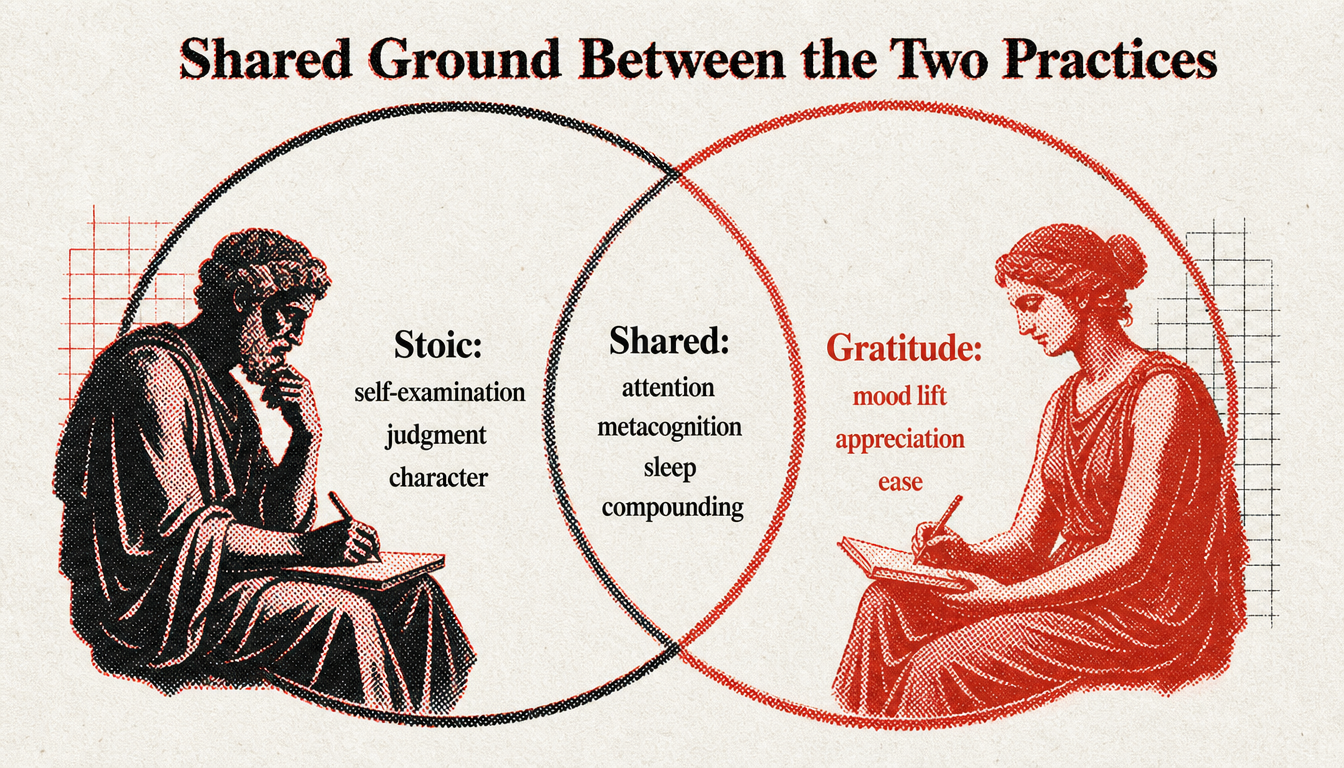
- Attention training. Both practices force you to slow down and direct your mind. In a life of constant input, the act of writing itself is a discipline.
- Metacognition. Both create distance between you and your thoughts, which is the precondition for changing any of them.
- Sleep and stress benefits. Men who journal in either tradition consistently report better sleep and lower baseline stress compared to men who do not.
- Compounding. Both practices compound. The tenth month is far more valuable than the first, because you are now comparing yourself against months of your own recorded history.
- Cheap and portable. A notebook and a pen. No app subscription, no equipment, no coach required.
- Private. Neither practice depends on an audience. Nothing has to be posted, shared, or validated. In an era of performative self-improvement, that alone is worth something.
If you commit to either practice for a year with genuine consistency, you will be a different man. The question is which kind of different.
Which Practice Fits Which Man

The best practice is the one that matches your current bottleneck. A man drowning in reactivity needs stability before he needs philosophy. A man coasting on autopilot needs confrontation more than appreciation. The table below maps common conditions to the practice that fits.
| Situation or Condition | Recommended Practice | Reason |
|---|---|---|
| Chronic negativity, cynicism, or low mood | Gratitude | Fast attentional shift stabilizes baseline |
| Coasting, plateau, sense of drift | Stoic | Forces confrontation with the gap between values and behavior |
| High reactivity, short temper | Start gratitude, layer stoic later | Stability first, then examination |
| Recovering from grief or loss | Gratitude | Reorients toward what remains |
| Recovering from professional failure | Stoic | Dispute distorted judgments, plan the next move |
| Leadership role, hard decisions daily | Stoic | Sharpens judgment through nightly review |
| New father or building a legacy | Stoic | Creates a record of character to pass on |
| Long-term relationship struggling | Both, gratitude for partner, stoic for self | Different tools for different targets |
| First time journaling ever | Gratitude | Build the writing habit before the harder practice |
Most men benefit from starting with gratitude for two to four weeks, purely to establish the daily writing habit, then transitioning to a stoic practice once the seat time is normal. Trying to start with a full stoic examen when you have never written a private word in your life is like trying to squat 315 on day one at the gym. It can be done, but usually it just makes you quit.
How to Actually Run Each Practice
Both practices fail more often from vague execution than from wrong choice. Below is a workable minimum viable version of each. Neither is the only correct format, but both are enough to produce real results if held for ninety days.
A Working Stoic Practice
- Morning, five to ten minutes. Write one line on what could go wrong today, one line on the virtue you most need to embody, and one line on what is genuinely in your control today.
- Evening, ten to twenty minutes. Walk through the day. What did I do well? Where did I fall short of the man I want to be? What will I do differently tomorrow? Be specific. Vague self-criticism is useless.
- Weekly, thirty minutes. Read the week's entries. Look for patterns. Identify one recurring failure and design a concrete counter-move for the coming week.
The evening review is the load-bearing wall. If you do nothing else, do that.
A Working Gratitude Practice
- Once daily, three to five minutes. List three specific things you are grateful for. Not "my family" but "my son laughing when I picked him up from school." Specificity is what makes the practice work.
- Weekly, ten minutes. Write a longer entry about one person, event, or circumstance you would miss badly if it disappeared tomorrow.
- Occasionally. Write a full gratitude letter to someone who shaped you. Send it if you can. Do not skip this step. It is the highest-leverage version of the practice.
Both practices reward consistency far more than intensity. Ten minutes a day for a year beats two hours on a Sunday you eventually skip.
The Verdict for Men Serious About Getting Stronger
For the man whose target is character, discipline, judgment, and legacy, stoic journaling is the more powerful practice. It is harder, less pleasant, and slower to reward, which is exactly why it produces the outcomes it does. The practice is a form of resistance training for the mind, and like all resistance training, the discomfort is not a bug in the system; it is the mechanism.
Gratitude journaling is not a lesser practice. It is a different practice, aimed at a different target. For men whose primary struggle is baseline mood, reactivity, or a sense that they take too much for granted, it is more effective in the short and medium term. Many strong men run it in parallel with a stoic practice, using gratitude to open the day and stoic examination to close it.
If forced to pick one for a man aged twenty-five to forty-five who is already familiar with the language of self-development but not yet consistent in his behavior, the answer is stoic journaling. The gap most men in that group need to close is not appreciation. It is honest self-examination followed by action. Gratitude can support that work. It cannot replace it.
Start tonight. Ten minutes. One page. Three questions: What did I do well today? Where did I fall short of the man I want to be? What will I do differently tomorrow? Do that for ninety nights without missing more than two in a row, and you will not need anyone to tell you which practice builds stronger men. You will have the evidence in your own handwriting.