

The 7 Stoic Frameworks Every Man Should Master Before 40

You already know the difference between the man you are and the man you intend to become. That gap is not a knowledge problem. You have read the quotes, saved the threads, and finished the audiobook on your commute. The problem is that insight evaporates the moment life pushes back. Stoicism solves this not by inspiring you but by giving you repeatable operating procedures for the moments that matter.
This guide lays out seven Stoic frameworks for men who want structure, not sentiment. Each one is a decision tool you can run under pressure. If you master three of them, the dichotomy of control, negative visualization, and the view from above, you will already outperform most men who quote Marcus Aurelius on social media. Master all seven, and you build a character that holds when circumstances stop cooperating.
Where to Start: The Three That Matter Most

Seven frameworks can feel like a menu you never order from. So start here. If you do nothing else this year, install these three in the order given, because each one depends on the discipline built by the one before it.
- The Dichotomy of Control teaches you where to spend your energy. Everything downstream requires it.
- Negative Visualization rewires how you value what you already have and prepares you for loss.
- The View From Above shrinks your ego and your anxiety at the same time.
These three form the spine. The remaining four, voluntary discomfort, the reserve clause, memento mori, and the inner citadel, add muscle to that spine. Depth beats breadth every time you practice philosophy. A man who lives one framework fully outranks a man who name-drops ten.
How I Selected and Ranked These Frameworks

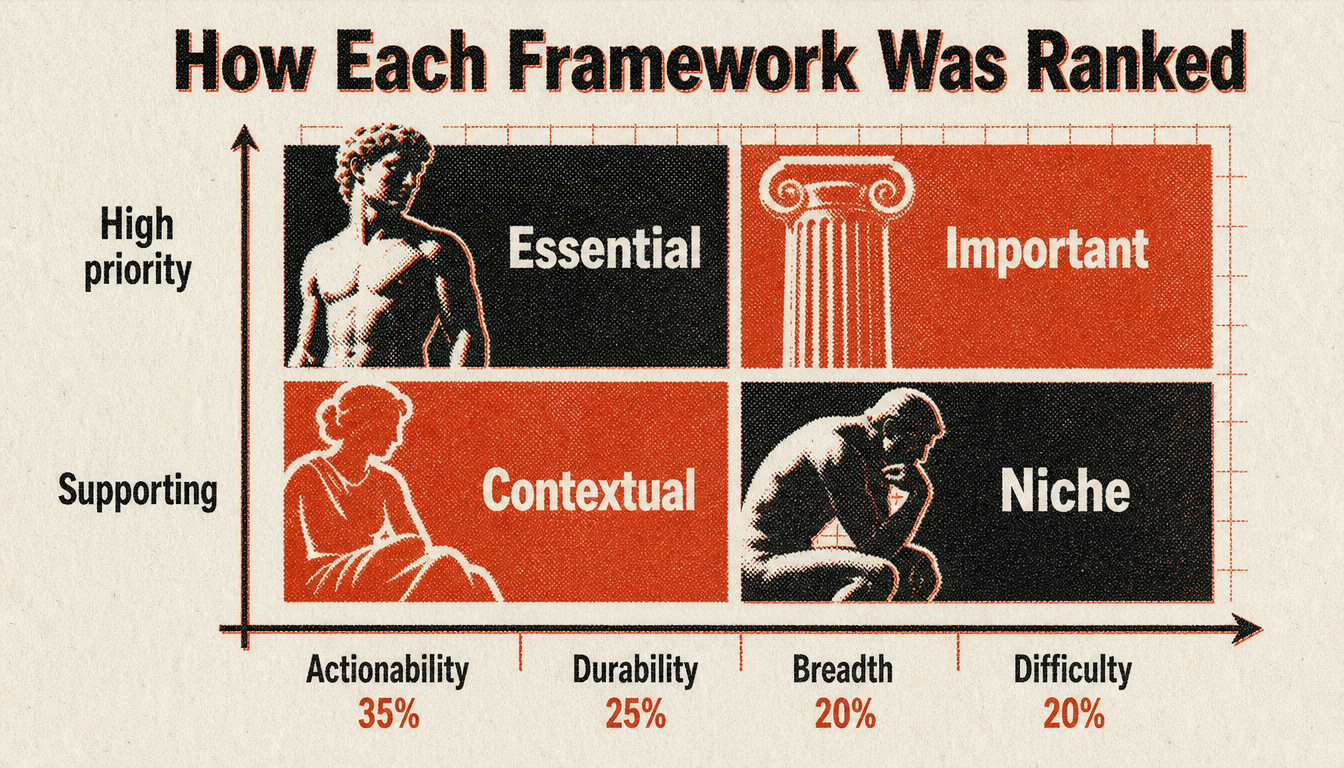
Stoic literature is vast, and much of it repeats itself. I filtered the entire canon against four criteria, weighted by how directly each one changes daily behavior rather than dinner-party conversation.
- Actionability (35%): Can you run this framework in real time, mid-argument, mid-crisis, mid-temptation? Abstract virtue talk scored low.
- Durability (25%): Does the benefit compound over years, or does it fade like a motivational high?
- Breadth of application (20%): Does it touch work, relationships, health, and legacy, or only one lane?
- Difficulty of mastery (20%): Harder frameworks ranked higher when the payoff justified the cost, because easy wins rarely reshape a man.
The diagram below shows how these four criteria feed into the ranking of stoic frameworks for men.
Every framework here earned its place by changing how a man acts under load, not how he sounds at brunch. With the method clear, here is the full field at a glance.
The 7 Frameworks Compared at a Glance

Before the deep dives, scan the table. It gives you the shape of each framework, when to reach for it, and how central it is to a Stoic life.
| Framework | Core Function | Primary Use | Mastery Priority |
|---|---|---|---|
| Dichotomy of Control | Directs energy to what you govern | Anxiety, blame, wasted effort | Essential |
| Negative Visualization | Values the present, braces for loss | Gratitude, resilience | Essential |
| View From Above | Deflates ego and drama | Perspective, humility | Essential |
| Voluntary Discomfort | Builds tolerance through practice | Toughness, freedom from comfort | High |
| Reserve Clause | Acts hard, holds outcomes loosely | Ambition without despair | High |
| Memento Mori | Uses death to clarify priorities | Urgency, legacy | High |
| Inner Citadel | Guards the mind from external chaos | Composure, integrity | Advanced |
Now take each one apart and learn to operate it.
The Seven Frameworks in Detail

1. The Dichotomy of Control
Epictetus opens his handbook with a single distinction: some things are within our power, and some are not. Your judgments, your effort, your response, these you control. Outcomes, other people, reputation, weather, and the market, these you do not. Every unit of anxiety you carry traces back to spending emotional energy on the second category.
How to run it: When frustration hits, name the object of your worry out loud, then sort it. If it lands in the "not up to me" column, you drop the emotional weight and act only on your input. You cannot control whether you get the promotion. You control the quality of your work and how you show up.
- Advantage: Cuts anxiety at the root and ends the habit of blame.
- Drawback: Men often misuse it as an excuse for passivity, treating effort as "out of their control" too.
Best for the man who lies awake replaying conversations he cannot change.
2. Negative Visualization
The Stoics called it premeditatio malorum, the premeditation of adversity. You deliberately imagine losing what you value: your job, your health, the people you love. Not to wallow, but to strip away the numbness of taking things for granted. A man who has mentally rehearsed loss stops treating his wife, his body, and his time as permanent fixtures.
How to run it: Once a week, spend five minutes picturing a specific loss in concrete detail. Then return to the present and notice that the thing still stands. The gratitude that follows is not forced. It arrives on its own.
- Advantage: Generates real gratitude and inoculates you against future shocks.
- Drawback: Done carelessly, it tips into rumination and dread instead of appreciation.
Best for the man who chases the next milestone and never feels satisfied with what he has already built.
3. The View From Above
Marcus Aurelius repeatedly zoomed out, imagining himself and his empire from a great height until his problems shrank to their true size. Your inbox drama, the insult from a colleague, the deal that fell through, all of it looks different from ten thousand feet and across a hundred years.
How to run it: When you feel your ego flare, mentally rise above the scene. Picture the city, then the continent, then the span of centuries in which your name will not be remembered. The point is not nihilism. It is proportion. You return to the moment calmer and less self-important.
- Advantage: Dissolves ego and disproportionate reactions in seconds.
- Drawback: Can breed detachment if you forget to re-engage with the life in front of you.
Best for the man whose pride gets him into fights that cost more than they are worth.
4. Voluntary Discomfort
Seneca advised setting aside days to eat plainly, dress roughly, and sleep hard, then asking, "Is this the condition I so feared?" You practice hardship on purpose while life is good, so that when hardship arrives uninvited, it finds you already trained. Cold showers, fasting, hard workouts, sitting with boredom instead of reaching for your phone, all count.
How to run it: Choose one deliberate discomfort per week and complete it without complaint or announcement. The private nature matters. Broadcasting it turns discipline into performance.
- Advantage: Widens your comfort zone and breaks dependence on ease.
- Drawback: Attracts men who confuse suffering for virtue and turn it into ego-driven extremism.
Best for the man who knows he has grown soft and reaches for comfort at the first sign of friction.
5. The Reserve Clause
The Stoics acted with full commitment while adding a mental qualifier: "fate permitting." You pursue the goal with everything you have, yet you hold the outcome with an open hand. This is how you stay ambitious without becoming brittle when reality vetoes your plan.
How to run it: Before any major effort, state your intention and attach the clause. "I will win this client, if circumstances allow." You pour yourself into the input. You refuse to stake your peace on the result. When it goes your way, good. When it does not, your foundation holds.
- Advantage: Combines relentless effort with emotional stability.
- Drawback: Weak men use the clause as a pre-loaded excuse for half effort.
Best for the ambitious man who spirals when a plan collapses.
6. Memento Mori
Remember that you will die. Not as a morbid obsession, but as a scheduling tool. Death is the deadline that makes every other deadline honest. A man who keeps his mortality in view stops postponing the conversations, the training, and the work that actually build a legacy.
How to run it: Each morning, acknowledge that this day is not guaranteed, then choose the one action you would not want to leave undone. Let that priority survive the noise of the day.
- Advantage: Injects urgency and clarifies what deserves your finite hours.
- Drawback: Misapplied, it fuels reckless "life is short" impulsiveness rather than disciplined focus.
Best for the man who tells himself he will get serious "someday."
7. The Inner Citadel
The most advanced framework, and the sum of the others. Marcus described a fortress inside the mind that no external force can breach without your consent. Insults, setbacks, and chaos reach the walls, but only your own judgment can open the gate. The citadel is where your character lives, untouched by what happens to you.
How to run it: Between any event and your response, insert a deliberate pause. In that pause, you remember that the event is external and your reaction is yours to author. Over years, the pause becomes automatic, and composure becomes your default state.
- Advantage: Delivers unshakeable composure and integrity under pressure.
- Drawback: Takes the longest to build and cannot be faked in a crisis.
Best for the man ready to stop reacting and start governing himself.
Which Framework to Master First, by Situation

You do not need all seven at once. Match your starting point to the pressure you feel most. The table maps common situations to the framework that will move the needle fastest for you.
| Your Situation | Start With | Why |
|---|---|---|
| Chronic anxiety and overthinking | Dichotomy of Control | Stops energy leaking into the uncontrollable |
| Never satisfied, always chasing | Negative Visualization | Restores gratitude for what you already hold |
| Quick to anger and wounded pride | View From Above | Shrinks the ego reactions that cost you |
| Gone soft, avoid all friction | Voluntary Discomfort | Rebuilds tolerance through deliberate practice |
| Crushed by failed plans | Reserve Clause | Separates effort from outcome |
| Endless procrastination on what matters | Memento Mori | Converts "someday" into today |
Pick one. Run it daily for a month before you add another. Layering too fast produces a man who knows every framework and lives none of them.
Building the Sequence: How the Frameworks Stack
These tools are not a random collection. They build on each other in a deliberate order, each one preparing the ground for the next. The process diagram below shows the recommended sequence for mastering stoic frameworks for men over time.
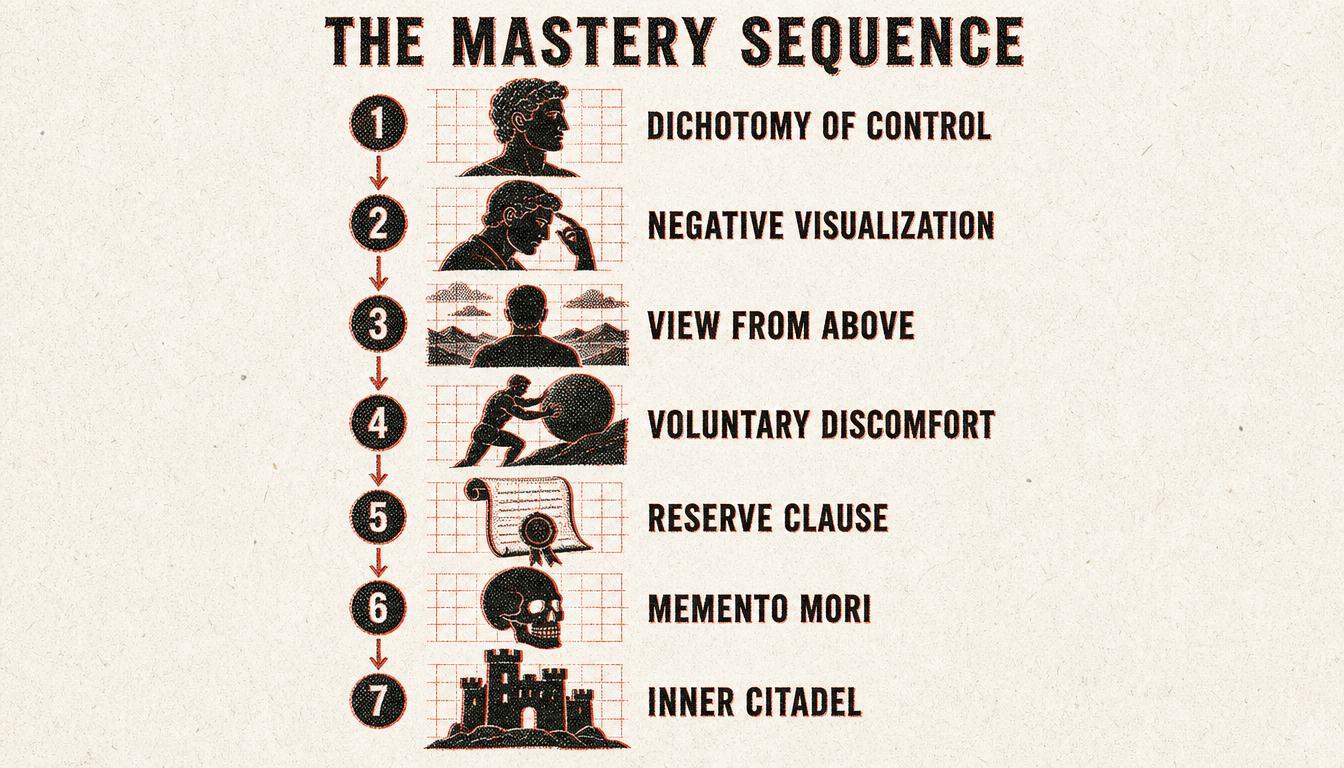
You begin by sorting what you control. Once that discipline holds, you learn to value the present through negative visualization and to keep perspective with the view from above. Only then do you add the harder practices: training discomfort, holding outcomes loosely, and living against the deadline of death. The inner citadel is not a separate step. It is what you have built once the other six run automatically. The citadel is the result, not the starting point.
Do not rush this. A man who spends a full year on the first three frameworks ends that year more transformed than a man who skims all seven in a weekend and forgets them by Monday.
Bringing It Together
The gap between the man you are and the man you intend to become closes through repetition, not revelation. You have read enough. What separates you now is whether you install one of these frameworks as a daily practice or add this article to the pile of things you agreed with and never used.
Start with the three essentials. Sort what you control. Rehearse loss to sharpen gratitude. Zoom out when your ego flares. Those three alone will change how you carry yourself within weeks. Layer in the others as the earlier ones become second nature.
Keep these principles in front of you as you practice:
- Depth over breadth. One framework lived fully beats seven understood vaguely.
- Practice in private. Discipline announced becomes performance. Keep it quiet.
- Sequence matters. Master control before you attempt the citadel.
- Judge by action. Measure progress by how you behave under pressure, not by how much you have read.
- Play the long game. These frameworks compound over decades, which is exactly why they belong to you before 40.
The philosophy was never the hard part. Living it is. Choose your first framework today and run it tomorrow morning. The rest follows from that.