

The Dichotomy of Control: A Man's Guide to What Actually Matters
Most men waste their lives fighting battles they cannot win. They rage at traffic. They lose sleep over a colleague's opinion. They strategize endlessly about outcomes that depend on a thousand variables outside their hands. Then they wonder why they feel exhausted, anxious, and somehow always behind.
The dichotomy of control is the oldest, hardest, and most useful idea in Stoic philosophy. Epictetus opened the Enchiridion with it for a reason. Once you internalize it, the noise in your life starts to drop. Not because the world gets quieter, but because you stop arguing with it.
This guide is for the man who has already read the quotes, watched the videos, and bought the journals, and who still finds himself reactive, distracted, and disappointed in his own discipline. You know the concepts. What you need is a working system.
What This Guide Will Give You

By the end of this read, you will have a clear operating definition of the dichotomy of control, a method to apply it to your daily decisions, and a framework for using it across four domains that matter most to a man's life: mental toughness, masculine conduct, social presence, and long-term legacy.
This is intermediate-level material. It assumes you have heard of Stoicism, have probably encountered Marcus Aurelius or Ryan Holiday, and are tired of surface-level treatments. Expect roughly twenty minutes to read carefully, and a lifetime to practice.
Prerequisites
- Basic familiarity with Stoic thinkers (Epictetus, Marcus Aurelius, Seneca) is helpful but not required.
- Willingness to audit your own behavior honestly, including the parts that embarrass you.
- A notebook or note app. You will not retain this through reading alone.
The Dichotomy of Control, Stated Plainly

Epictetus, a former slave turned philosopher, opened his manual with a sentence that should be tattooed on the inside of every man's skull: some things are up to us, and some things are not.
That is the dichotomy of control. Two categories. No third option.
What is up to you: your judgments, your intentions, your effort, your responses, your standards. What is not up to you: other people's opinions, outcomes, reputation, weather, traffic, the economy, your body's eventual decline, whether your work gets recognized.
The dichotomy is not a coping mechanism. It is a precision instrument. It tells you where to spend your finite attention and where to stop bleeding energy. Every minute you spend trying to control the uncontrollable is a minute stolen from the only territory you actually own: your own conduct.
Why Most Men Get This Wrong
Men in particular tend to confuse control with effort. We are taught that hard work conquers all, that grinding harder bends reality to our will. That message is half true and dangerously incomplete. Effort is yours. Results are not.
You can train six days a week and still get injured. You can build a flawless business plan and still lose to a market shift. You can be the best father you know how to be and still have a son who chooses his own painful path. The Stoic does not stop trying. He stops mistaking trying for guaranteeing.
The Trichotomy: A Useful Refinement
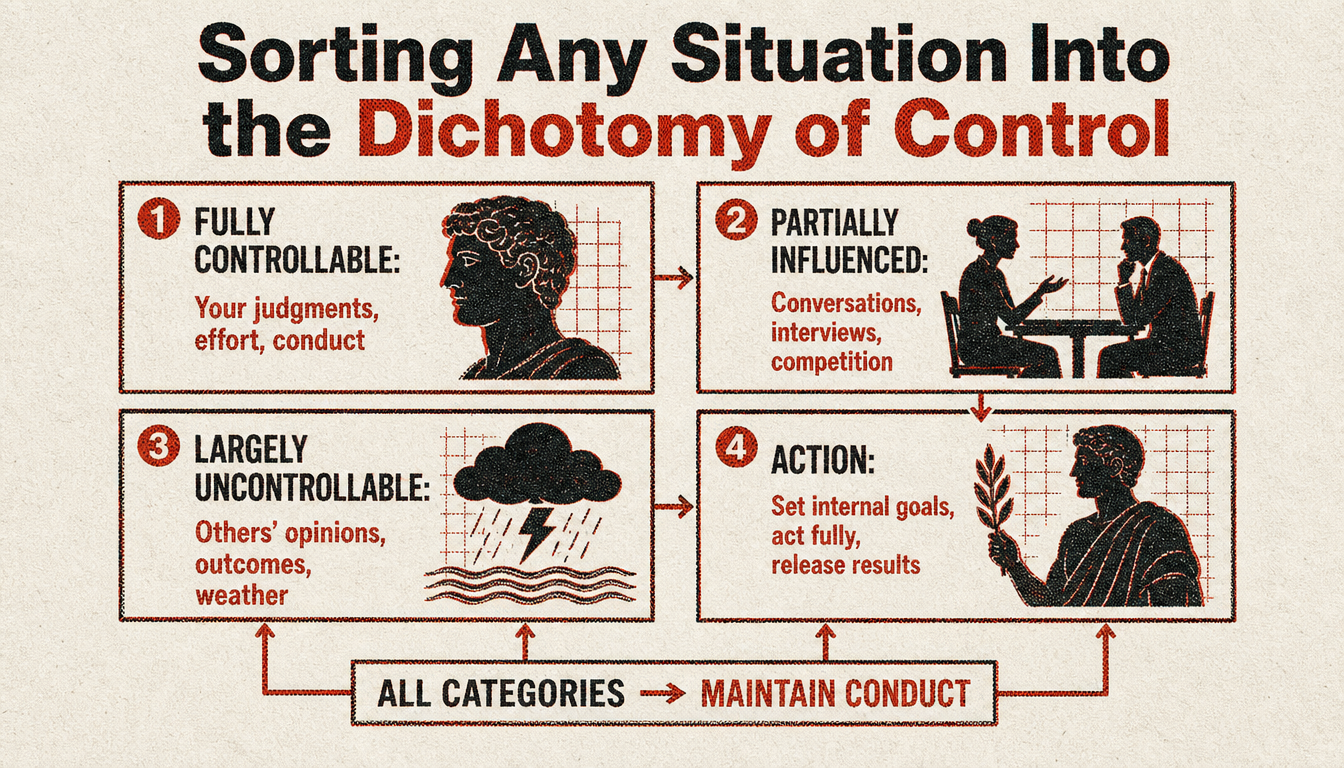
Modern Stoic scholar William Irvine proposed a refinement worth knowing. He argued that between fully controllable and fully uncontrollable lies a third category: things you have partial influence over. A tennis match. A job interview. A conversation with your wife.
For those, Irvine suggests setting internal goals rather than external ones. Your goal in the interview is not to get the offer. Your goal is to prepare thoroughly, arrive composed, and represent yourself honestly. Those are yours. The hiring decision is not.
The diagram below maps how to sort any situation you face into these categories.
Applying the Dichotomy to Mental Toughness

Mental toughness, properly understood, is not the ability to endure suffering through sheer grit. That is a brittle, exhausting model that breaks the men who try to live by it. Real mental toughness is the ability to keep your judgment clean under pressure, which is the dichotomy of control applied in real time.
The Two-Question Filter
When something hits you, a rude email, a market drop, a diagnosis, a betrayal, run it through two questions before you react.
- Is any part of this within my control right now? If yes, act on that part. Immediately and proportionately.
- What part is not within my control? Name it explicitly. Then release it, not because it does not matter, but because gripping it changes nothing.
This sounds simple. It is not. The discipline is in doing it before the emotional cascade takes over, when your nervous system wants to make the uncontrollable feel like an emergency that demands frantic action.
The Premeditation Practice
Seneca recommended premeditatio malorum, the premeditation of evils. Spend a few minutes each morning rehearsing what could go wrong that day, and how you would respond. The traffic. The difficult client. The argument with your partner.
The purpose is not pessimism. The purpose is to pre-sort each item into the dichotomy before it arrives, so that when it does arrive, your response is already loaded. You stop being ambushed by ordinary events.
Suffering Versus Pain
Pain is data. Suffering is the story you tell about the pain. The dichotomy of control separates them cleanly. The injury, the loss, the insult, those are pain. They happen. The narrative loop where you replay it for hours, imagining alternate timelines, rehearsing arguments you will never have, that is suffering. And suffering is largely produced by treating uncontrollables as controllables.

Masculine Conduct: Standards You Actually Own

A man without standards is a man at the mercy of his environment. He becomes whatever the room asks him to be. The dichotomy of control gives you a way to build standards that are yours, not borrowed from the latest podcast or imposed by social pressure.
Conduct Is Controllable. Image Is Not.
Here is a hard distinction most men miss. Your conduct, what you actually do, is fully yours. Your image, how you are perceived, is not. You can behave with integrity for forty years and still be misunderstood by people who never bothered to look closely.
The trap is optimizing for image. The Stoic optimizes for conduct and lets the image fall where it falls. Marcus Aurelius, who actually was emperor of Rome, wrote constantly to himself about not caring what posterity would say of him. He cared about acting rightly today.
A Working Code
Build a personal code of three to five non-negotiable standards. Make them about your behavior, not your outcomes. Examples that respect the dichotomy:
- I keep my word, even when it costs me.
- I train my body four times a week, regardless of how I feel.
- I do not speak ill of people who are not in the room.
- I look my children in the eye when they speak to me.
- I do the hardest task before checking my phone.
Notice these are all conduct. None of them say "be respected" or "be successful." Those are downstream. They depend on factors you do not own. The code anchors you to what you own.
The Comparison Trap
Comparing yourself to other men is one of the fastest ways to violate the dichotomy. Other men's results, status, money, relationships, are not in your control. Your own progress is. Track yourself against yourself, last quarter against this quarter, and the comparison trap loses its grip.
Social Presence Without Performance

Most advice on social presence teaches you to perform. Stand this way, talk that way, manage this impression. It treats presence as a controllable output. It is not. Presence is a byproduct of internal alignment, and the dichotomy of control is the alignment tool.
Why Anxious Men Lack Presence
A socially anxious man is a man trying to control the uncontrollable in real time. He is monitoring how he is being received, adjusting based on micro-expressions, running constant calculations to optimize an outcome that depends on the other person's mood, history, and biases. It is exhausting and it leaks. People feel the strain.
The man with presence is not better at managing impressions. He has stopped trying to manage them. He has internalized that he controls what he says and how he conducts himself, and nothing else. The result is a kind of stillness that other people register as confidence.
The Conversational Application
In any conversation, your controllables are: listening attentively, speaking honestly, asking real questions, holding eye contact, and not lying to seem more impressive. Your uncontrollables are: whether the other person likes you, whether they remember the exchange, whether they invite you back.
Direct all your attention to the first list. Resist the pull of the second. You will find conversations get sharper, shorter, and far more memorable, not because you optimized for memorability, but because you stopped chasing it.
Handling Disrespect
When a man insults or dismisses you, his behavior is not in your control. Your response is. The Stoic response is rarely retaliation, which assumes you can correct his judgment, an uncontrollable. The Stoic response is to evaluate the insult against your own standards. If it is true, you adjust. If it is false, it changes nothing about you, and his opinion remains his problem.
The table below contrasts the reactive and Stoic response patterns across common social pressure points.
| Situation | Reactive Response | Stoic Response |
|---|---|---|
| Public criticism | Defend, explain, retaliate | Consider if true; act on truth, ignore noise |
| Being ignored | Escalate to gain attention | Continue your work; attention is not owed |
| Compliments and praise | Absorb as validation | Note it; do not let it shape conduct |
| Being underestimated | Prove them wrong | Keep standards; let results speak or not |
| Group disagreement | Conform or argue loudly | State position once, clearly, then listen |
Legacy: Building What Outlasts You
Legacy is where most men get the dichotomy most wrong. They believe legacy is something they construct, polish, and leave behind. They cannot. Legacy is what survives in the memories and habits of people who outlive you, and those people are not in your control.
What You Actually Leave
You do not leave a reputation. You leave behaviors, lessons, and examples encoded in the people you raised, mentored, employed, and stood beside. Whether those people transmit it accurately, generously, or at all, is not yours.
What is yours is the quality of what you put in. Every interaction with your children is a deposit. Every conversation with a younger man you mentor is a deposit. Every decision to act on principle when no one was watching is a deposit. The compounding is not in your hands. The deposits are.
The Long Horizon Reframe
Try this exercise. Imagine yourself at eighty, looking back. Do not ask what you achieved. Ask what you can honestly say you tried to do, with consistency, across the decades. That is the legacy question rephrased through the dichotomy. The answer is always about effort and conduct, never about outcomes.
Most men inflate their goals and underestimate their habits. The Stoic does the opposite. He holds modest expectations about outcomes and ferocious expectations about his own daily conduct. Over forty years, the daily conduct compounds into something the goal-chasers never reach.
Releasing the Outcome
Marcus Aurelius wrote that the present moment is all anyone ever loses, because the past is gone and the future is not yet ours. This is the dichotomy applied to time itself. You do not control yesterday or tomorrow. You control what you do in the next hour. Treat the next hour as the only territory you have, because it is.
Frequently Asked Questions
Is the dichotomy of control just a fancy way to give up?
No. It is the opposite. Giving up means refusing to act because outcomes are uncertain. The dichotomy of control demands that you act fully on what you can affect, while refusing to waste energy on what you cannot. It is a sharper, more disciplined form of effort, not a retreat from it.
How is this different from positive thinking or manifestation?Positive thinking and manifestation generally claim that mental states can shape external outcomes. The dichotomy of control claims the opposite: external outcomes are largely not yours to shape, and your job is to keep your internal state clean regardless of what happens externally. It is grounded, not aspirational.
What if I genuinely cannot stop caring about results?
Caring about results is normal. The practice is not to stop caring. It is to stop letting that caring distort your behavior or destroy your peace. You can want the promotion, prepare excellently for it, and still accept calmly if it does not come. Wanting and gripping are different.
How long does this take to become natural?
Years. The intellectual grasp takes an afternoon. The behavioral integration takes the rest of your life. Expect to fail at it daily and to slowly fail less dramatically over time. That is the practice.
Does this apply to relationships, or is it only for work and goals?
It applies everywhere, and relationships are where it cuts deepest. You do not control your partner's feelings, your children's choices, or your friends' loyalty. You control how you show up. Most relational suffering comes from trying to control the other person's interior. Stop doing that and most of it dissolves.
Next Steps
Reading this is the easy part. Translating it into a daily operating system is the work. Here is a sequence that has held up for me and for the men I have watched implement it seriously.
- Write your dichotomy list this week. Take a current source of stress and split it into two columns: what you control, what you do not. Act on the first column today. Acknowledge the second and stop spending energy there.
- Draft your personal code. Three to five conduct-based standards. Post them where you will see them every morning. Review weekly.
- Build a morning premeditation habit. Five minutes. List what could go wrong today and pre-sort each item into the dichotomy. You will be calmer by mid-afternoon than you have been in years.
- Read the primary texts. Epictetus's Enchiridion is short and brutal in the best way. Marcus Aurelius's Meditations is a man writing to himself, which is the most honest form of philosophy. Seneca's letters are a third pillar.
- Find one other man to practice with. Stoicism in isolation tends to drift into theory. A conversation partner who will call you out when you are gripping the uncontrollable is worth more than ten books.
The dichotomy of control will not make your life easier. It will make it cleaner. The noise drops. The energy concentrates. You stop fighting the weather and start building the house. That is the trade, and for the man tired of motion without progress, it is the only trade worth making.