

The Quiet Power of Social Presence: Why It Beats Charisma Hacks

The men who dominate a room rarely try to. The ones straining for charisma, rehearsing power poses, memorizing conversational openers, and practicing dominant handshakes are almost always the ones who fail to command genuine attention. Real social presence in men is quieter, older, and stranger than the self-help industry admits.
Charisma techniques are the surface. Presence is the substrate. And confusing the two costs men years.
The Charisma Myth That Sold a Generation

Walk into any bookstore's self-development section and you will find the same promise repackaged a hundred ways: master these techniques, execute these micro-behaviors, deploy these verbal patterns, and you will become magnetic. The formula usually includes some combination of the following.
- Hold eye contact three seconds longer than feels natural
- Lower your vocal register and slow your cadence
- Occupy more physical space, shoulders back, feet planted wide
- Use the other person's name strategically
- Mirror their body language with a slight delay
- Ask open-ended questions and listen with performative intensity
The premise is that charisma is a stack of behaviors. Assemble the stack correctly and presence emerges. This is the operating theory of most social skills content aimed at men, and it has produced a generation of men who have read the manuals, practiced the drills, and still feel invisible in rooms that matter.
The theory became dominant because it flatters both the seller and the buyer. The seller gets to package an intangible quality into a checklist. The buyer gets to believe that the gap between his current self and the man he wants to be is closable through technique alone. Both parties avoid the harder conversation about what actually generates gravity in a human being.
The techniques are not wrong, exactly. They describe symptoms of presence with reasonable accuracy. The problem is treating symptoms as causes.
Why the Charisma Stack Collapses Under Pressure

Techniques work in low-stakes environments. A rehearsed line lands at a networking event. A practiced posture holds during a five-minute introduction. Men who have drilled these behaviors often report early wins, which reinforces the belief that they are on the right path.
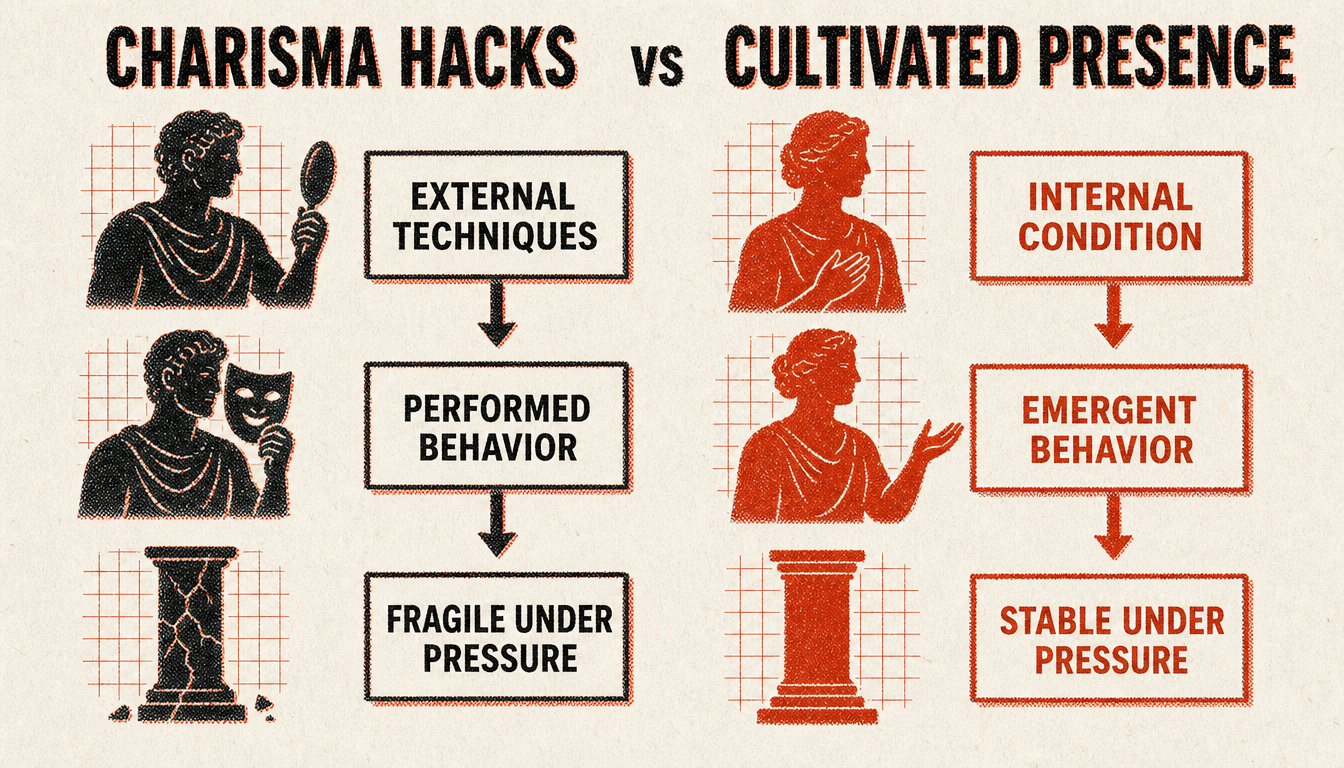
Then the pressure rises. A hostile question in a boardroom. A conflict with a partner who knows you too well to be fooled by a lowered voice. A moment of genuine consequence where the mask slips because the mask was never load-bearing. In these moments, the charisma stack does not just fail. It reveals itself as a stack, and the revelation is worse than having no technique at all.
Three specific failure modes recur.
The Congruence Gap
Humans are exceptional detectors of incongruence between what a person projects and what they feel. When a man performs confidence he does not possess, observers register the mismatch even if they cannot articulate it. They describe him as trying too hard, as slick, as untrustworthy. The techniques amplify the very impression they were meant to hide.
Cognitive Load
Executing a behavioral stack consumes attention. A man tracking his posture, his cadence, his eye contact, and his conversational openers has no bandwidth left for the actual person in front of him. Presence, by definition, requires being present. The stack prevents it.
Fragility
Technique-based confidence has no root system. It works until it does not, and when it fails, the man has no fallback because there was never anything underneath. This is why men who rely on charisma hacks tend to avoid situations that might expose them, gradually shrinking their lives to fit the range where the tricks still function.
The Older Model: Presence as Byproduct
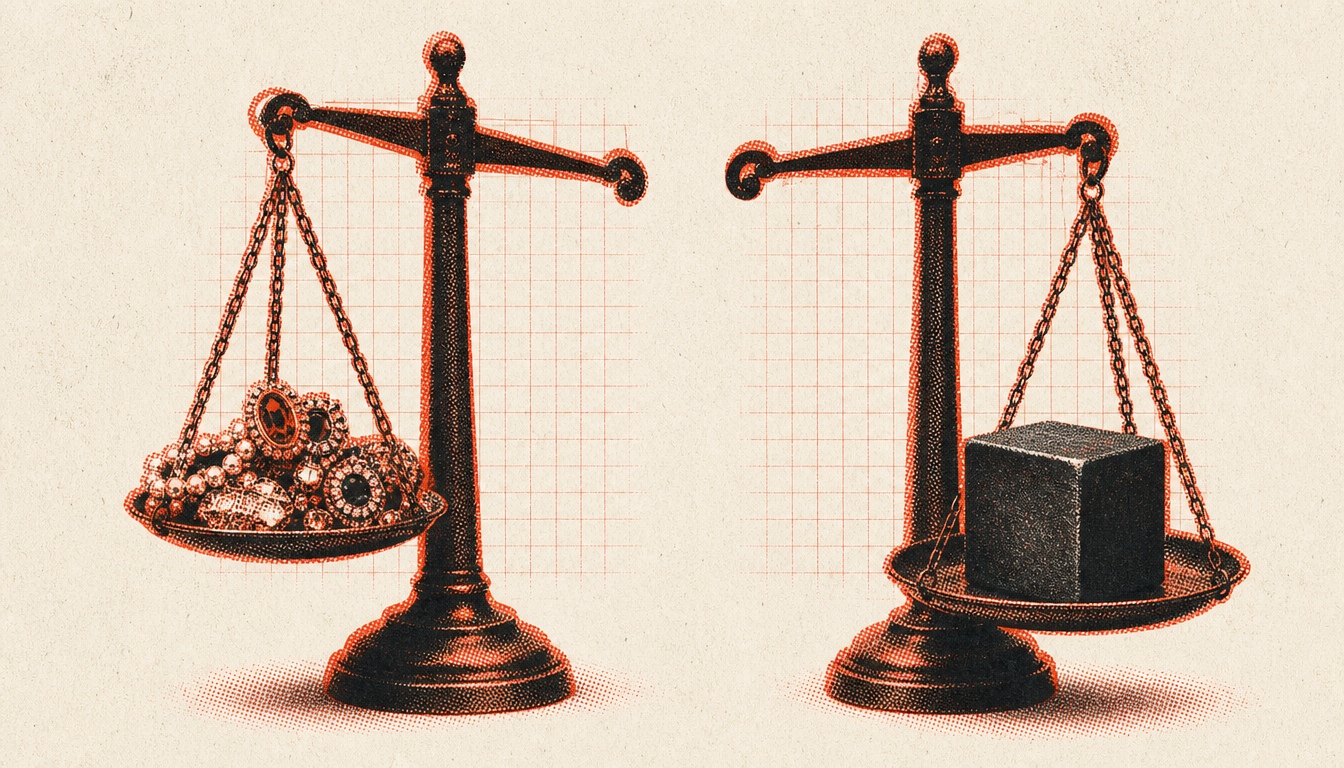
Long before self-development became an industry, philosophers and military traditions taught something different. Presence was understood not as a set of behaviors to acquire but as the natural signature of a certain kind of internal life. The Stoics called it the composed soul. Samurai codes described it as immovable mind. The commonality across traditions is that presence radiates outward from an inner condition, and any attempt to reverse the direction, to install presence from the outside in, produces counterfeit.
The diagram below maps how the two models produce opposite results.
Three foundations recur across every tradition that has taken this seriously.
Foundation One: Settled Relationship With Outcome
The single most reliable generator of social presence in men is genuine indifference to the reaction they provoke. Not performed indifference, which reads as arrogance. Actual indifference, which comes from having built a life whose worth does not depend on the approval of the current room.
This is why senior operators, veterans, and men who have survived real adversity often possess presence without training. They have already been in rooms where the stakes were higher than social approval, and the memory of those rooms recalibrates every subsequent one. The Stoic practice of premeditatio malorum, deliberate rehearsal of loss, is the classical technology for producing this recalibration without needing to lose things first.
A man who has genuinely accepted that he might lose the deal, the relationship, the reputation, and would still be intact, carries himself differently than a man who has not. The difference is legible to everyone in the room within seconds.
Foundation Two: Attention as the Primary Currency
Presence is often described as the ability to hold attention, but this reverses cause and effect. Men who hold attention are usually men who give it fully. The rarest resource in modern life is undivided attention, and a man capable of offering it to whoever is in front of him is offering something most people have not experienced in years.
This has nothing to do with eye contact drills. It is a matter of what a man is actually thinking about while another person speaks. If he is rehearsing his response, monitoring his own performance, or scanning the room for higher-status observers, his attention is fractured and the fracture is visible. If he is genuinely engaged with the substance of what the other person is saying, the eye contact and body language handle themselves.
The discipline here is training the mind to stop performing and start listening. This is harder than any behavioral drill because it requires dismantling the internal narrator that most men have running constantly in social situations.
Foundation Three: Physical Groundedness Earned Through Repetition
The body carries the man's history. A man who has trained hard, lifted heavy things, been cold, been tired, and pushed through it moves differently than a man who has not. This is not about aesthetics. It is about the nervous system's baseline state.
Chronic physical challenge downregulates the fight-or-flight response to social stimuli. A room full of strangers registers as trivial to a nervous system that has processed real physical stress. The man does not have to remind himself to relax his shoulders because his shoulders were never tense to begin with. This is why physical training has been part of every serious tradition of male development, from Spartan agoge to monastic manual labor to military basic training. The body is not separate from the presence. The body is where the presence lives.

The Comparison That Clarifies Everything

Set the two approaches side by side and the choice becomes obvious to any man who has watched both operate over years.
| Dimension | Charisma Hacks | Cultivated Presence |
|---|---|---|
| Source | External techniques applied to behavior | Internal condition expressed through behavior |
| Time to visible effect | Days to weeks | Months to years |
| Performance under pressure | Degrades or collapses | Stabilizes or intensifies |
| Cognitive load in use | High, consumes attention | Low, frees attention |
| Detected as authentic | Often perceived as performative | Registered as real without analysis |
| Compounds over time | Plateaus quickly | Deepens indefinitely |
| Transferable across contexts | Context-specific, brittle | Context-independent, robust |
The charisma approach offers a faster start. The presence approach offers a durable finish. Men optimizing for the first six weeks pick the former. Men building for the next thirty years pick the latter.
Anticipating the Objections
The argument above will provoke reasonable pushback. Three objections deserve direct answers.
Objection One: Techniques Still Help Beginners
True, with a qualification. A man who cannot maintain eye contact at all, who mumbles, who physically shrinks in every interaction, will benefit from basic behavioral instruction. The mistake is treating this remedial floor as the ceiling. Techniques are useful for reaching baseline competence. They are actively counterproductive when treated as the path to genuine presence. Use technique to remove obvious deficits, then abandon technique to build what actually matters.
Objection Two: Some Men Seem to Fake It Successfully
Some men do appear to succeed through pure technique, at least for a while. Politicians, salesmen, certain executives. What is easy to miss is the ceiling on these careers and the private cost. Men who build entire identities on performed presence tend to burn out, hollow out, or eventually meet a room they cannot fool. The visible success cases are survivorship bias. The invisible casualties are numerous.
Objection Three: This Sounds Like Excusing Passivity
The presence-first argument is sometimes read as permission to do nothing, to sit back and wait for internal development to produce external results. This is a misreading. Cultivating presence is more demanding than practicing techniques, not less. It requires physical training, philosophical study, deliberate exposure to discomfort, and honest self-examination. The work is heavier. It just does not look like work to observers because the output is a way of being rather than a set of behaviors.
The Practical Transition: How to Shift Without Losing Ground
Abandoning charisma techniques cold turkey is unwise for a man who has been leaning on them. The techniques, while insufficient, are doing some load-bearing work. The transition is gradual and runs on parallel tracks.
Step One: Audit Your Current Performance Layer
Spend a week noticing what you do socially that is technique rather than expression. The rehearsed openers, the deliberate posture adjustments, the vocal modulation, the strategic pauses. Do not try to stop yet. Just build awareness of how much of your social behavior is performed versus emergent. Most men are shocked by the ratio.
Step Two: Begin the Substrate Work
While maintaining current behaviors, start building the three foundations in parallel.
- Daily physical training that includes genuine intensity. Not a gentle routine. Something that regularly puts you at the edge of what you can handle. This recalibrates the nervous system over months.
- Structured philosophical reading, particularly Stoic texts, focused on the relationship between internal state and external circumstance. Fifteen minutes a day, with a journal. The point is not to accumulate quotes but to gradually reorganize how you interpret social stakes.
- Deliberate exposure to social discomfort without the safety net of techniques. Enter one situation per week where you consciously drop the performance layer and interact from whatever is underneath, even if it is awkward. The awkwardness is the training.
Step Three: Retire Techniques As They Become Unnecessary
As the substrate develops, specific techniques will start to feel absurd. The rehearsed opener will feel like a lie because you no longer need it. The performed eye contact will feel excessive because natural attention has replaced it. Let each technique fall away when it becomes obviously redundant. Do not force the retirement. Trust the process to make certain behaviors unnecessary.
Step Four: Test Under Rising Stakes
Presence built in low-stakes environments does not automatically transfer to high-stakes ones. Deliberately enter progressively harder rooms. Difficult conversations you have been avoiding. Meetings with people who intimidate you. Environments where you are the least experienced person present. Each successful pass without reverting to technique strengthens the substrate.
Step Five: Accept the Timeline
This is a project measured in years, not weeks. The men who have this quality did not acquire it in a quarter. They built it through sustained effort across decades, often without naming it explicitly. Setting realistic expectations prevents the abandonment that comes when quick results fail to appear.
What Actually Changes When Presence Replaces Performance
Men who complete this transition report a set of changes that are difficult to describe in advance but obvious in retrospect.
Conversations become shorter and more consequential. When you are not performing, you say less, and what you say lands harder. People start seeking your input on matters that never came up before because something in your demeanor now suggests you might have something to say.
Certain relationships end. Men who befriended your performance discover they were never friends with you and drift away. This is usually painful in the short term and clarifying in the long term. The relationships that remain are with people who wanted the actual person underneath the show.
Professional dynamics shift. Rooms you used to work hard to influence become rooms you simply occupy. Decisions get made in your direction without you having pushed for them. This is disorienting for men accustomed to overt effort, and some misinterpret it as luck.
Solitude becomes tolerable. The performance model requires an audience. Presence does not. A man who has built the substrate can spend long periods alone without the identity erosion that men dependent on external validation experience. This turns out to be one of the more valuable outputs of the whole project.
The Quiet Point
The self-development market will keep selling charisma techniques because techniques are packageable and presence is not. The demand will keep existing because men in a hurry want the version that can be practiced in a mirror this weekend. Neither the supply nor the demand will disappear.
The men who quietly dominate their fields, their families, and their own inner lives are running a different program. It is older, slower, harder, and largely invisible to those still working the surface. It produces something that cannot be faked and does not degrade under pressure.
The choice comes down to a single question. Do you want to appear to have presence, or do you want to be a man from whom presence is the natural exhaust of how you have built your life? The first path is shorter. The second path is the one that ends somewhere worth arriving.
Which project are you actually working on?