

7 Signs You're Stuck in Performative Masculinity (And How to Exit)

By the end of this article, you will recognize the specific behaviors that signal you're trading authentic strength for a performance, and you'll have a tested framework to dismantle each one. No motivational fluff. Just the diagnostic work most men avoid.
Performative masculinity is the habit of optimizing your behavior for an audience, real or imagined, instead of optimizing it for your character. It feels productive because it generates feedback. It is corrosive because that feedback replaces the inner compass that should govern a serious man.
Prerequisites: What You Need Before Reading Further

This piece assumes you've already moved past surface-level self-improvement. If you're still looking for hacks, this won't land. The men who benefit from this work share a few traits.
- You've consumed enough self-development content to feel its diminishing returns
- You can sit with uncomfortable self-assessment without immediately reaching for a coping mechanism
- You have at least a passing familiarity with Stoic concepts, dichotomy of control, virtue ethics, memento mori
- You're willing to be honest about behaviors you've publicly defended
- You have 30 to 60 minutes weekly to run a structured self-audit
If those check out, the seven signs below will read less like an article and more like a mirror. The exits attached to each one are not generic advice. They are specific interventions you can run this week.
The 7 Signs of Performative Masculinity and How to Exit Each One

Performative masculinity rarely announces itself. It hides inside behaviors that look disciplined, ambitious, or principled. The diagnostic is simple: ask whether the behavior would persist if no one ever found out about it. If the honest answer is no, you've found a performance.
The map below organizes the seven signs by the underlying motive driving them.
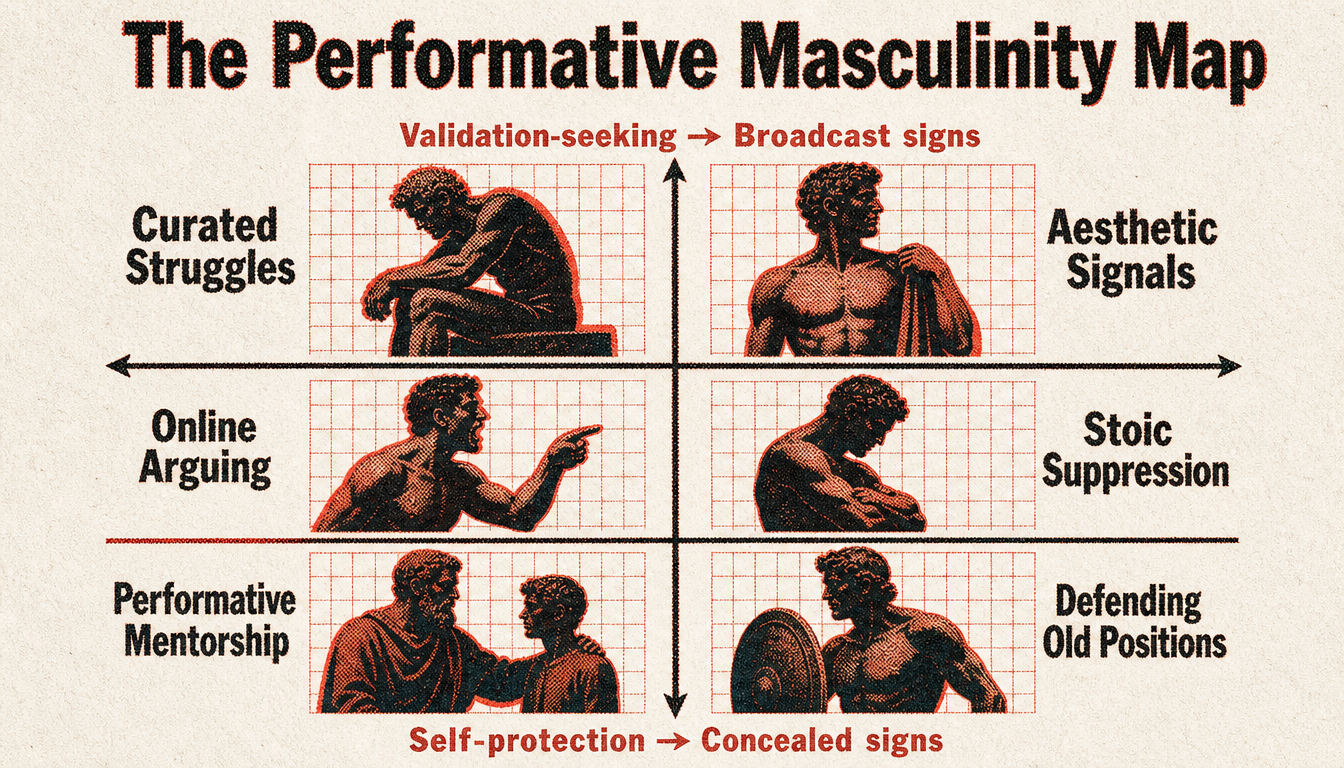
Sign 1: You Curate Your Struggles for Public Consumption
You post the gym selfie after the hard session. You mention the 4:30 AM wake-up in conversations where it doesn't belong. You frame your sacrifices as proof of seriousness. The struggle becomes content before it becomes character.
The Stoics had a term for this: kenodoxia, empty glory. Marcus Aurelius reminded himself repeatedly that the opinion of others is the thinnest possible foundation for a man's worth. When you broadcast your difficulty, you outsource your motivation. The audience now has to keep clapping for you to keep going.
The exit: Run a 30-day silence protocol on one specific area of effort. Train, save, study, build, whatever it is, and tell no one. Notice how quickly the motivation wobbles when no applause is coming. That wobble is the diagnostic. The discipline that survives silence is yours; the rest belonged to the audience.
Sign 2: Your Aesthetic Signals Outpace Your Substance
The watch, the car, the wardrobe, the office setup, the carefully composed bookshelf behind you on video calls. Each item carries a message about who you are. None of them require you to actually be that person.
Aesthetic signaling is not inherently wrong. A man should care how he presents himself. The performative trap is when the curation of signals outpaces the cultivation of the substance they're supposed to indicate. You own the Stoic anthology but haven't finished it. You wear the heritage boots but couldn't change a tire.
The exit: Audit one signal-heavy domain in your life. List every item or behavior in that domain. For each one, write down the underlying capability or virtue it implies. Then rate, honestly, where you actually stand on that capability. Anywhere the gap exceeds two points on a ten-point scale, you have an integrity debt to close before you acquire one more signal.
Sign 3: You Argue Online to Sharpen Your Image, Not Your Thinking
Notice what happens when someone challenges you on a platform. Do you steelman their position privately before responding? Or do you immediately draft the most quotable rebuttal you can manage? If it's the second, you're not debating. You're performing.
This sign is dangerous because it feels intellectual. You're engaging with ideas, supposedly. But the metric you're optimizing for is engagement, not understanding. Over time, this rewires your reasoning. You begin to hold positions because they perform, not because they're true.
The exit: Before posting any argumentative response, write the opposing position in a private note until you can articulate it more persuasively than the person you disagree with. If you can't, you don't yet understand the issue well enough to comment publicly. Most performative men quit after one attempt at this exercise. Don't.
Sign 4: You Confuse Stoicism with Suppression
This one cuts especially close for readers of philosophical self-development. You've adopted the vocabulary, dichotomy of control, amor fati, view from above, but you're using it as armor against your interior life rather than as a tool to examine it. When your wife asks how you feel, you say "it's not in my control." When grief arrives, you intellectualize it away.
Real Stoicism is not emotional suppression. Seneca wept. Marcus mourned. The discipline is in how you respond to emotion, not whether you allow yourself to feel it. The performative version of Stoicism is a costume worn by men who never wanted to do the harder work of integration.
The exit: Each evening for two weeks, write a single paragraph naming the strongest emotion you felt that day and what triggered it. No analysis, no philosophical reframe. Just acknowledgment. You will be surprised how unfamiliar this feels and how quickly it changes your relationship with your inner life.
Sign 5: Your Mentorship Is Really Self-Promotion
You give advice to younger men, but you watch their faces for admiration. You tell stories where you are the protagonist who figured it out. You frame your help in ways that center your competence rather than their growth. This is mentorship as theater.
The test is simple: can you give counsel that makes the other man look better than you in the retelling? Can you let him take credit for an insight you handed him? If those scenarios feel uncomfortable, the mentorship was about you.
The exit: Practice anonymous contribution. Help someone in a way that cannot possibly be traced back to you. Make an introduction without taking credit. Send useful resources from a context-free email. Pay for a stranger's coffee. The point is not the act itself; it is dismantling the reflex to be seen as the helper.
Sign 6: You Defend Positions You No Longer Believe
Somewhere along the way, you took a public stance, on politics, on diet, on a method of training, on a parenting philosophy. New information has since arrived. You can feel the position weakening under your own examination. But you keep defending it because the social cost of changing your mind feels higher than the internal cost of intellectual dishonesty.
This is one of the most expensive forms of performative masculinity. It corrodes your judgment in slow, compounding ways. Every defense of a position you privately doubt teaches your brain that consistency of image matters more than accuracy of thought. Eventually, you can no longer tell what you actually believe.
The exit: Identify one belief you've publicly held for over two years. Write a steelman of the opposing view. If it persuades you even partially, publicly update your position with specificity. Say what changed your mind and how. The short-term social cost is real. The long-term gain in self-trust is incalculable.
Sign 7: Your Ambition Is Calibrated to Be Witnessed
Look at your goals. The big ones. Now imagine you could achieve every one of them, but no one would ever know. Same wealth, same fitness, same accomplishments, but completely invisible to every person whose opinion you currently care about. Does the goal still appeal?
If the answer cools significantly under that condition, your ambition is performative. You're not building a life. You're building a portfolio for an audience. This is the deepest sign on the list because it shapes the entire architecture of how you spend your hours.
The exit: Conduct a private legacy exercise. Write what you would do with the next decade if no one whose opinion you currently weight would ever know any of it. Compare that list to your current goals. The delta between the two reveals exactly how much of your life is being spent on performance versus substance.

A Quick Comparison: Performative vs. Substantive Masculinity

The contrast below isn't theoretical. It's the actual choice point you face in dozens of small decisions each week.
| Dimension | Performative Masculinity | Substantive Masculinity |
|---|---|---|
| Primary audience | External observers | Your own conscience |
| Feedback loop | Likes, status, validation | Quiet competence over time |
| Response to silence | Discomfort, search for audience | Stability, continued effort |
| Treatment of mistakes | Hidden or rebranded | Examined and integrated |
| Mentorship style | Centers the mentor | Centers the protege |
| Goal calibration | Optimized for visibility | Optimized for meaning |
| Emotional life | Suppressed or weaponized | Acknowledged and disciplined |
Most men live somewhere in the middle. The work is not achieving perfect substance overnight; it is migrating one column to the other, one behavior at a time.
Shortcuts: Small Moves That Reveal the Performance

The seven exits above require sustained effort. But several smaller moves can give you immediate diagnostic data on where you stand. These are the kinds of things that take five minutes and produce uncomfortable clarity.
- The phone-down test: When something good happens, can you sit with it for ten minutes before telling anyone? If not, your enjoyment is wired to the broadcast, not the event.
- The clothing inventory: Walk through your wardrobe and identify any item you bought primarily for how others would perceive you wearing it. Awareness alone shifts future decisions.
- The unwritten compliment: Give genuine, specific praise to someone in a private channel where no one else will see it. Notice the resistance.
- The unread bookshelf audit: Count the books you display versus the books you've actually finished. The ratio is a useful proxy for performance-to-substance across other domains.
- The 24-hour opinion delay: When a public event invites hot takes, wait a full day before commenting. Most performative impulses cannot survive 24 hours of patience.
These shortcuts are not the work itself. They are the canaries in the mine. They tell you which sections of the seven signs deserve your concentrated attention.
Application Patterns: Adapting the Framework to Your Context

The seven signs manifest differently depending on the arena of your life. A founder's performative masculinity looks nothing like a corporate executive's, which looks nothing like a tradesman's. The underlying motive is the same; the symptoms are field-specific.
Pattern A: The Builder or Founder
If you run a company or build publicly, your performative tendencies usually concentrate in Sign 1 and Sign 7. The grind narrative, the milestone post, the relentless personal brand. Your exit strategy should emphasize the silence protocol. Build a meaningful piece of your operation, an internal process, a product feature, a team development, that you commit never to publicize. Let it become a category of value that exists only because you decided it should.
Pattern B: The Corporate Operator
If you climb inside an organization, Sign 5 and Sign 6 typically dominate. Mentorship becomes political. Position-defense becomes survival. Your exit work should concentrate on the intellectual honesty exercise. Pick one organizational orthodoxy you've publicly endorsed but privately question. Develop a rigorous private case for the opposing view. You don't need to broadcast the change; you need to know you can still think.
Pattern C: The Independent Professional or Tradesman
If your work is largely solo, Sign 2 and Sign 4 tend to surface most. The aesthetic of the disciplined craftsman becomes a costume. The lone-wolf Stoic becomes a justification for isolation. Your exit work should focus on the emotional acknowledgment practice and the substance audit. Strip one signal-heavy area down to function-only for 90 days and notice what your identity does in the absence of the visual proof.
Across all three patterns, the framework is the same: identify the dominant signs, run the corresponding exit, measure the discomfort, and stay with it long enough for the new pattern to set.
Practice Checklist: Run This in the Next Seven Days
Reading produces nothing. The checklist below converts the framework into actions you can complete this week. Treat it as a minimum viable engagement with the material.
- [ ] Identify which of the seven signs hits you hardest. Write one paragraph explaining how it shows up in your specific life.
- [ ] Choose one domain of effort and commit to the 30-day silence protocol. Tell no one you're doing it.
- [ ] Conduct an aesthetic-versus-substance audit on one signal-heavy area. List the integrity gaps.
- [ ] Write the strongest possible version of an opposing view on a position you've publicly held.
- [ ] Begin the two-week emotion journal. One paragraph nightly. No philosophical reframes.
- [ ] Perform one act of anonymous contribution this week.
- [ ] Run the private legacy exercise. Compare the invisible-success version of your goals to your current ones.
- [ ] Schedule a 60-minute review at the end of week one to assess what shifted.
If you complete even half of this list, you will know more about your relationship to performance than 95 percent of men who have read similar material and done nothing with it.
The Most Important Move: Where to Start Tomorrow
If you read this whole piece and remember nothing else, remember this: the single most diagnostic exit on the list is the silence protocol. Pick one area of effort, train, build, save, study, and commit to 30 days of complete public silence on it. No posts, no mentions, no humble-brags in conversation.
This one practice exposes every other sign on the list. You will feel the urge to broadcast and notice what's underneath it. You will feel motivation flicker in the absence of an audience and learn whether your discipline is yours or borrowed. You will discover whether your ambition can survive invisibility.
Performative masculinity is not a moral failing. It is a default state for men raised in a culture that rewards visibility over virtue. Exiting it is not a one-time decision but a sustained practice of choosing the harder, quieter path each time the easier, louder one presents itself.
The men who do this work do not become more impressive. They become harder to impress. That is the actual marker of substance, and it is available to you starting tomorrow morning, the moment you decide that the only audience worth performing for is the man you'll be in twenty years.