

The Quiet Man Who Built an Empire on Stoic Habits: A Case Study

A man with no natural advantages, no inheritance, and no charisma to speak of built a portfolio of small businesses, a body he no longer hides, and a reputation that walks into rooms before he does. He did it in four years, on a system built entirely from Stoic habits. This is the case study of how a quiet man converted ancient discipline into measurable results.
Call him Marcus, a composite drawn from the kind of man who reads philosophy and still can't get himself to the gym. The details here are illustrative, but the mechanism is real and repeatable. What follows is not a highlight reel. It is a breakdown of the exact levers he pulled and what each one returned.
The Starting Point: A Man Who Knew Everything and Did Nothing

Marcus had read the books. He could quote Marcus Aurelius on the futility of anger and Seneca on the shortness of life. He owned three journals, all blank past the second page. He knew the theory of cold showers, deep work, and delayed gratification better than most men who actually practiced them.
That was the problem. His knowledge had outgrown his behavior by a mile, and the gap between the two had become its own source of shame. Every piece of wisdom he absorbed and failed to act on made him feel weaker, not stronger. He was intellectually rich and behaviorally bankrupt.
The external picture matched. He was thirty-one, mildly overweight, stuck in a job he tolerated, and prone to disappearing in group conversations. He avoided conflict, deferred to louder men, and told himself he was simply reserved. In private he knew it was fear wearing the costume of temperament.
The motivation to change did not arrive as a lightning bolt. It arrived as fatigue. He was tired of being a spectator of his own potential. He decided to stop consuming philosophy and start metabolizing it. The rule he set was simple: no new idea entered his life unless it came attached to a daily action.
The System: Turning Stoic Principles Into Daily Mechanics

Marcus rejected the idea of transformation through inspiration. Motivation was a mood, and moods lie. Instead he engineered a set of habits so small they were almost embarrassing, then defended them with religious consistency. The Stoics gave him the principles. He supplied the mechanics.
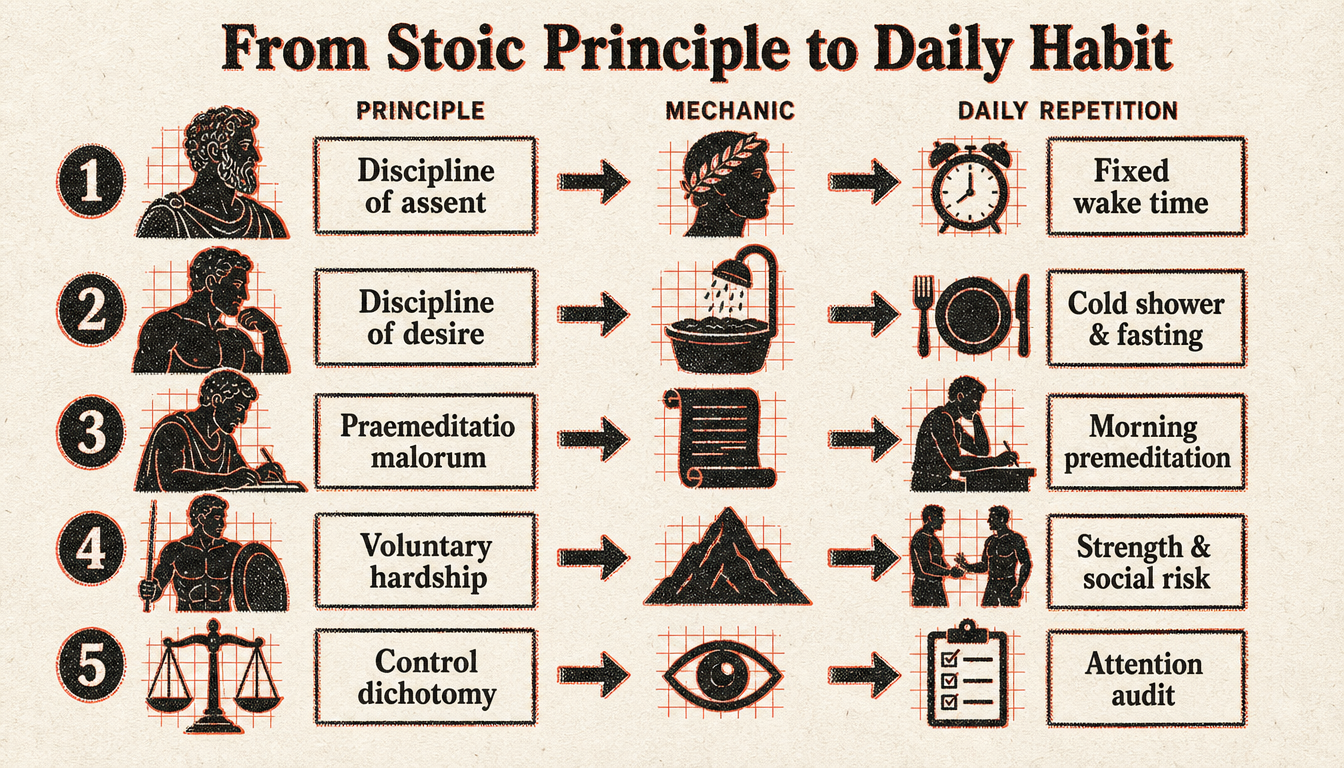
The diagram below illustrates how he translated abstract Stoic virtues into concrete daily practices.
He Built a Morning That He Controlled
The first habit was a fixed wake time, non-negotiable, weekends included. Not because early rising is magic, but because it was the first decision of the day he could win before the world had a vote. The Stoics called this the discipline of assent, the practice of governing what you agree to. His alarm became a daily rehearsal of that discipline.
He added a cold shower, kept short and deliberate. The point was never the cold. The point was doing something his body voted against and doing it anyway. Each morning he collected a small piece of evidence that his will outranked his comfort. Over months, that evidence compounded into a self-image no motivational video had ever given him.
Then came ten minutes of writing. Not gratitude lists. A premeditation of the day ahead, in the Stoic tradition of praemeditatio malorum. He named what could go wrong, who might irritate him, and how a composed man would respond. He was rehearsing his own character before the day tested it.
He Made Discomfort a Scheduled Appointment
Marcus understood that comfort was quietly draining his capacity. So he installed voluntary hardship on a schedule. Three strength sessions a week, chosen for their difficulty rather than their aesthetics. A weekly fast that taught him hunger was a sensation, not an emergency. One genuinely awkward social action per day, whether starting a conversation or stating an unpopular opinion.
Each of these was an application of Seneca's advice to practice poverty and hardship on purpose, so that misfortune, when it arrives, finds you rehearsed. The gym taught him his body could be argued with. Fasting taught him his appetites were negotiable. The daily social risk taught him that the discomfort of being seen faded in seconds and left confidence behind.
He Audited His Attention Like a Ledger
The final pillar was attention. Marcus treated his focus as capital and tracked where it leaked. He removed social media from his phone, not as a detox but as a permanent policy. He worked in ninety-minute blocks of undistracted effort, treating interruption as theft.
Epictetus drew a hard line between what is in our power and what is not. Marcus applied it to his inputs. He stopped consuming outrage news, gossip, and the endless commentary on other men's lives. He redirected the reclaimed hours into a side business, learning skills at night that he could sell by day.
The Results: What Four Years of Stoic Habits Actually Produced

The changes were invisible for the first ninety days, which is precisely why most men quit before them. Marcus kept records, and the records tell a clearer story than any feeling could. Below is the before-and-after across the metrics he tracked most closely.
| Metric | Before | After (4 years) | Change |
|---|---|---|---|
| Body weight / composition | Overweight, avoided mirrors | Lean, trained 3x weekly | Sustained fat loss, visible muscle |
| Income streams | 1 (salaried job) | 3 (job + two businesses) | +200% sources |
| Daily deep work | Under 1 hour, fragmented | 3 focused hours | ~3x output |
| Social presence | Silent in groups | Speaks, leads, disagrees calmly | Qualitative reversal |
| Consistency streak | Days before quitting | Years of daily practice | Durable identity shift |
The financial result gets the attention, but the deeper result was character. Marcus became a man who did what he said he would do, first to himself and then to everyone watching. That reliability was the asset every other outcome grew from.
Why It Worked: The Mechanics Behind the Transformation

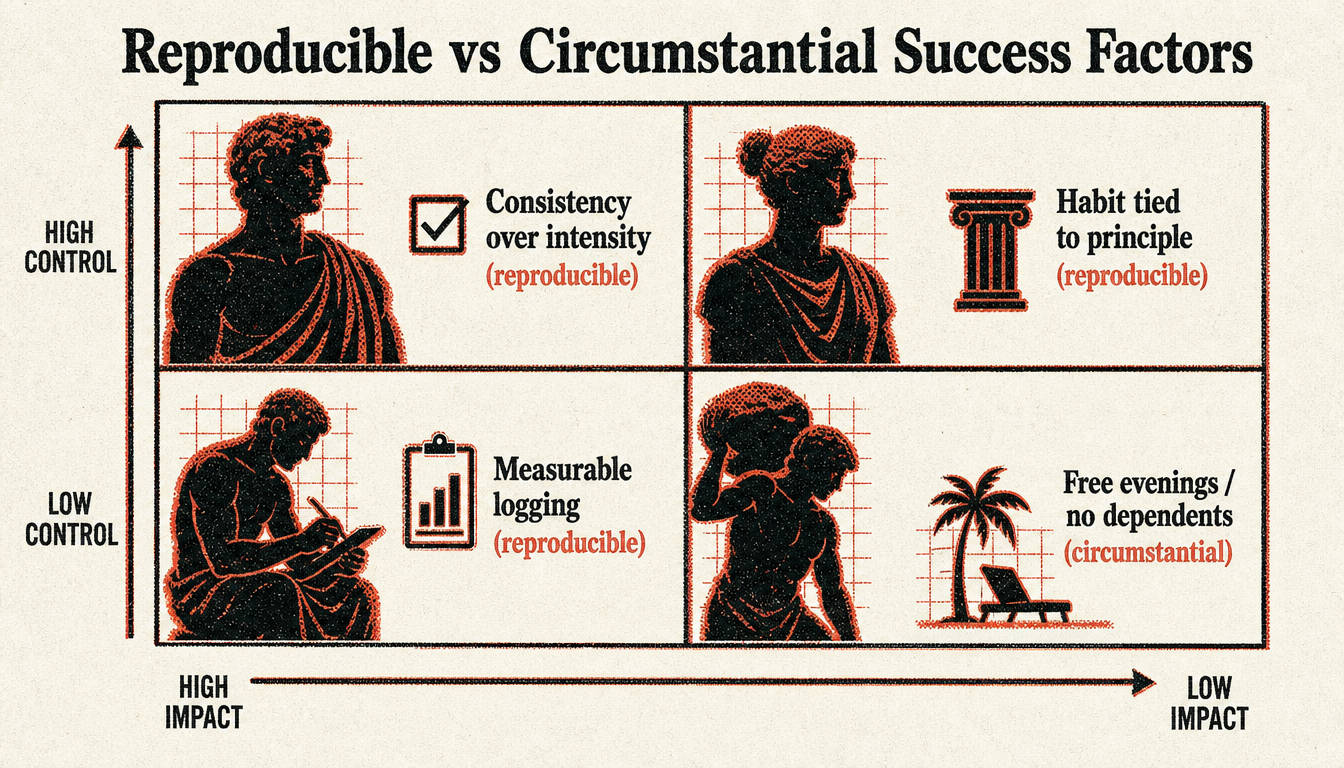
Luck played a smaller role here than the results suggest. Five factors did the heavy lifting, and four of them are fully reproducible. The comparison below separates what any man can copy from what depended on Marcus's specific circumstances.
He Optimized for Consistency, Not Intensity
Most men fail because they design a heroic routine they can sustain for eleven days. Marcus designed a modest routine he could sustain for eleven years. He deliberately kept each habit small enough that a bad day couldn't break it. A ten-minute writing session survives exhaustion. A ninety-minute morning ritual does not.
This is the reproducible core. Consistency beats intensity because compounding requires time, and time requires that you never fully stop. His edge was not doing more than other men on his best day. It was doing something on his worst.
He Attached Every Habit to a Principle
Marcus never did a cold shower for its own sake. He did it as an expression of the discipline of desire. This mattered more than it sounds. When a habit is only a habit, skipping it costs nothing. When a habit represents a value you hold about the kind of man you are, skipping it costs your self-respect. He raised the price of quitting by connecting action to identity.
He Made His Progress Measurable
Feelings are unreliable narrators. Marcus tracked wake times, training sessions, deep work hours, and business income in a plain log. The numbers removed his ability to lie to himself. On days he felt like a failure, the record often disagreed. On days he felt satisfied, the record sometimes exposed drift. Measurement turned vague ambition into a scoreboard he couldn't argue with.
He Chose Discomfort Before It Chose Him
By scheduling hardship, Marcus stopped fearing it. The man who fasts by choice does not panic at hunger. The man who lifts heavy does not fold under physical strain. The man who speaks up daily does not freeze when a real confrontation arrives. He had inoculated himself. Adversity found a man who had already met its smaller cousins many times.
The One Advantage He Didn't Earn
Honesty demands one caveat. Marcus had no dependents in his early years, which gave him free evenings to build. That was circumstance, not virtue. A man with young children and two jobs cannot copy his schedule directly. He can copy the principles, but he must scale the mechanics to his own reality, and he should expect a longer timeline. Pretending otherwise would be a lie the Stoics would despise.
How to Reproduce These Stoic Habits Results in Your Own Life
The value of a case study is only in what you can take from it. Marcus's system was not exotic. It was ordinary practices held together by uncommon consistency. Here is how to begin without repeating the mistakes that stall most men.
Start With One Habit, Not Ten
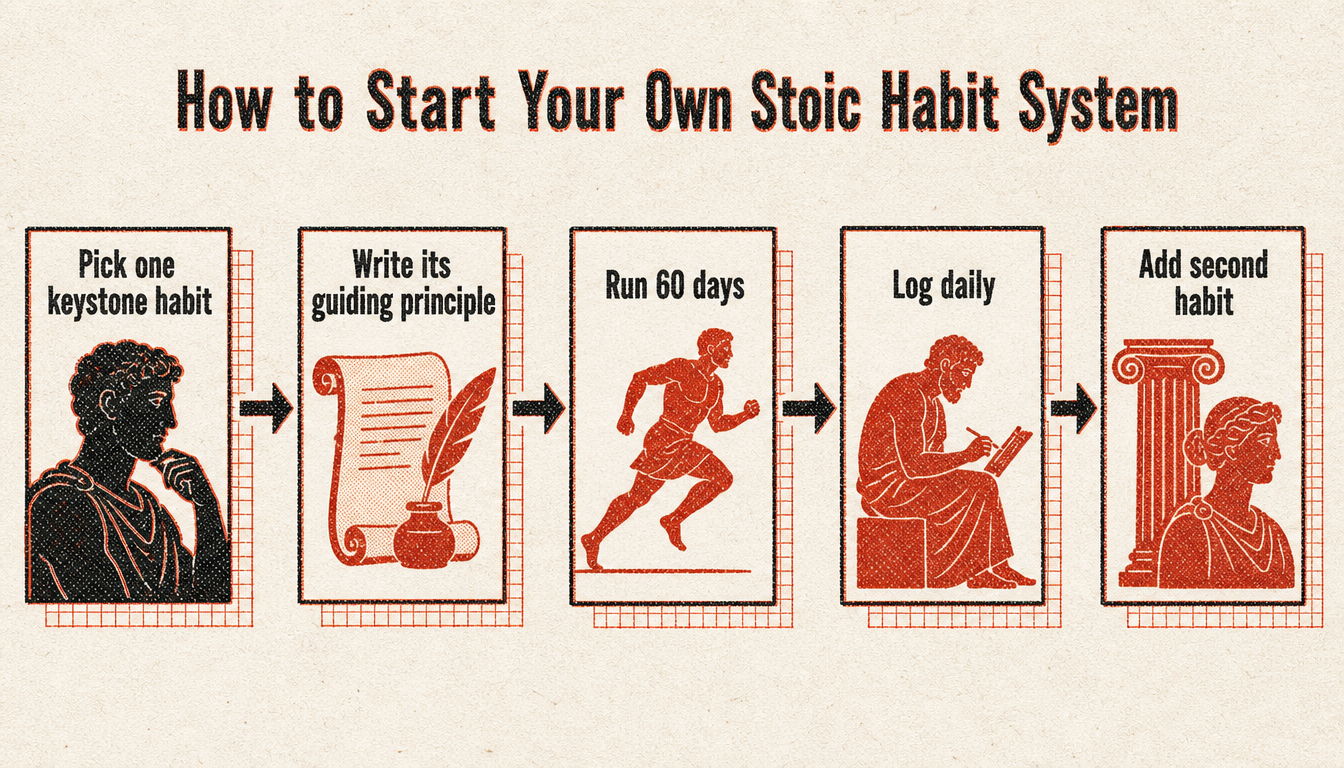
The instinct after reading a story like this is to redesign your entire life by Monday. That instinct has buried more transformations than laziness ever did. Choose a single keystone habit, most likely a fixed wake time or one daily act of discomfort. Run it for sixty days before adding anything. You are not building a routine yet. You are proving to yourself that you keep promises.
Define the Principle Behind the Practice
Before you adopt a habit, write the reason in one sentence. Not the benefit, the principle. "I rise at the same time because I govern my day rather than react to it." This sentence is what you'll reach for when motivation is gone, and motivation will be gone often. The principle is the load-bearing wall.
Keep a Boring, Honest Log
Track your habits in the plainest format you'll actually maintain. A checkmark per day is enough. The log's job is not to impress anyone. Its job is to make self-deception difficult. Review it weekly and ask one question: is the trend line real, or am I telling myself a story?
Adjust the Scale to Your Life
If your circumstances are heavier than Marcus's, shrink the mechanics, not the principles. Ten minutes of deep work still counts. One weekly training session still counts. A single hard conversation a week still builds the muscle. The direction matters more than the volume in the beginning. Volume comes later, once the identity is set.
Conclusion: The Empire Was Built on Ordinary Mornings
Marcus did not win because he found a secret. He won because he stopped waiting to feel ready and started acting like the man he intended to become, in small, daily, unglamorous ways. The businesses, the body, and the presence were downstream of one decision made every morning for years: honor the principle over the mood.
The lesson for any man who knows more than he does is uncomfortable and freeing at once. You already have enough philosophy. What you lack is the discipline to convert one idea into one action, today, and again tomorrow. Choose a single habit. Attach it to a principle you actually believe. Log it honestly. Then let time do the compounding it always does for the men who refuse to quit.
The empire is not built in the grand gesture. It is built in the ordinary morning, defended against your own weaker self, one day at a time.