

I Tried Premeditatio Malorum for 60 Days: Here's What Changed

For 60 days I spent ten minutes every morning imagining the worst parts of my day before they happened. Missed deadlines. A cold response from someone I respect. The slow erosion of a relationship I'd been neglecting. It sounds grim on paper. In practice, it did something no motivational video ever managed: it stopped me from flinching at my own life.
The premeditatio malorum practice, the Stoic exercise of premeditating adversity, is one of those ideas that reads well and gets ignored. I'd known about it for years. I'd quoted Seneca at dinner parties. I had never actually done it with any consistency. This is the record of what happened when I finally did.
Why I Started Rehearsing Disaster on Purpose
I was not in crisis. That was the problem. My life looked functional from the outside, and I'd learned to mistake functional for solid. Work was steady, my health was fine, my relationships were coasting. Underneath that surface I carried a low hum of dread I couldn't name, the feeling that everything I'd built was one bad phone call away from collapse.
Every setback landed like an ambush. A client pushing a deadline sent me into a full afternoon of rumination. A short reply from a friend made me spiral into stories about being disliked. I reacted to small friction as if it were catastrophe, which meant I had no capacity left for actual catastrophe. My reactions were running my day.
I'd read enough Stoic material to know the diagnosis. The problem wasn't the events. The problem was that I met each one unprepared, as if the universe had personally promised me a smooth ride and then broke its word. Seneca's answer was blunt: the unexpected blow lands heaviest. Rehearse the blow, and it loses its power to stagger you.
So I made a rule. Every morning, before checking my phone, I would sit and deliberately imagine what could go wrong that day. Not vaguely. Specifically. I gave myself 60 days, because 30 felt like a trial and 90 felt like a sentence I'd quit on.
What the Daily Premeditatio Malorum Practice Actually Looked Like
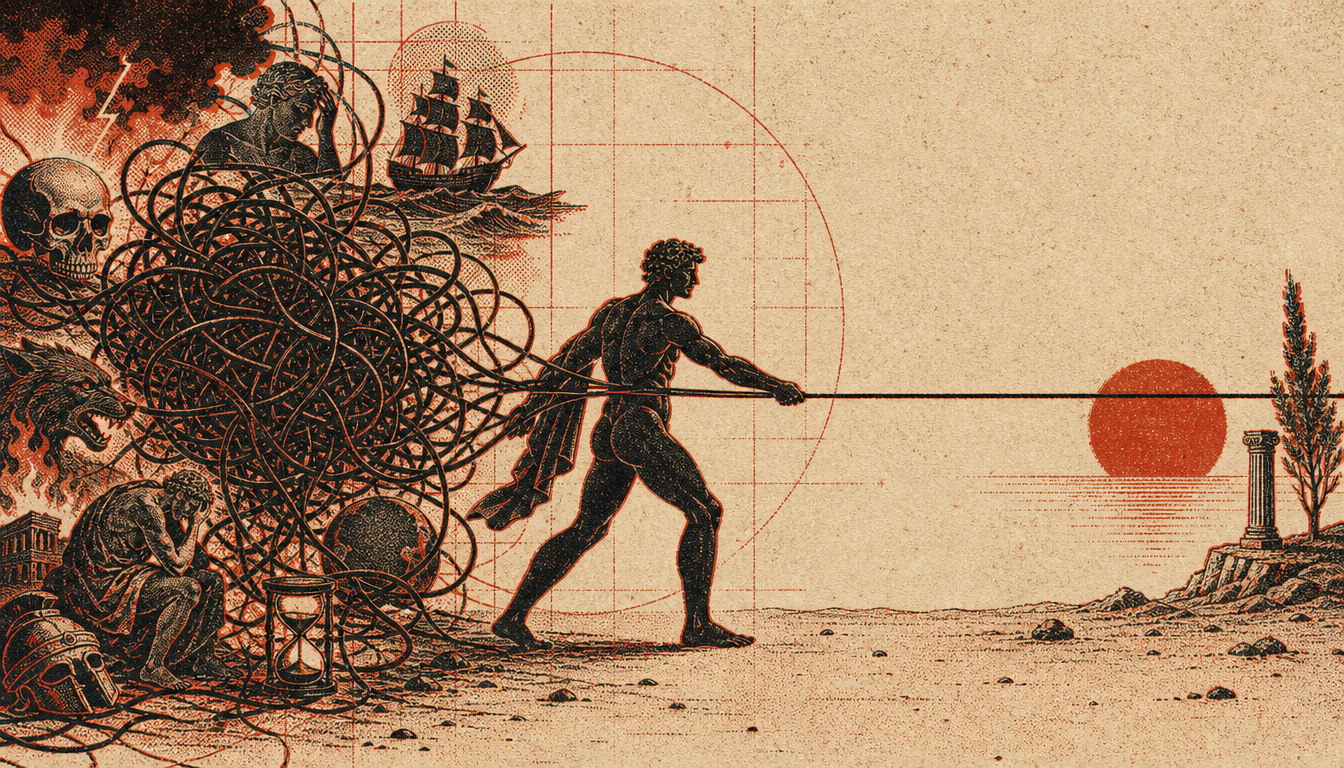
The romantic version of Stoic practice involves candlelight and a leather journal. Mine involved a kitchen chair, a cheap notebook, and a timer set for ten minutes. The point was never the aesthetics. The point was showing up before I'd talked myself out of it.
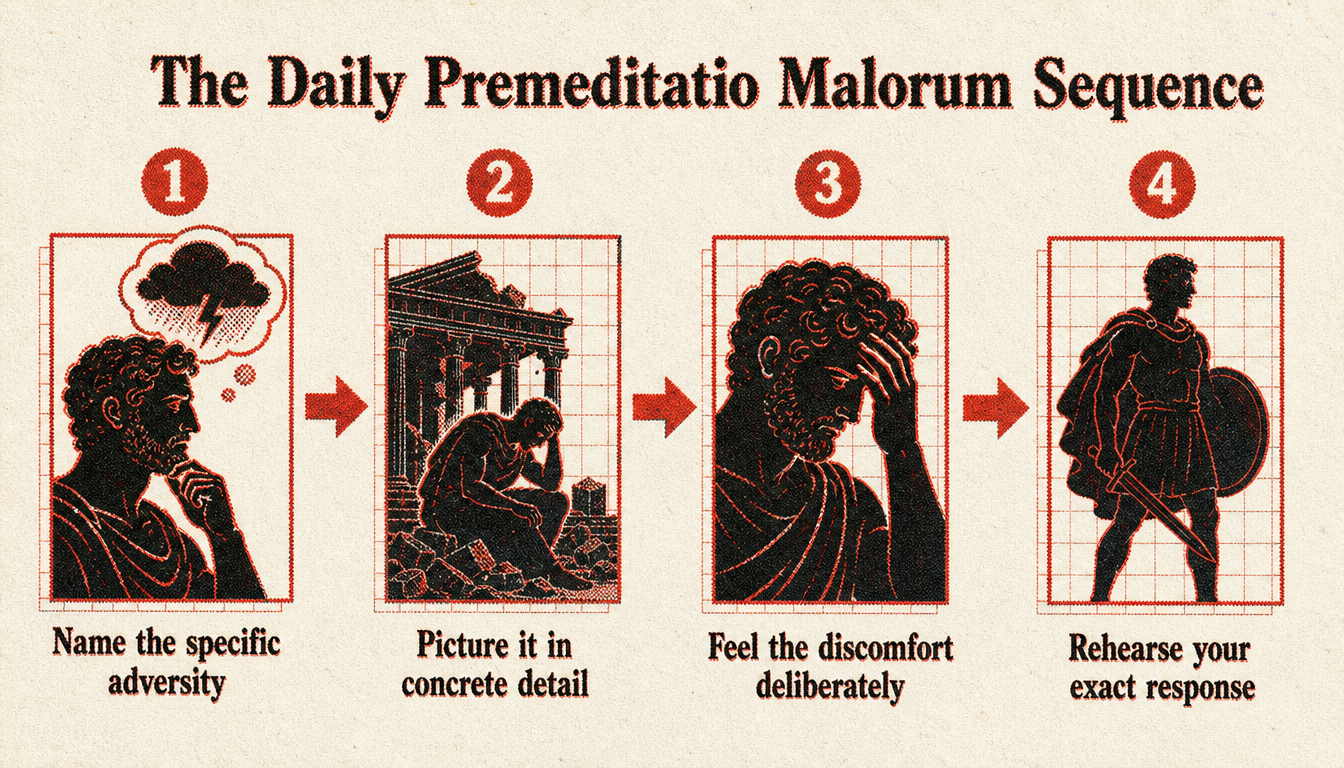
The exercise itself follows a simple arc that I refined over the first two weeks. The diagram below shows the daily sequence I settled into.
Phase One: The Clumsy First Two Weeks
The first sessions were a mess. I sat down, closed my eyes, and my mind went either blank or straight into anxiety. Instead of calmly picturing a difficult meeting, I catastrophized. I imagined getting fired, losing income, my family judging me, the whole doom cascade in thirty seconds flat. That is not the practice. That is a panic attack with a philosophy label.
I learned the difference the hard way. Premeditatio malorum is not worrying faster. Worry loops with no exit. This exercise has a structure: name the specific adversity, picture it in concrete detail, then rehearse your response to it. The response is the entire point. Without it you're just marinating in fear.
By day ten I had a working rhythm. I'd pick one realistic difficulty, a tense conversation with a colleague, say. I'd imagine his exact tone, the pause before he disagreed with me, the heat rising in my chest. Then I'd rehearse staying level. What would I say. How would I breathe. What would I refuse to make it mean about my worth. The dread started to feel less like a threat and more like a drill.
Phase Two: When It Started Working
Around week three, something shifted. A real version of one of my rehearsed scenarios happened. A project I'd led got picked apart in a review. Six weeks earlier that would have ruined my day and probably my week. This time I noticed something strange: I'd already been here. I'd sat with this exact discomfort in a quiet room at 6 a.m. My body didn't spike. I responded instead of reacting.
That single experience did more for my commitment than any amount of reading. The rehearsed adversity had drained the ambush out of the real one. I wasn't calmer because I'd suppressed the feeling. I was calmer because I'd met it before, alone, on my own terms.
From there the practice expanded. I stopped limiting it to the day ahead and started rehearsing larger losses: my health failing, a friendship ending, my career stalling for a decade. Counterintuitively, imagining these did not depress me. It made me grateful for the versions that hadn't happened, and clearer about which ones I actually had power over.
Phase Three: Making It a Reflex
By the final stretch, the formal ten minutes mattered less. The habit had leaked into my whole day. Before walking into any high-stakes moment, I'd run a thirty-second version in my head. Worst plausible outcome, my planned response, the meaning I'd refuse to attach. It became a mental posture rather than an appointment on my calendar.
The Difficulties Nobody Warns You About
Selling this practice as clean and transformative would be dishonest. It has traps, and I fell into most of them.
The biggest was the line between preparation and rumination. Some mornings I could not tell whether I was building resilience or feeding anxiety. On the bad days I'd finish the session more agitated than when I started, having spun the same dark scenario a dozen times with no resolution. I eventually built a hard rule: every imagined adversity must end with a rehearsed response, or the session doesn't count. No response, no exit, no practice. Just fear.
The second difficulty was frequency. Doing this every single day dulled the edge. When every morning was disaster rehearsal, my mind started treating it as routine noise. I learned to vary it. Some days I rehearsed a specific event, some days a large abstract loss, some days I skipped the vivid imagery entirely and just journaled about what I'd take for granted if it vanished.
The third was other people misreading it. When I mentioned the practice to a couple of friends, they heard "negative thinking" and worried about me. That reaction reveals how badly our culture confuses forced optimism with strength. Refusing to look at the downside isn't confidence. It's fragility dressed up as positivity. But I stopped explaining it. The results spoke for themselves in how I carried myself.
How Premeditatio Malorum Differs From Worrying
Because the confusion between the two nearly derailed me, it's worth laying out plainly. These two mental activities can feel identical from the inside while producing opposite results.
| Dimension | Worry / Rumination | Premeditatio Malorum |
|---|---|---|
| Direction | Loops with no endpoint | Moves toward a rehearsed response |
| Focus | The feeling of dread itself | Your concrete action under pressure |
| Control | Fixates on what you can't control | Separates controllable from uncontrollable |
| Duration | Expands to fill available time | Bounded and deliberate |
| Result | Higher anxiety, paralysis | Lower reactivity, readiness |
What 60 Days Actually Changed

The changes were not dramatic in a way that would make a good movie trailer. They were structural, the kind you only notice when you compare who you are now to who you were two months ago.
My reactivity dropped. The gap between a provocation and my response widened. Where I used to snap or sulk, I now had a half-second of space, and half a second is the whole game. That space is where a man decides who he's going to be in a hard moment.
My relationship to control sharpened. Rehearsing bad outcomes forced me to sort every scenario into two piles: what I could influence and what I couldn't. I stopped wasting energy defending against imaginary attacks and started preparing for real ones. The diagram below maps the core shifts I tracked across the two months.
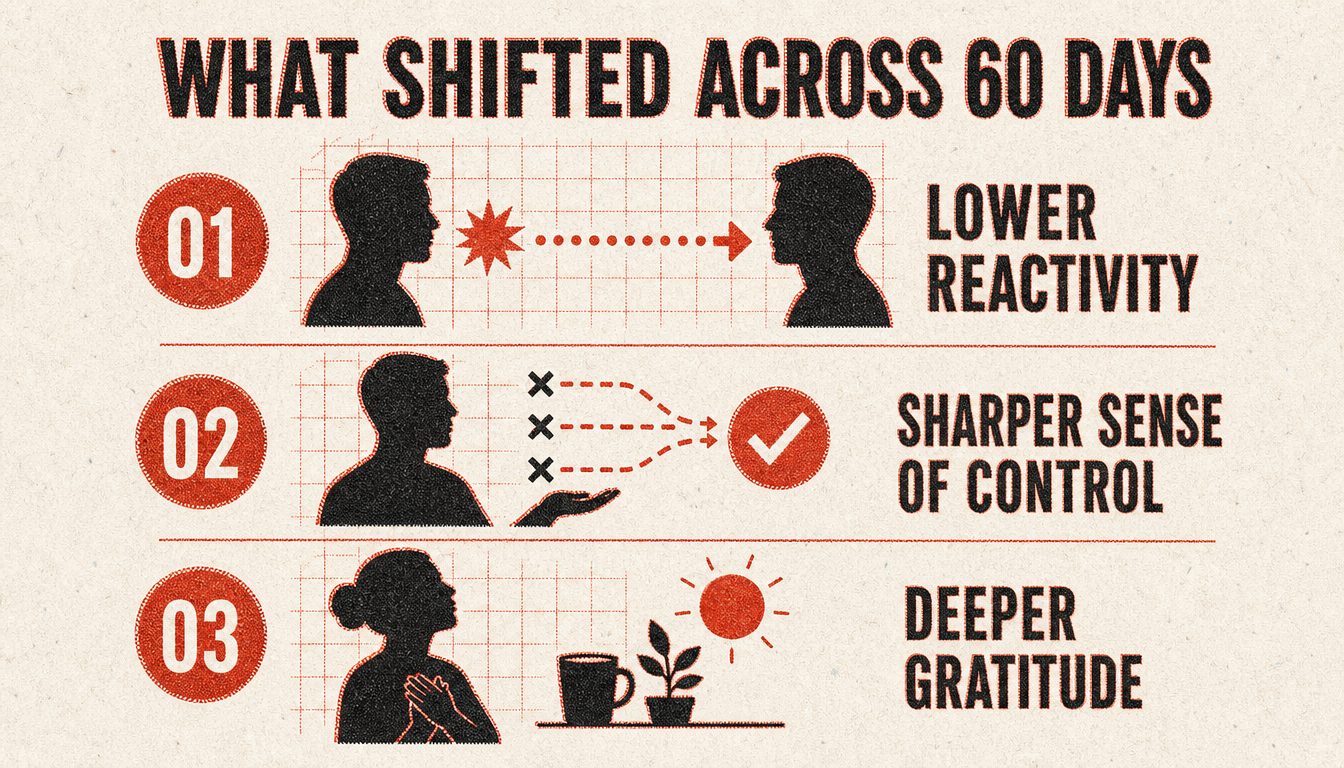
Gratitude showed up as a side effect I never aimed for. When you spend ten minutes imagining your health gone, your working body afterward feels like a gift rather than a given. This isn't the hollow gratitude of listing three things before bed. It's the sharp appreciation that comes from having genuinely, if briefly, lived through the loss in your mind.
The Lessons I'd Tattoo on My Forearm If I Weren't a Coward About Needles
Sixty days produced a handful of durable lessons. Not inspirational quotes. Working principles I still use.
- The response is the practice, not the fear. Every session that ended with a rehearsed action made me stronger. Every one that ended in vague dread made me weaker. When I got discouraged around week four, tracking this distinction is what kept the habit alive.
- Specificity beats intensity. Imagining one precise difficulty, the exact words, the exact face, did far more than imagining vague catastrophe. The mind rehearses what it sees clearly, not what it feels loudly.
- You cannot be ambushed by what you've already met. The single most valuable outcome was that real setbacks stopped landing as surprises. I'd been there before, in the quiet, and that familiarity stripped out the panic.
- Preparing for loss deepens appreciation of what you have. This one blindsided me. I expected the practice to make me grim. It made me grateful, because I stopped treating my ordinary blessings as permanent fixtures.
- Discomfort you choose builds tolerance for discomfort you don't. Voluntarily sitting with imagined adversity each morning raised my baseline tolerance for the involuntary kind. Chosen difficulty is training weight.
Advice for the Man About to Try This
If you're going to attempt a real premeditatio malorum practice, learn from my clumsiness instead of repeating it.
Start small and specific. Do not open with your own mortality on day one. Pick one plausible difficulty from the day ahead, a hard email, an awkward conversation, a rejected pitch, and rehearse only that. Build the muscle before you load the bar.
Set a hard time limit. Ten minutes maximum. The bound is what separates this from rumination. When the timer ends, you stop, whether or not the fear is fully resolved. Resolution isn't the goal. Rehearsal is.
Always finish with the response. This is the rule I wish someone had shouted at me on day one. Name the adversity, see it clearly, then rehearse exactly how you'll meet it. If you skip the response, you're just scaring yourself before breakfast.
Track your reactivity, not your mood. You won't feel transformed day to day. The change shows up in how you handle the next real setback. Keep a short note each time a rehearsed scenario plays out in reality and how you responded. That evidence is what carried me through the weeks when it felt pointless.
If I did it again, I'd vary the practice from the start instead of grinding the same format daily until it went numb. I'd also resist explaining it to skeptics. The practice defends itself through your composure, not your arguments.
The One Thing Worth Remembering
Sixty days of rehearsing disaster taught me something I'd read a hundred times and never understood: composure is not a personality trait you're born with. It's a rehearsed response. The men who stay level under pressure aren't calmer by nature. They've met the difficult moment before, in their own minds, and refused to be ambushed by it.
You already know the concept. You've probably nodded along to Stoic quotes and moved on, the same way I did for years. The gap between you and the version of yourself you keep imagining isn't more knowledge. It's ten deliberate minutes a day, doing the unglamorous work of meeting adversity before it arrives.
Start tomorrow morning. One difficulty, ten minutes, one rehearsed response. Then do it again the day after. That's the whole method, and it changed more for me in two months than a decade of reading about it ever did.