10 Daily Stoic Practices That Compound Into a Disciplined Life

Most men who read Stoic philosophy treat it as intellectual furniture. They quote Marcus Aurelius at dinner, nod at Epictetus on a podcast, and then return to the same reactive, distracted, undisciplined life they had before opening the book. Knowledge without practice is decoration. The men who actually change are the ones who reduced philosophy to a small set of repeatable acts and then ran those acts every day for years.
This article lays out ten daily Stoic practices, ranked and compared, that compound into a disciplined life. The criteria are simple: does the practice produce measurable behavioral change, can it be done in under thirty minutes, and does it survive contact with a bad day?
The Top Three: Where to Start if You Start Nowhere

If you do nothing else from this list, do these three. They are the spine of a Stoic operating system, and every other practice below either feeds into them or extends them.
- The Morning Premeditation — five minutes spent rehearsing the obstacles, irritations, and temptations the day will bring, so none of them ambush you.
- The Evening Review — ten minutes interrogating the day: what did I do well, where did I fail, what will I correct tomorrow.
- The Voluntary Discomfort Block — one deliberate act per day that your softer self would refuse: a cold shower, a fasted morning, a hard conversation, a heavier set.
These three were the practices Seneca, Epictetus, and Marcus Aurelius returned to most often in their writing, and they remain the practices most likely to survive a chaotic week. Everything else compounds on top of them.
How These Practices Were Selected

Self-development content fails men in two predictable ways. It is either abstract to the point of uselessness ("live virtuously") or so granular it becomes a second job ("complete this 47-step morning routine"). The practices in this article were chosen against five evaluation axes:
- Philosophical fidelity (weight: high) — the practice is rooted in primary Stoic texts, not modern reinterpretation.
- Behavioral leverage (weight: high) — small input, large downstream effect on conduct.
- Daily sustainability (weight: high) — can be done on a bad day, on the road, when sick, when busy.
- Compounding effect (weight: medium) — value increases with repetition rather than plateauing.
- Resistance to ego inflation (weight: medium) — the practice humbles rather than flatters the practitioner.
A practice scoring poorly on sustainability was cut even if it scored well on fidelity. The point is a system you actually run, not a system you admire.
The Full Comparison: All Ten Practices at a Glance

The table below sets out every practice in this article side by side. Read it as a menu, then read the detailed sections for the ones that match where you are.
| Practice | Time Required | Primary Benefit | Difficulty | Recommendation |
|---|---|---|---|---|
| Morning Premeditation | 5 min | Emotional pre-armor | Low | ★★★★★ |
| Evening Review | 10 min | Self-correction | Low | ★★★★★ |
| Voluntary Discomfort | 5–30 min | Resilience, hedonic reset | Medium | ★★★★★ |
| The View From Above | 3 min | Perspective, ego deflation | Low | ★★★★ |
| Dichotomy of Control Audit | 5 min | Reduces anxiety, focus | Low | ★★★★★ |
| Memento Mori Reflection | 2 min | Urgency, priority clarity | Low | ★★★★ |
| Negative Visualization | 5 min | Gratitude without sentiment | Low | ★★★★ |
| Daily Reading (10 pages) | 15 min | Mental framework upkeep | Low | ★★★★ |
| The Silent Hour | 60 min | Restoration of judgment | Medium | ★★★ |
| Service Without Recognition | variable | Character, social presence | Medium | ★★★★ |
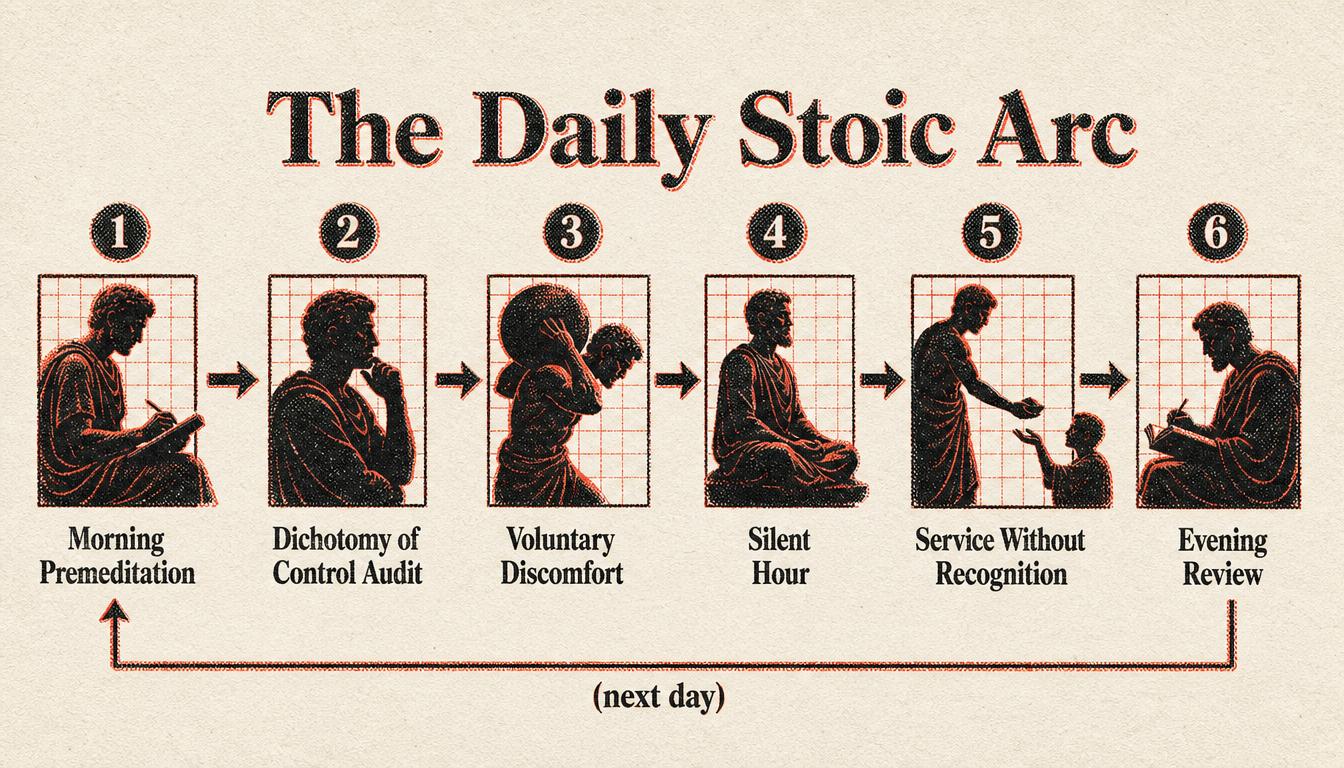
The diagram below illustrates how these practices reinforce one another across the arc of a single day.
The Ten Practices in Detail

What follows is a working manual. Each entry explains what the practice is, why it matters, how to run it, and who should prioritize it. Read with a pen.
1. The Morning Premeditation (Praemeditatio Malorum)
What it is: Before the day begins, you mentally rehearse the friction it will contain. The traffic. The colleague who interrupts. The temptation to skip the gym. The email that will provoke you.
Why it matters: Marcus Aurelius opens Book II of his Meditations with exactly this exercise. He tells himself he will meet the ungrateful, the arrogant, the deceitful, and that none of this should surprise him. Surprise is what converts friction into reactivity. Pre-rehearsed friction has no element of surprise, and therefore little power.
How to run it: Sit for five minutes after waking, before phone or coffee. Name three specific obstacles you expect today. For each, state how the disciplined version of you will respond.
Pros: Immediate effect on emotional volatility. Free. Requires no equipment.
Cons: Can drift into anxious rumination if done without structure.
A man who rehearses his obstacles each morning is rarely defeated by them.
For the man who reacts before he thinks.
2. The Evening Review (Examen)
What it is: A nightly interrogation of the day. Seneca describes it directly in On Anger: he summons himself before himself, examines what he said, did, and failed to do.
Why it matters: Most men never close the loop on their behavior. They live forward without ever auditing backward, which guarantees the same mistakes recur for decades. The review converts experience into data and data into correction.
How to run it: Ten minutes before sleep. Three questions: Where did I act according to my values? Where did I fail? What specifically will I do differently tomorrow? Write the answers. Memory is unreliable; ink is not.
Pros: The single highest-leverage practice for accelerating self-knowledge.
Cons: Easy to skip when tired. Requires honesty most men avoid.
For the man who repeats the same mistakes and cannot explain why.
3. Voluntary Discomfort
What it is: One deliberate, scheduled act of discomfort per day. A cold shower. A fasted morning until noon. Sleeping on the floor for a week. Walking instead of driving. Lifting heavier than you want to.
Why it matters: Seneca recommended periodic poverty in Letters to Lucilius: a few days each month of plain food and rough clothes, so that comfort is never mistaken for entitlement. The modern man drowns in convenience, and convenience is the slow corrosion of his will.
How to run it: Pick one act per day. Make it non-negotiable. Rotate the modality so the body and mind don't adapt into another comfort.
Pros: Builds physical resilience and a calibrated relationship to ease.
Cons: Can become performative or ego-driven if not done quietly.
For the man whose life has become too soft to recognize.
4. The View From Above
What it is: A brief contemplative exercise where you imagine yourself rising above the scene of your life. Your room, your city, your continent, the planet. You see your problems at scale.
Why it matters: Marcus used this constantly. The view dissolves the felt importance of small grievances. You return to your desk lighter, with proportion restored.
How to run it: Three minutes, eyes closed, when stress spikes. Picture the zoom out. Hold it. Return.
Pros: Effective acute intervention for anger or panic.
Cons: Less useful as a standalone daily anchor; better as a tool.
For the man who loses proportion in the heat of the day.
5. The Dichotomy of Control Audit
What it is: Epictetus opens the Enchiridion with the foundational distinction: some things are in our power, others are not. A daily audit asks, of every concern occupying your mind, which side of the line it falls on.
Why it matters: Most anxiety is energy spent on the wrong side of the line. The audit reassigns that energy to actions you can actually take.
How to run it: Five minutes mid-morning. List your current worries in one column. Mark each as "in my control" or "not in my control." For the first group, identify the next action. For the second, release.
Pros: Dramatically reduces anxious looping. Sharpens focus.
Cons: Requires the discipline to actually release what you've marked as outside your control.
For the man whose mind churns on problems he cannot solve.
6. Memento Mori
What it is: A short, daily reminder that you will die, and so will everyone you love.
Why it matters: Not morbidity. Calibration. A man who forgets death wastes hours on trivia and postpones the conversations that matter. Marcus reminded himself constantly that he could leave life at any moment, and let that direct his conduct.
How to run it: Two minutes in the morning. Ask: if today were the last, what would I refuse to leave undone? Then do that thing first.
Pros: Cuts through procrastination faster than any productivity system.
Cons: Loses force if rushed or treated as a slogan.
For the man postponing the life he claims to want.
7. Negative Visualization
What it is: Briefly imagine losing what you currently have. Your health. Your wife. Your job. Your sight.
Why it matters: Gratitude built on slogans evaporates. Gratitude built on the felt sense of loss is durable. The Stoics used this to inoculate themselves against entitlement.
How to run it: Five minutes weekly is enough, but a thirty-second version daily is better. Pick one possession or relationship. Imagine it gone. Return to the day.
Pros: Produces real gratitude, not performative gratitude. Strengthens relationships.
Cons: Can become melancholic if overdone.
For the man who has more than he appreciates.
8. Daily Reading of Primary Texts
What it is: Ten pages a day of Marcus, Seneca, or Epictetus. Not commentary. Not summaries. The source.
Why it matters: A framework decays without exposure to its original voice. Modern paraphrase smooths off the rough, useful edges. The primary texts confront you in a way that aggregated content does not.
How to run it: Fifteen minutes, same time each day. Underline. Return to the same passages quarterly.
Pros: Builds a mental library that surfaces precisely when needed.
Cons: Slower payoff than the active practices.
For the man whose principles dissolve under pressure.
9. The Silent Hour
What it is: One hour per day with no input. No phone, no music, no podcast, no conversation. Walking, sitting, or working with the hands.
Why it matters: Judgment requires silence to form. A man who consumes content from waking to sleeping has no internal voice left, only echoes of other men's voices.
How to run it: Carve the hour deliberately. Morning walk, evening sit, lunchtime drive without audio. Protect it like a meeting.
Pros: Restores original thought. Improves decision-making across every domain.
Cons: The hardest practice to defend in a noisy life.
For the man who cannot remember the last opinion he formed alone.
10. Service Without Recognition
What it is: One act per day done for another person, with no expectation or possibility of credit. Anonymous if possible.
Why it matters: Marcus repeatedly reminded himself that the good man does the work and moves on, like a vine that bears grapes and seeks nothing further. Service without recognition is the cleanest test of character: are you doing it because it is right, or because someone is watching?
How to run it: Identify the act in advance. Execute. Tell no one. Move on.
Pros: Builds a quiet strength visible to others without ever being announced.
Cons: Requires real maturity; otherwise you'll find subtle ways to leak the news.
For the man whose virtue has become a brand.
Which Practices Suit Which Man

Not every practice belongs at the front of every man's queue. Use the table below to find the right entry point based on the gap you actually have, not the gap you wish you had.
| Situation / Goal | Start With | Why |
|---|---|---|
| You react emotionally and regret it | Morning Premeditation + View From Above | Removes the element of surprise; restores proportion in the moment |
| You repeat the same mistakes | Evening Review | Closes the feedback loop most men leave open |
| Life has become too comfortable | Voluntary Discomfort + Memento Mori | Reintroduces friction and urgency |
| You feel anxious about uncontrollable events | Dichotomy of Control Audit | Reassigns energy to the actionable side of the line |
| You consume content but don't change | Daily Reading + Silent Hour | Replaces echo with original judgment |
| Your relationships feel transactional | Negative Visualization + Service Without Recognition | Rebuilds gratitude and character beneath the relationships |
Pick one. Run it for thirty days before adding a second. The trap is bundling six practices on day one, abandoning all of them by day ten, and concluding that Stoicism doesn't work. Stoicism works. Bundling doesn't.
How These Practices Compound
Daily stoic practices are not a checklist. They are an architecture. The morning premeditation feeds the dichotomy audit, which feeds the evening review, which sharpens tomorrow's premeditation. Voluntary discomfort makes memento mori felt rather than abstract. Daily reading keeps the language of the framework alive in your head, which makes the silent hour productive rather than vacant.
The first thirty days produce noticeable change: less reactivity, better sleep, cleaner decisions. The first year produces structural change: relationships improve, work output rises, the people around you sense a difference they cannot quite name. The first five years produce a different man. Not a louder one. A heavier one. The kind of man whose presence in a room shifts the room without him saying anything.
This is the legacy compounding the Stoics were after. Not a memorable quote on a calendar. A character so thoroughly built that nothing in the world easily moves it.
Summary and the Way In
The ten practices in this article are not equal, and you should not treat them as such. If you are starting from zero, the answer is unambiguous:
- Begin with the Morning Premeditation, the Evening Review, and one act of Voluntary Discomfort. These three carry most of the weight.
- Add the Dichotomy of Control Audit in week two if anxiety is a primary obstacle.
- Add Daily Reading in week three to anchor the framework in the source.
- Layer the remaining practices over the following months, one at a time, only after the prior layer is automatic.
Three principles to govern the system:
- Consistency beats intensity. A five-minute review run for a year outperforms a two-hour retreat run once.
- Quiet beats announced. The practice you broadcast is the practice you've already corrupted.
- Correction beats perfection. You will miss days. The Stoic move is to resume without ceremony, not to start over on Monday.
A disciplined life is not built on a decision. It is built on a small number of acts, repeated past the point of motivation, until they become the man rather than the routine. Pick one practice. Run it tomorrow. Then run it the day after. The compounding starts there.