

The Morning Routine That Builds Unbreakable Masculine Discipline
By the end of this article, you will have a structured masculine morning routine grounded in Stoic principles, one you can execute tomorrow to build the kind of discipline that survives bad moods, bad weather, and bad news. You will know exactly what to do in the first ninety minutes after waking, why each element matters, and how to defend the routine when life pushes back.
Most morning routine advice fails because it treats mornings as a productivity hack. What follows treats mornings as character formation. The difference is the difference between a man who performs discipline when convenient and a man who has become disciplined.
Prerequisites: What You Need Before You Begin

This framework assumes you already understand that motivation is unreliable and that consistency compounds. If you are still chasing hacks, stop here and address that first. Read Marcus Aurelius. Sit with the idea that no one is coming to save you.
To execute the routine, you need the following:
- A fixed wake time you can hold seven days a week, weekends included
- A bedroom arranged so your phone is not the first thing you touch
- A journal and a pen kept where you wake up, not in another room
- Clothes for training laid out the night before
- Cold water access, whether a shower, a tub, or an outdoor hose
- Roughly ninety minutes of protected time before your first obligation
The audience for this piece is men with at least a few years of adult responsibility, men who have tried and abandoned routines before, and men who suspect the problem was not the routine but the framework beneath it. If you are still building basic self-awareness, this will feel heavy. If you are ready to structure what you already know, it will feel like relief.
The Philosophy Behind a Masculine Morning Routine

A masculine morning routine is not a checklist. It is a daily rehearsal of the kind of man you claim to be. The Stoics called this praemeditatio, the deliberate preparation of the mind before the day tests it. Marcus Aurelius opened his day by reminding himself he would meet ungrateful, arrogant, and dishonest men. He did not do this to be cynical. He did it to be unshakeable.
The reason most routines collapse is that they optimize for feeling good. A masculine routine optimizes for becoming useful, resilient, and clear. Feeling follows.
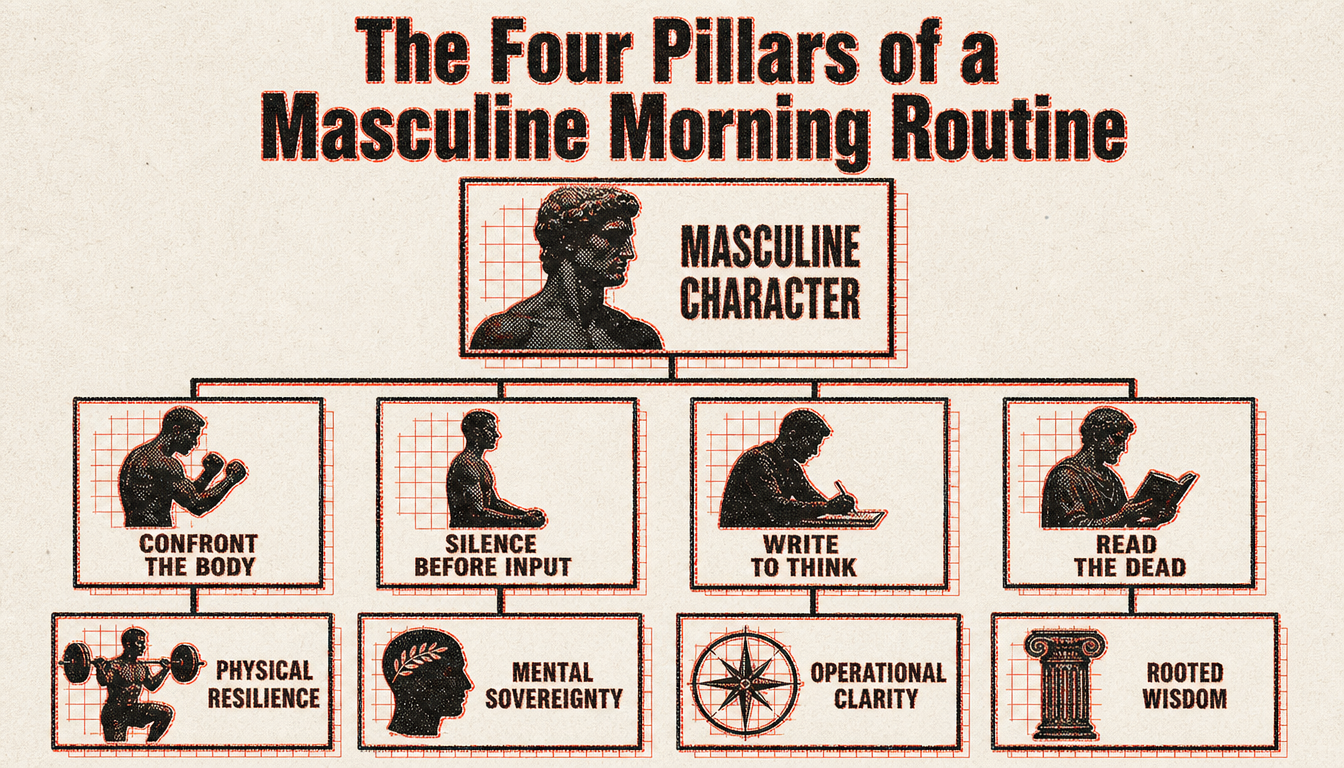
The diagram below illustrates how the four pillars of the routine map to distinct dimensions of character.
Discipline is not what you do when you want to. It is what you do when you do not want to, executed as if you did. The morning is the first negotiation of the day, and every skipped session teaches your nervous system that your word to yourself is optional.
The Four Pillars of the Routine

The routine has four pillars, executed in order. Each pillar addresses a specific weakness modern men carry: softness of body, softness of mind, absence of reflection, and absence of purpose. The order matters. Reversing it produces a lesser man.
Pillar One: Confront the Body
The first action after waking is a physical demand your body would rather avoid. Not a stretch. Not a slow amble to the coffee machine. A demand. Push-ups until you feel your heart working, a cold shower held past the point of protest, or a set of kettlebell swings that leaves you breathing hard.
The purpose is not fitness. Fitness is a byproduct. The purpose is to win the first argument of the day: the argument between the part of you that wants comfort and the part of you that has decided who you are. When you win that argument at six in the morning, every subsequent argument that day starts with your foot on higher ground.
Cold exposure earns particular attention here. The involuntary gasp, the desire to step out, the mental narration begging for warmth: this is anxiety in miniature, and learning to sit inside it teaches you to sit inside larger discomforts later. A man who cannot tolerate ninety seconds of cold water will not tolerate a difficult conversation with his boss, his wife, or himself.
Pillar Two: Silence Before Input
After the body, the mind. Before you consume anyone else's thoughts, spend time with your own. This means no phone, no news, no podcast, no email. Ten to twenty minutes of deliberate silence.
You can sit in meditation, you can walk, you can drink coffee facing a window. What you cannot do is let another voice into your head before your own voice has spoken. The modern man's greatest cognitive theft is the surrender of his first waking thoughts to algorithms designed by strangers to profit from his attention.
The Stoics practiced praemeditatio, a morning meditation on what the day would demand and how a good man would meet it. You can do the same. Ask yourself three questions: What is likely to test me today? Who do I intend to be when it does? What would I regret if I died this evening?
Pillar Three: Write to Think
Journaling is not therapy. It is command and control. A man who cannot articulate his intentions on paper cannot execute them under pressure. Ten minutes with a pen is worth an hour of thinking without one, because writing forces the vague to become specific.
Keep it structured. Three sections work well:
- The obstacle: What will most likely pull me off course today?
- The virtue: Which of the four cardinal virtues, wisdom, courage, justice, temperance, does today require most?
- The measure: By what specific action will I know, tonight, that I lived by that virtue?
This is not aspirational writing. It is operational. You are giving yourself orders.
Pillar Four: Read the Dead
Finish with fifteen to thirty minutes of reading from a source older than you. Ideally, older than your country. Seneca, Epictetus, Marcus Aurelius, Musonius Rufus, or if you prefer another tradition, the Bhagavad Gita, the Analects, Ecclesiastes. Books that have survived centuries were preserved for a reason. They contain what modern content cannot: the weight of consequence.
Read slowly. A single paragraph considered carefully outperforms ten pages consumed quickly. The goal is not to finish the book. The goal is to let the book finish something in you.

The Ninety-Minute Structure in Practice

Here is how the four pillars fit into a ninety-minute window. Adjust the times to your schedule, but keep the sequence.
| Time | Activity | Purpose |
|---|---|---|
| 0-5 min | Wake, feet on floor, no phone | Reclaim first agency |
| 5-25 min | Physical training or cold exposure | Win the first argument |
| 25-40 min | Silence, meditation, or slow coffee | Protect internal voice |
| 40-55 min | Structured journaling | Convert intent to command |
| 55-90 min | Reading from classical text | Anchor in older wisdom |
Notice what is absent: news, social media, email, television, and casual conversation. These enter later, once your mind has been set. A man who begins his day inside other men's frames spends his day inside them.
Why This Order Cannot Be Reversed
The sequence moves from body to breath to pen to page, from most physical to most abstract. This mirrors how attention actually rebuilds after sleep. Trying to journal before training leaves you sluggish and vague. Trying to read before silence leaves you consuming without processing. The body opens the mind. Silence organizes it. Writing sharpens it. Reading feeds it.
The Modern Traps That Break the Routine

Most men who attempt a routine like this fail within three weeks. The failures follow predictable patterns.
Trap One: The Phone Reach
The first hand movement upon waking determines the tone of the day. If the hand reaches for the phone, the day belongs to whoever runs the apps. Put the phone in another room. If you use it as an alarm, buy a separate alarm clock. This is not extreme. It is basic hygiene.
Trap Two: Weekend Amnesia
A five-day routine is a five-day habit. A seven-day routine becomes character. The weekend collapse is where most self-development dies, because the man who trains Monday through Friday and drifts on Saturday teaches himself that discipline is a role he plays, not a self he is.
Trap Three: The Optimization Spiral
Some men, upon finding a working routine, cannot stop tinkering with it. They add supplements, then breathwork protocols, then infrared devices, then a new journaling method they read about. The routine bloats past ninety minutes into three hours, becomes impossible to sustain, and collapses. Then they blame the routine.
Keep it lean. The four pillars are enough. Add nothing until you have executed the base for ninety consecutive days.
Trap Four: Motivation Dependency
You will have mornings when you do not want to do any of this. These are the mornings that matter most. The routine executed only when you feel like it is not a routine. It is a mood. Men are built on the days they act against their mood.
Coaching Notes and Ground-Level Tactics
After teaching this framework to men across professions, a few small adjustments consistently separate the men who stick with it from the men who don't.
- Lay out clothes and gear the night before. Every decision you push to the morning is a decision your tired brain will lose.
- Use the same chair, same corner, same cup. Environmental cues do enormous work. Do not underestimate ritual anchoring.
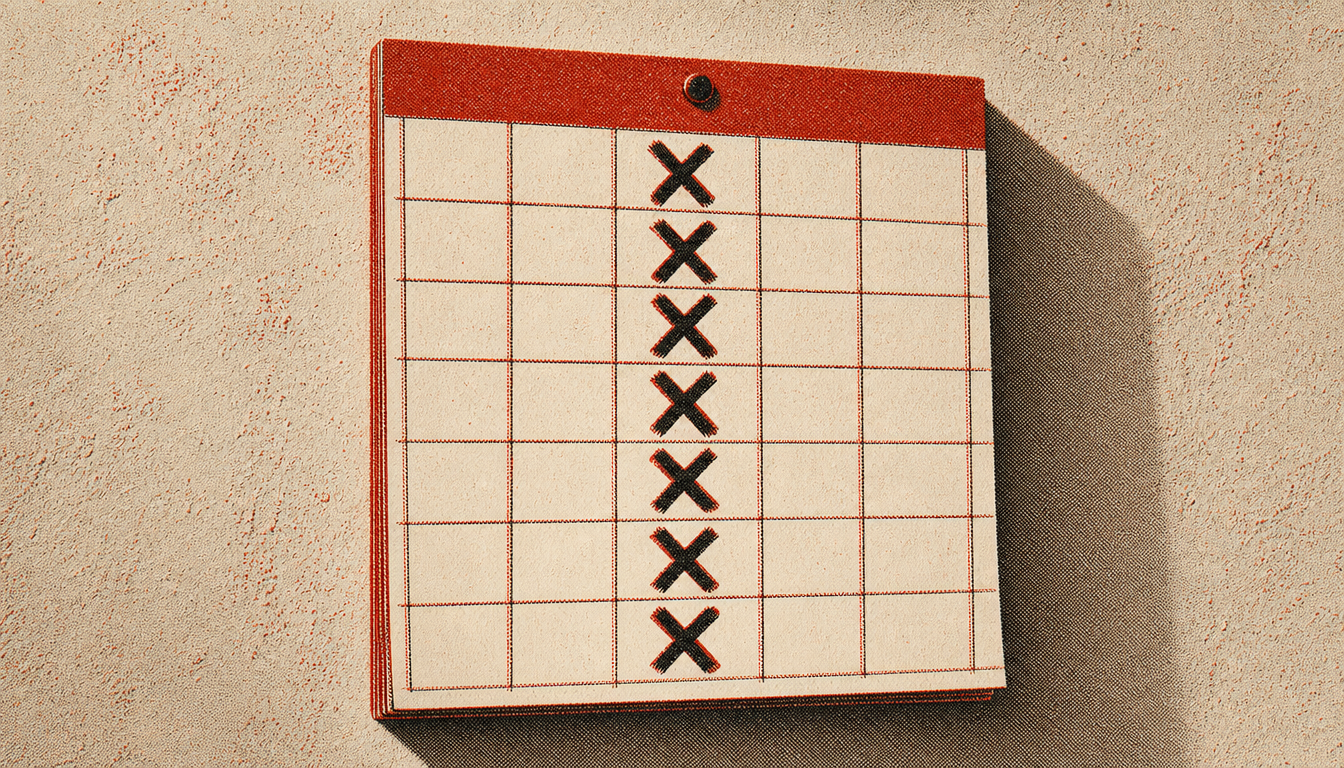
- Track compliance, not perfection. A wall calendar with an X for each completed morning is more motivating than any app. Do not break the chain.
- If you miss a day, do not double up. Simply execute the next morning. Compensating breeds guilt cycles and abandonment.
- Announce nothing. Do not tell friends, post about it, or seek validation. Public performance leaks the private force that discipline requires.
- Sleep is part of the routine. A masculine morning is built the night before. A fixed bedtime is not optional.
- Do the routine when traveling. A compressed version, twenty minutes total, is better than skipping. The point is unbroken identity.
Adapting the Routine to Your Season of Life
The base framework holds, but the emphasis shifts depending on where you are in life. A single man in his late twenties has different obligations than a father of three in his early forties. Both need discipline. Both need the four pillars. What changes is proportion.
The Young Professional
If you are in your late twenties, unmarried, and building a career, weight the physical and reading pillars heavily. This is your capacity-building decade. Train hard, read wide, and use journaling to clarify what kind of man you are constructing. The temptation at this stage is diffusion, chasing every opportunity. The routine anchors you.
The Family Man
If you have young children, the ninety-minute window may be impossible in one block. Split it. Physical training and cold exposure before the house wakes, silence and journaling with coffee, reading at lunch or before sleep. The sequence matters more than the continuity. What you must protect is the first physical demand and the phone-free opening. Everything else can flex.
The Man in Transition
If you are between jobs, recovering from a divorce, grieving, or otherwise unmoored, the routine becomes structural scaffolding. In these seasons, execute the routine even when it feels pointless, especially when it feels pointless. The routine is not producing outcomes right now. It is preserving the man who will produce outcomes later.
The Established Man
If you are past forty with career and family in place, the risk is comfort. The routine becomes a hedge against the slow decay that ambushes men who stop demanding anything of themselves. Increase the difficulty of the physical pillar, deepen the reading, and use journaling to interrogate whether you are still building or merely maintaining.
The Implementation Checklist
Before your first execution, walk through this list. Do not skip items. The routine's early days depend on frictionless setup.
- [ ] Fixed wake time selected and set for seven days a week
- [ ] Phone relocated to a room other than the bedroom
- [ ] Non-phone alarm clock acquired and tested
- [ ] Journal and pen placed within arm's reach of the bed
- [ ] Training clothes laid out the night before
- [ ] Cold water source identified and accessible
- [ ] Classical text selected and placed in reading spot
- [ ] First-morning obstacle identified in writing
- [ ] Bedtime set to allow at least seven hours of sleep before wake time
- [ ] Wall calendar or paper tracker prepared for compliance marking
- [ ] Ninety-day commitment made privately, told to no one
Execute for ninety days without modification. After ninety days, evaluate. Not before.
What to Expect in the First Ninety Days
The arc of adoption is predictable. Knowing it in advance prevents you from mistaking normal difficulty for personal failure.
Days 1-10: Novelty carries you. The routine feels significant. You will overcommit and possibly overreach. Do not add elements. Hold the base.
Days 11-30: The novelty fades. Mornings feel heavy. You will invent reasons to skip. This is the phase where most men quit. The single most important act in this window is executing on the mornings you least want to. Each of those mornings is worth ten easy ones.
Days 31-60: The routine begins to feel like part of who you are, not something you are doing. External stressors that would have derailed you a month ago now barely register. You will notice you are calmer in conflict, sharper in decisions, and more present in conversation.
Days 61-90: The routine becomes invisible in the best sense. You no longer negotiate with it. It negotiates for you. Now, and only now, you may consider refinements.
The One Thing to Do Tomorrow
If you do nothing else from this article, do this: tonight, put your phone in another room, set a separate alarm, and place a glass of water and a book by your bed. Tomorrow morning, before you touch any screen, drink the water, do twenty push-ups, and read one page. That is it.
The full routine can wait until you have proven, for three consecutive mornings, that you can win the first five minutes of the day. Most men cannot. The men who can, over years, become the kind of men younger men study.
The most important pillar, if you had to pick one, is the first: confront the body before you consult the phone. Everything else in the routine is downstream of that single act. It is the daily declaration that you own your first movement, your first thought, and by extension, your day.
Discipline is not built in the moments you feel strong. It is built in the moments you feel nothing and act anyway. Tomorrow morning is one of those moments. Meet it.