

Memento Mori: How Contemplating Death Sharpens a Man's Purpose
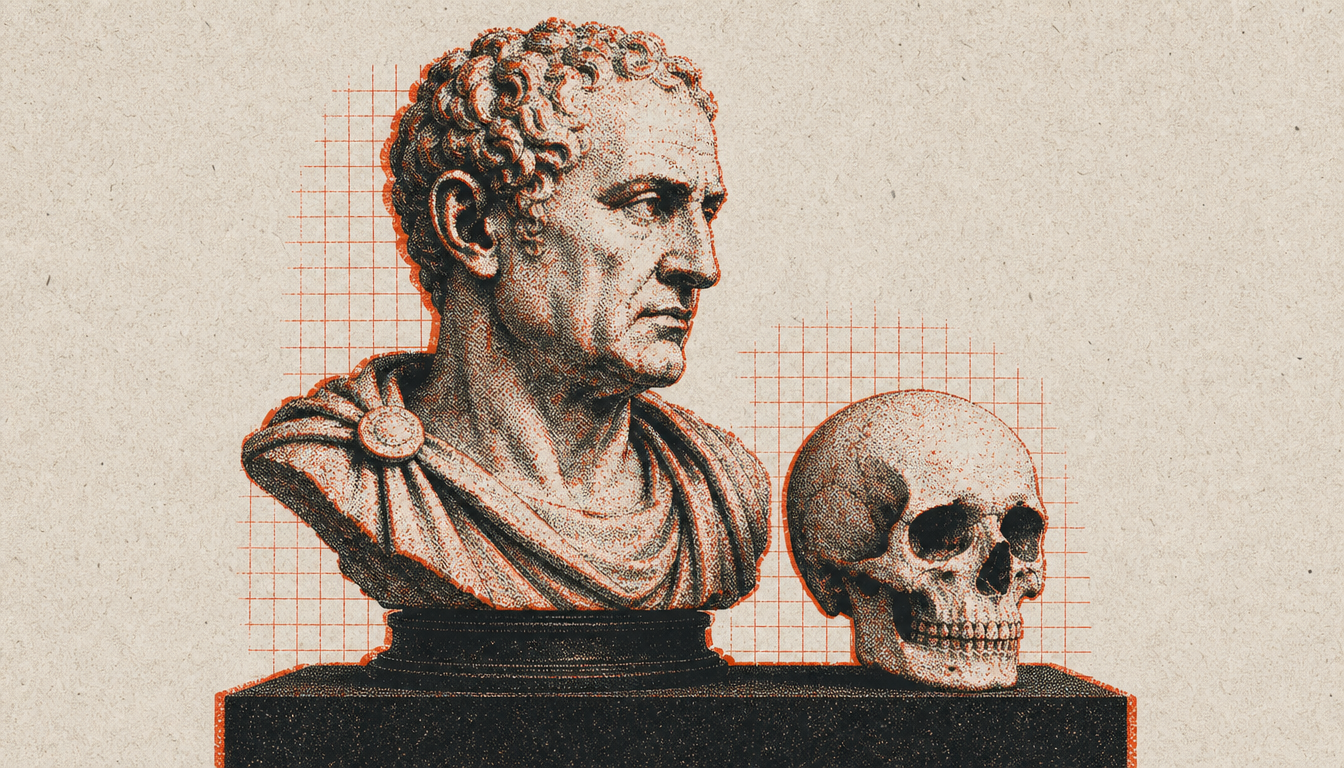
A man who forgets he will die builds his life on sand. Every hour he spends performing for strangers, chasing dopamine, or delaying the work that matters assumes he has time to correct course later. He does not. The Stoics understood this, and they built one of the most useful mental disciplines in human history around it: memento mori, the deliberate contemplation of your own death as a tool for living well.
This is not morbid. It is the opposite. Contemplating death is what forces you to finally live. The men who take this seriously stop tolerating what they used to tolerate, in themselves and in their circumstances. The men who dismiss it as a bumper sticker keep drifting.
What Is Memento Mori, and Why It Still Matters

The Latin phrase memento mori translates roughly as "remember that you must die." It appears throughout the writings of Marcus Aurelius, Seneca, and Epictetus, though the Stoics were not the first or last to use it. Christian monastic traditions kept skulls on their desks. Samurai were taught to meditate on death each morning. Renaissance painters embedded symbols of mortality inside still-life compositions so that a viewer glancing at a table of fruit and wine would also see the skull beneath.
The point across all these traditions is the same. A man who keeps his death visible makes better decisions. He weighs his hours differently. He tolerates less nonsense from himself. He becomes harder to manipulate, because the fear of missing out and the fear of social disapproval lose their grip once the larger fear, the real one, is faced directly.
The modern world has quietly deleted this discipline. Death is outsourced to hospitals and hidden behind screens. Aging is treated as a marketing problem. Funerals are shorter. Grief is medicated. The average man under forty may never have sat with a corpse, and he certainly is not encouraged to sit with the thought of his own. The result is a generation of men who understand mortality intellectually but do not feel it, and therefore do not let it shape their behavior.
The Current State: Distraction as a Way of Life
Look honestly at how the average day gets spent. Waking hours are fragmented by notifications, most of which serve someone else's business model. Attention is rented out to platforms that measure success in the seconds they steal. Ambition is often outsourced to whichever creator most recently made discipline look aesthetic on camera. The behavioral gap that many men feel, the space between what they know they should do and what they actually do, is not a personal defect. It is the predictable output of an environment engineered to keep them mildly stimulated and permanently postponing.
Motivational content has stepped into this gap and largely failed. It tends to run on borrowed emotion. A video, a quote, a podcast episode delivers a hit of resolve that fades within the day. The listener treats the feeling as the accomplishment. Nothing structural changes. He returns to the same environment, the same reflexes, the same friends, the same phone, and the same inner script.
Stoic memento mori operates on a different mechanism. It does not try to inspire you. It tries to sober you. Inspiration is a stimulant, and stimulants require ever larger doses. Sobriety, in the Stoic sense, is a permanent adjustment to reality. Once a man genuinely internalizes that his time is finite and non-refundable, he does not need to be motivated to stop wasting it. He simply stops, because wasting it now feels absurd.
Point One: Mortality Clarifies What Actually Matters
The first argument for practicing memento mori is diagnostic. Most men cannot answer, in a specific sentence, what they want their life to have meant. They can list goals, but the goals were often chosen by comparison with peers or algorithms rather than by their own reflection. The contemplation of death cuts through this.
Try the exercise honestly. Imagine yourself at the end, lucid, looking back at the decades. Which choices feel weighty and which feel like static? The relationships you neglected because you were busy signaling to strangers. The body you let soften because the discomfort of training seemed larger than the discomfort of decline. The book you did not write, the business you did not start, the apology you did not offer, the son you did not father with full presence. These items rise to the surface because death is the only honest editor.
Seneca wrote that it is not that we have a short life to live, but that we waste much of it. His argument was not that life is tragically brief. It was that men squander what they have and then complain about the shortage. The remedy he prescribed was not to work harder. It was to notice.
A counterpoint deserves acknowledgment. Some argue that thinking about death frequently produces anxiety rather than clarity. This is a real risk if the practice is done badly. Ruminating on death without an accompanying framework becomes a spiral. The Stoic version is different because it always couples the contemplation with action. You remember you will die, and then you ask what a man who remembered this would do in the next hour. The contemplation ends in a decision, not in a mood.
Point Two: Mortality Builds Mental Toughness by Rightsizing Fear
The second argument is about fear. Most of what a modern man fears is socially constructed. He fears looking foolish, being judged, losing status, being disliked, being wrong in public, being rejected romantically, being underestimated professionally. These fears govern behavior more than any physical threat.
Memento mori rightsizes them. If you are going to die, and everyone who currently judges you is also going to die, and none of you will be remembered in three generations by name, then the social fear that stops you from speaking up in a meeting or from asking a woman to dinner or from starting the project you have been deferring is revealed as what it is: a phantom. Not nothing, but not the emergency your nervous system treats it as.
This is where mental toughness stops being a slogan and starts being a practice. Toughness is not the absence of fear. It is the accurate weighing of fear. A man who has genuinely faced his mortality has already priced in the worst outcome any social situation can deliver. The rejection, the embarrassment, the criticism, the failure, none of these erase him faster than time will. He can therefore act.
The comparison below illustrates how a memento mori mindset reshapes common situations that stall men in the behavioral gap.
| Situation | Default Mindset | Memento Mori Mindset |
|---|---|---|
| Difficult conversation with a friend | Avoid to preserve the relationship | Have it now, because you will not have infinite chances |
| Public speaking or presenting | Rehearse fear of judgment | Recognize the audience will forget within a week |
| Starting a demanding project | Wait for the right conditions | Begin today, because conditions do not improve with delay |
| Physical training | Optional if motivated | Non-negotiable maintenance of a finite body |
| Reconciling with family | Someday, when it feels easier | This year, because the window closes |
Point Three: Mortality Sharpens Presence and Social Weight

The third argument is less discussed and more useful than it sounds. Men who have internalized their mortality carry themselves differently in rooms. They are harder to rush, harder to flatter, harder to intimidate. This is not a pose. It is a byproduct of no longer needing the room's approval to feel real.
Most social friction in a man's life comes from a subtle neediness he does not admit to. He wants to be liked, included, respected, seen as competent. These desires are not shameful, but when they drive behavior they leak into voice, posture, and pacing. Other people feel it. They respond by taking him less seriously, which increases his need, which leaks further. The loop is exhausting and it degrades every relationship it touches.
Contemplating death interrupts this loop. Not because you stop caring about people. You care more, in fact, because you understand the loss ahead of time. But you stop needing them to validate your existence, because your existence is already framed by something larger than their opinion. This produces the quality that older cultures called gravitas. It cannot be faked, coached, or bought. It is the residue of having looked at the end and returned to the room.
Presence of this kind changes outcomes. In negotiations you are willing to walk away, and the willingness itself often wins the deal. In leadership you can deliver hard truths without softening them into meaninglessness. In friendships you can say what needs to be said. In romance you can pursue without desperation and withdraw without cruelty. All of it flows from the same root: you know your time is limited, so you refuse to spend it performing.
Point Four: Mortality Is the Only Honest Foundation for Legacy
The fourth argument concerns what a man leaves behind. Legacy is a word that has been softened by marketing, but its original meaning is severe. Your legacy is what continues to act in the world after you can no longer act. It is the character your children inherited by watching you. It is the standards you enforced in your household. It is the work that outlasts your name. It is the men you mentored who now mentor others.
You cannot build legacy while denying death, because legacy is defined by death. The question of what remains is only meaningful because you will not. A man who avoids thinking about his end also avoids thinking about what his life is producing that will survive him, and he tends to produce very little. Not because he lacks capacity, but because he has never seriously asked.
The exercise here is concrete. Write, in your own hand, the eulogy you would want delivered at your funeral. Not the polite one your family would improvise, but the accurate one, describing the man you actually were. Then write the eulogy that would be accurate if you died next month with no further changes. Compare them. The gap between the two documents is your work. Every day you spend closing it is a day well spent. Every day you spend widening it is borrowed.
Some men resist this exercise because it feels grandiose, as if only presidents and generals deserve to think about legacy. This is a modern confusion. Legacy is not about scale. A father who raised sons of character has left a legacy more consequential than most celebrities. A friend who was reliable across decades has left one. A craftsman whose work still functions after his death has left one. What matters is not the size of the footprint but its integrity.
The Path Forward: Turning Contemplation Into Structure
Prediction is easy in this domain because the pattern is old. Men who do not confront mortality tend to arrive at their forties and fifties with a familiar cluster of regrets: bodies they neglected, relationships they under-invested in, work they never quite committed to, and a vague sense that the years accelerated without permission. The regret literature on the dying is remarkably consistent across cultures. The men who avoid these regrets are almost always the ones who, by temperament or training, kept the reality of their end close.
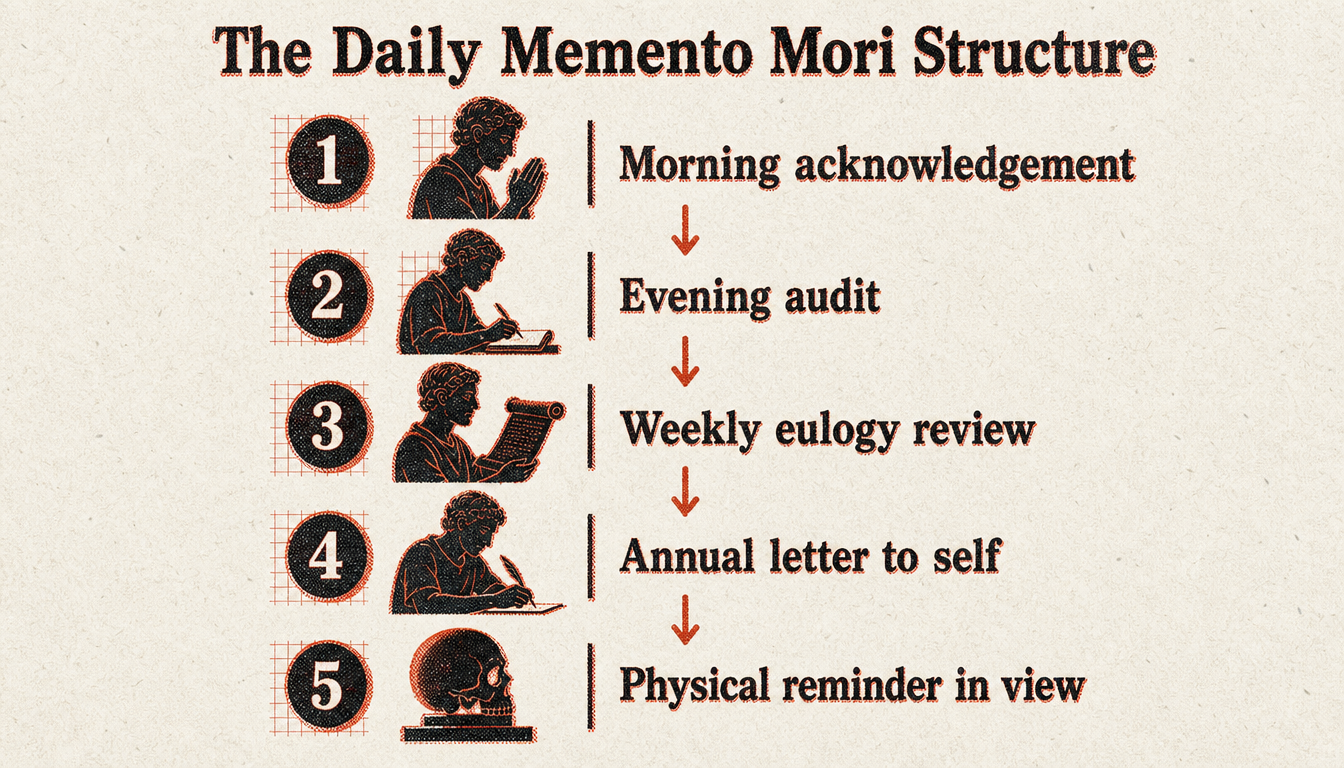
The proposal is not that you become preoccupied with death. Preoccupation is its own dysfunction. The proposal is that you install a small, repeatable structure so the awareness stays present without dominating your mood.
- A morning acknowledgement. Before the phone, before the news, take sixty seconds to acknowledge that today is not guaranteed and that you have chosen, provisionally, to spend it. State one thing you will do with the day that a man aware of his mortality would prioritize.
- An evening audit. Before sleep, ask honestly whether the day's hours matched the priority you named that morning. Do not moralize the answer. Just observe it. Patterns emerge within two weeks.
- A weekly review of the eulogy gap. Once a week, look at the two-eulogy exercise. Ask what one action in the coming seven days would close the gap by any measurable amount.
- An annual confrontation. Once a year, ideally on your birthday, write a letter to yourself as if it were your last. What would you tell the people you love. What would you tell yourself about how the year was spent. File it. Read the previous year's letter first.
- A physical reminder. Keep some object in your daily field of view, a coin, a stone, a small figure, that signifies mortality to you personally. It sounds primitive because it is. Primitive works.
These practices are not a philosophy. They are the scaffolding that lets the philosophy actually run inside a human life. Without scaffolding, memento mori remains a phrase men admire on a screen and forget by lunch. With scaffolding, it becomes the underlying operating system that quietly reorganizes attention, courage, relationships, and output.
Conclusion: The Only Deadline That Matters
The claim at the start of this essay was that a man who forgets he will die builds his life on sand. Everything examined since has been an argument for that claim. Clarity, toughness, presence, and legacy all trace back to the same root discipline. Not because death is beautiful, and not because the Stoics were poets, but because mortality is the one honest constraint a man cannot argue with, negotiate around, or postpone into next quarter.
The men who take this seriously do not become grim. They become concentrated. They stop tolerating the low-grade cowardice that most days are made of. They speak more directly, train more consistently, love more attentively, and build more deliberately. They also, and this is worth naming, tend to enjoy their lives more than the men who spend their years pretending the deadline is not real.
The question worth sitting with is not whether you will die. That is settled. The question is whether the man reading this paragraph will use the remaining time as a resource or squander it as a given. There is no third option, and there is no later date on which the question becomes easier to answer. What will you do with the hour after you close this page?