

Why Knowing What to Do Isn't Enough: The Action Gap Explained

You've read the books. You've listened to the podcasts. You can recite the principles of discipline, deep work, cold exposure, and Stoic indifference to opinion. Yet your week ended the same way it started, with the same unwritten chapter, the same unmade call, the same workout skipped. This is the knowledge action gap, and it is one of the most costly problems in a modern man's life.
It is expensive because it disguises itself as progress. Consuming information feels like building something. It is not. The gap between what you know and what you do is where most ambition quietly dies, dressed up as research.
The Anatomy of the Knowledge Action Gap

The knowledge action gap is the measurable distance between what a person understands intellectually and what they execute consistently in behavior. It is not laziness. It is not a lack of intelligence. In fact, it tends to widen as intelligence grows, because the smarter you are, the more sophisticated your reasons for delay become.
Consider the executive summary before we open the case:
- Knowledge accumulates faster than behavior changes, creating a permanent surplus of unused insight.
- The gap is maintained by identity, environment, and emotional regulation, not by missing information.
- Closing it requires a structured system of constraints, not more inspiration.
- Stoic practice offers a tested operating model for converting principle into practice.
What the Gap Actually Is
Knowing how to eat well is not the same as eating well. Knowing how to lead a team is not leading one. The gap is the residue between cognitive recognition and embodied behavior. Every man reading this has lived inside it. The question is whether you are willing to look directly at it without flinching.
| Item | Detail |
|---|---|
| Subject | The knowledge action gap in adult men |
| Category | Behavioral psychology and self-development |
| Position | Central obstacle in personal growth across domains |
| Scope | Health, work, relationships, character, legacy |
| Why It Matters | Determines whether knowledge produces a life or just a library |
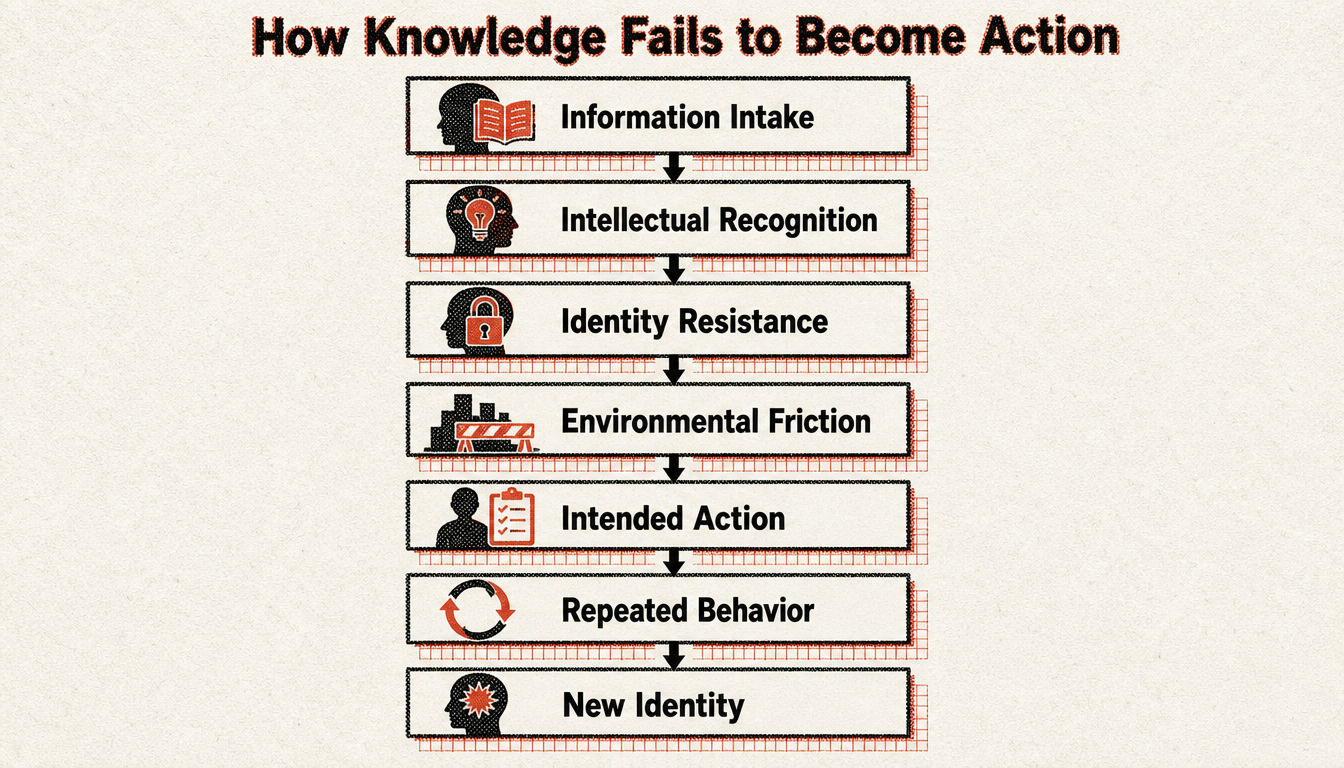
The diagram below maps the basic structure of how knowledge fails to become action.
The Structural Mechanics: Why the Gap Exists

Most men assume the gap is a willpower problem. It is not, or at least, not primarily. Willpower is the symptom you notice. The structure beneath it has three load-bearing walls.
Wall One: Consumption Feels Like Progress
Reading a chapter on cold tolerance activates the same sense of forward motion as taking a cold shower. The brain rewards the input. It does not distinguish well between learning about a virtue and practicing it. This is why men can spend a decade absorbing content about discipline without becoming disciplined. The dopamine economy of consumption pays out before any behavior changes.
Information is not transformation. The receipt is not the meal.
Wall Two: Identity Lags Behind Insight
You can intellectually accept a new idea in an afternoon. You cannot rewrite who you believe you are that quickly. If a man has spent twenty years operating as someone who avoids confrontation, reading a book on courage will not make him courageous by Monday. The old identity has muscle memory. It runs in the background like a daemon process, quietly vetoing actions that contradict the self-image it protects.
Wall Three: Environment Beats Intention
A man who reads about focus while sitting next to a phone that buzzes every four minutes is conducting an experiment in defeat. The environment is the first draft of the day's behavior. Most attempts to close the gap fail because they target the will rather than the conditions surrounding the will.
Comparison With Adjacent Concepts
| Concept | What It Describes | Difference From the Gap |
|---|---|---|
| Procrastination | Delaying a known task | A single behavior, not a systemic pattern |
| Akrasia | Acting against one's better judgment | Classical term, philosophical rather than operational |
| Analysis paralysis | Stalling due to too many options | A trigger of the gap, not the gap itself |
| Knowledge action gap | Persistent divergence between understanding and behavior | The broader system that contains the others |
Measuring the Gap: A Quantitative Look

The gap resists measurement because most men refuse to track honestly. They estimate effort by intention rather than output. To shrink the gap, you have to measure it. Pick three domains and assign a ratio: ideas absorbed versus actions taken on those ideas in the past ninety days.
The Three-Domain Audit
- Body: How many fitness or nutrition principles have you read about? How many are you currently practicing without negotiation?
- Craft: How many techniques, frameworks, or skills have you studied in your field? How many have you applied in your last ten working days?
- Character: How many virtues or behaviors have you read about wanting to embody? How many did you visibly demonstrate this week under pressure?
Most men, audited honestly, find a ratio somewhere between ten-to-one and fifty-to-one. They have consumed ten to fifty units of insight for every unit of action. This ratio is the gap, made visible.
What the Numbers Reveal
Tracking is not the goal. Confronting the ratio is. When a man sees that he has read forty articles on writing and produced two paragraphs of his own, the abstraction collapses. The gap stops being a vague feeling of underperformance. It becomes a concrete accounting of unused capital.
Indicators Worth Tracking
- Action latency: Time between learning a useful idea and the first application of it. Anything beyond seventy-two hours signals decay.
- Repetition rate: How often a new behavior is repeated in its first week. Below three repetitions, the behavior usually dies.
- Reversion frequency: How often you return to old behaviors after attempting new ones. High reversion points to identity or environment failure, not effort failure.

The Strategic Layer: Decisions That Close the Gap

Once the structure and the numbers are visible, the work becomes strategic rather than motivational. Motivation is a weather pattern. Strategy is architecture. Men who close the gap stop relying on the former and start designing the latter.
Decision One: Constrain Inputs Before Expanding Outputs
The first counterintuitive move is to consume less, not more. A man with a fifty-to-one ratio does not need another book. He needs to enforce a moratorium on new inputs until existing inputs have been tested in behavior. Stoic practice has a name for this discipline of attention. Marcus Aurelius reminded himself constantly that the mind is colored by the quality of its impressions. Letting in less is the precondition for acting on what is already there.
Decision Two: Pre-Commit to Behavior, Not Outcome
Outcomes are partly outside your control. Behaviors are not. The Stoic distinction between what depends on you and what does not is the operational hinge here. A man who commits to writing for forty-five minutes daily has made a behavioral promise he can keep. A man who commits to becoming a published author has made an outcome promise that depends on editors, markets, and luck. The first closes the gap. The second feeds it.
Decision Three: Engineer Friction Asymmetrically
Make the desired behavior easier than the default behavior. Lay out your gym clothes the night before. Block distracting sites at the router level. Remove alcohol from the house rather than relying on refusal in the moment. This is not weakness. It is the recognition that future you will be tired, distracted, and emotionally compromised, and that the present version of you has a duty to defend him.
Decision Four: Accept the Cost of Visible Failure
Men avoid action partly because action makes failure legible. A book unread can still be imagined as a book that would have changed everything. A workout program attempted and abandoned cannot. Closing the gap requires accepting that the price of progress is a visible record of imperfect attempts. The Stoics treated this as the basic tuition of a serious life.
Strategic Comparison: Two Approaches
| Dimension | Motivation-Based Approach | Structure-Based Approach |
|---|---|---|
| Energy source | Emotional state | Pre-built systems |
| Failure mode | Collapses when mood drops | Degrades slowly under pressure |
| Time horizon | Days to weeks | Years to decades |
| Identity effect | Reinforces dependence on feeling | Reinforces dependence on principle |
| Compatibility with the gap | Feeds it | Closes it |
The Stoic Frame: Principle as Operating System

Stoicism is often mistaken for a mood. It is closer to an operating system. Its value in closing the gap is that it provides a stable substrate beneath fluctuating feeling. A man running on Stoic principles does not need to want to act. He acts because the principle requires it, and the wanting becomes irrelevant.
The Dichotomy of Control as a Daily Filter
Every morning, sort the day's concerns into two columns: what you control and what you do not. The gap thrives in the second column, where men spend hours rehearsing scenarios, drafting imaginary arguments, and worrying about reception. Move attention back to the first column. There you find the actions that close the gap: the call you can make, the rep you can complete, the sentence you can write.
Premeditation as Behavioral Insurance
The Stoic exercise of premeditatio malorum, mentally rehearsing what could go wrong, is not pessimism. It is the practice of removing surprise as an excuse. If you have already imagined the resistance, the rejection, the discomfort, you cannot use them as reasons to abort when they arrive. The gap shrinks because the emotional element is metabolized in advance.
Memento Mori as Action Accelerator
Remembering death is not a morbid hobby. It is a clarifier. A man who genuinely understands he will die tends to negotiate less with himself about whether to act today. The library of unused knowledge becomes harder to tolerate when the reading list is finite. This is why the most effective self-development tradition for men has always been the one that refuses to flatter them about how much time they have.
Lessons Worth Generalizing
The gap is not unique to you. It is the default human condition under conditions of information abundance. What separates the men who close it is not talent or temperament. It is a small set of transferable habits.
Lesson One: Treat Knowledge as a Liability Until Acted Upon
Every unread idea you carry is a debt, not an asset. It costs cognitive space and produces the illusion of competence without the substance of it. Until knowledge is tested in behavior, treat it as borrowed, not owned.
Lesson Two: Build a Smaller, Tighter Operating Code
Most men have too many principles and too few practices. Strip your code down to three or four non-negotiable behaviors. A short list, executed without exception, builds more character than a long list executed when convenient.
Lesson Three: Make Action the Identity, Not the Goal
The man who lifts is a lifter. The man who writes is a writer. Identity follows repeated behavior, not stated intention. Stop saying you want to become something. Begin doing the smallest version of it today, and let the identity assemble itself around the action.
Lesson Four: Refuse the Comfort of the Next Book
There is always another book, another framework, another teacher. The temptation to keep searching is the gap defending itself. At some point, the man serious about change closes the current book, picks the one practice that matters most, and gives it ninety days of unbroken attention before opening anything new.
Practical Application Checklist
- Identify the single behavior whose absence costs you the most.
- Define its smallest non-negotiable daily version.
- Engineer the environment so that doing it is easier than not doing it.
- Commit to ninety days without consuming new content on the same topic.
- Track only the behavior, not the outcome.
- Review weekly with a witness, not alone.
Closing the Gap as a Way of Life
The knowledge action gap is not a problem to be solved once. It is a tension to be managed across a lifetime. New knowledge will always arrive faster than behavior can absorb it. The question is whether you treat that tension as a defect to be hidden or a discipline to be practiced.
The men who build something durable, in their bodies, their work, their families, their character, are not the ones with the largest libraries or the longest reading lists. They are the ones who took a smaller body of knowledge and pressed it into behavior with enough force that it left a mark on the world.
Key Takeaways
- The gap is structural, not motivational. Treat it as architecture, not feeling.
- Consumption produces the sensation of progress without the substance. Audit your input-to-output ratio honestly.
- Identity and environment quietly determine behavior. Redesign both before relying on willpower.
- Stoic principles offer a stable operating system for converting insight into action.
- A short code of non-negotiables, practiced without exception, outperforms a long list of aspirations.
What to Watch Going Forward
The information environment is not going to slow down. The volume of available insight on masculinity, performance, philosophy, and meaning will continue to grow. The men who flourish in this environment will be the ones who develop the rarer skill: not knowing more, but doing more with less. The gap will widen for most. For the disciplined few, it will be the place where a real life gets built.
Close the book when you finish this paragraph. Pick one thing you already know you should do. Do it today, badly if necessary, before the next idea arrives to distract you. That is where the work begins.