

From Knowing to Doing: A 30-Day Framework for Closing the Gap

You already know what to do. Read the philosophy. Studied the biographies. Absorbed the frameworks. And still, at the end of most weeks, the distance between the man you understand yourself capable of being and the man your calendar reflects is uncomfortable to measure. This article gives you a 30-day operating system to close that distance, built on Stoic discipline rather than motivation, and designed for men who are tired of watching themselves nod at wisdom they never execute.
By the end of this framework, you will have installed a repeatable daily architecture that converts insight into evidence, and you will have proof, on paper, that you are the kind of man who does what he says.
Why the Knowing-Doing Gap Exists in Men Who Should Know Better

The gap is not an information problem. If reading solved this, you would already be finished. The gap exists because the modern mind confuses recognition with ownership. Recognizing a truth feels almost identical to living it, especially in the private theater of your own head. Marcus Aurelius named this trap when he wrote about men who philosophize instead of behaving like philosophers. Eighteen centuries later, the diagnosis holds.
Three forces keep intelligent men trapped in the loop of consuming without executing:
- Identity inflation. Consuming a book about discipline gives a small dopamine reward that mimics the reward of being disciplined. The brain treats the map as the territory.
- Optionality worship. Not committing to one path feels like keeping all paths open. In practice, it closes them by attrition.
- Comfort with the private self. No one else sees the gap between what you know and what you do, so shame stays theoretical and pressure stays low.
The 30-day framework below attacks all three. It forces identity to be earned through action, closes optionality by demanding a single daily standard, and drags private commitments into observable reality. The point is not to learn more, but to make what you already know unavoidable in your behavior.
Prerequisites: What You Need Before You Start

This framework is written for men who have already done the intellectual work and are frustrated with themselves for not converting it. If that describes you, you need very little to begin. If it doesn't, close this tab and read for another year.
- Reading background: familiarity with at least one Stoic primary source (Marcus Aurelius, Epictetus, or Seneca) or a working understanding of virtue ethics.
- Self-awareness level: you can already name two or three specific behaviors that contradict the man you claim to be. Vague dissatisfaction is not enough.
- Tools: a paper notebook, a pen, a timer (phone is fine), and a calendar you already use.
- Time commitment: 20 minutes at the start of each day, 10 minutes at the end, and one 60-minute weekly review. No more.
- Environment: a fixed physical location where the morning and evening blocks happen. Same chair, same desk, same corner. Location is a lever, not decoration.
Notice what is not on the list: an app, a coach, a supplement stack, a new identity, a group. Anything you add before the base habit is stable becomes another form of preparation posing as progress.
The 30-Day Framework: Four Weeks, One Man

The framework runs in four weekly phases. Each phase has a single dominant task. You do not move to the next phase early, even if you feel ready. Feeling ready is often the exact signal that you have not yet been tested.
The diagram below illustrates the overall flow of from knowing to doing across the four weeks.
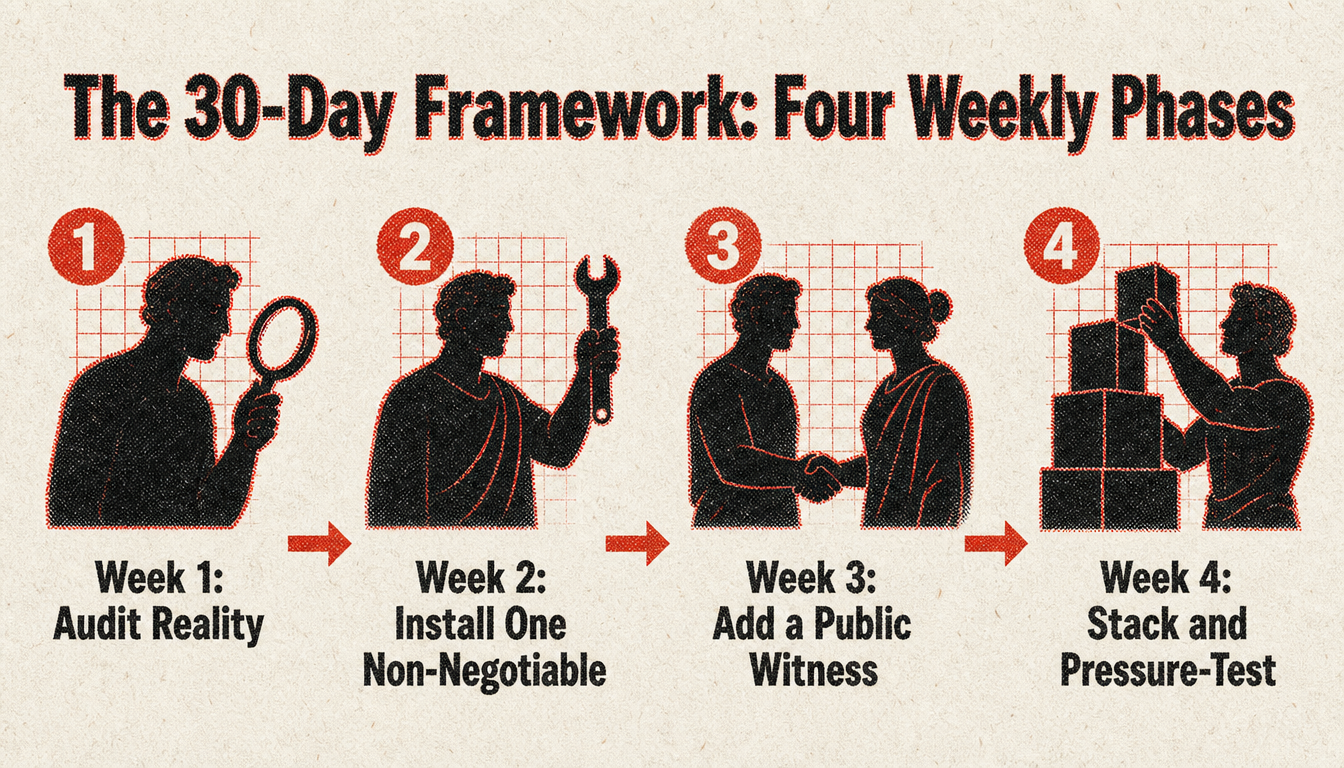
Week 1: Audit Reality Without Flinching
Before you change anything, spend seven days recording what you actually do. Not what you intend, not what you tell yourself at 11 p.m. when you promise tomorrow will be different. What you do.
Each night, write three things in the notebook:
- The three most time-consuming activities of the day, with honest duration estimates.
- One moment where you said one thing and did another, however small.
- One moment where your behavior matched a value you claim to hold.
Why this works: the Stoic practice of the evening review (Seneca describes it in his letters to Lucilius) predates every productivity system by two thousand years because it forces the mind to face its own record. Most men skip this step because the record is embarrassing. That embarrassment is fuel, not a reason to stop.
At the end of week one, you will have seven days of raw data on the man you currently are. Not the man you argue with in your head. The man on paper.
Week 2: Install One Non-Negotiable Daily Action
Choose one action, and only one, that directly contradicts the pattern you saw most clearly in week one. Not five actions. One.
Examples of the correct scale:
- If your audit showed two hours of evening scrolling, the action is: phone in a drawer in another room from 9 p.m. onward.
- If your audit showed avoidance of a difficult conversation, the action is: send one direct message per day that you have been postponing.
- If your audit showed physical decline, the action is: 30 minutes of deliberate movement before you check any screen.
The action must be binary. Done or not done. No sliding scale, no partial credit, no negotiation. At the end of each day, you write a single letter in the notebook: Y or N. That letter is the entire scoreboard for week two.
Why one and not five: men who fail this framework almost always fail because they tried to install a full life overhaul in a week. Willpower is a finite daily budget. Spread it across five new behaviors and you get five half-behaviors that collapse by day nine. Spend it on one and you get a keystone that starts to carry the others.
Week 3: Add a Public Cost to Failure
Private commitments have a well-documented failure rate because the only referee is the man who benefits from cheating. In week three, you introduce a witness.
Tell one specific person, a friend whose respect you actually care about, exactly what your daily non-negotiable is and how long you have been holding it. Ask them to check in with you at the end of the week with one question: did you hold the line every day.
You are not asking for encouragement. You are not asking for accountability partnership. You are creating a small, real social cost for lying. That is the entire mechanism.
This is where most men resist, because staying private is comfortable. The resistance itself is diagnostic. If telling one person what you already claim to be doing feels risky, then you have been quietly counting on the option to quit.
Week 4: Stack a Second Action and Test Under Pressure
Only in week four do you add a second daily action, chosen the same way as the first: it must contradict a specific pattern from the week-one audit, and it must be binary.
By this point, the first action should feel closer to a floor than a ceiling. If it doesn't, extend week two by another seven days before proceeding. There is no bonus for finishing on schedule. There is a heavy penalty for building the second story on a foundation that still wobbles.
In addition to the second action, deliberately introduce one unfavorable condition during the week: a poor night of sleep, a demanding work day, a social event that runs late, a trip. The point of the framework is not to perform under ideal circumstances. Any man can do that for six days. The point is to prove to yourself that the standard holds when the day is against you.

Comparing the Old Loop and the New Operating System

Most men who consume self-development content operate in what can be called the consumption loop: input, agreement, brief emotional spike, no behavioral change, guilt, more input. The 30-day framework replaces that loop with an execution system. The differences are worth seeing side by side.
| Dimension | Consumption Loop | 30-Day Framework |
|---|---|---|
| Primary output | Feelings and opinions | Written evidence of behavior |
| Success signal | Insight and agreement | Y or N in a notebook |
| Referee | Your own mood | Paper record plus one witness |
| Failure response | Consume more content | Audit the specific breakdown |
| Time horizon | Endless, vague | Fixed, 30 days, then reassessed |
| Identity source | What you believe about yourself | What your record proves |
Notice that the framework does not require you to feel more motivated, more disciplined, or more clear-headed. It requires you to leave a trail. Feelings follow evidence, not the other way around.
Coaching Yourself: Shortcuts That Do the Heavy Lifting

Once the base architecture is in place, small adjustments compound. These are not hacks in the shallow sense; they are leverage points that veterans of Stoic practice have used for centuries under different names.
- Fix the location before you fix the behavior. The same chair at the same time collapses decision cost. You are not deciding to write your evening review; you are sitting in the review chair.
- Pre-commit the night before, not the morning of. Write tomorrow's non-negotiable in the notebook before you sleep. Morning-you inherits an instruction from a calmer, less negotiable version of yourself.
- Name the enemy behavior specifically. "Being lazy" is unactionable. "Checking my phone before I stand up" is a target you can hit.
- Use the two-minute floor on bad days. On a day you feel wrecked, do the non-negotiable at the smallest defensible version rather than skipping it. The record is what matters.
- Separate reflection from planning. Evening is for what happened. Morning is for what will happen. Combining them turns both into wishful thinking.
- Refuse to read new material during the 30 days. No new books, no new frameworks, no new podcasts on discipline. Input is how you avoided execution last time.
The last point is the one most men resist and the one that most reliably separates finishers from quitters. Curiosity feels virtuous. During these thirty days, it is a distraction dressed as growth.
Applying the Framework to Different Domains of a Man's Life
The 30-day structure is domain-agnostic. The audit, the single action, the witness, the pressure test, and the review work whether you are rebuilding your body, your marriage, your career trajectory, or your bearing in a room. Three application patterns show how the same skeleton flexes.
Pattern 1: Physical Foundation
For the man whose audit reveals bodily neglect, the first non-negotiable is almost always movement before input. Thirty minutes of any deliberate physical work before the phone, the news, or the inbox. The second action, added in week four, is typically a sleep cutoff: lights out at a fixed time, non-negotiable, regardless of what feels urgent. Physical domain first is often correct because it is the most objective; the mirror and the barbell do not lie, and success here builds the identity capital that funds harder domains.
Pattern 2: Relational Presence
For the man whose audit reveals that he is physically present but mentally absent with the people he claims to love, the first non-negotiable is a fixed daily block, often 20 to 30 minutes, of undivided attention with no device in the room. The second action is one difficult, honest conversation per week that he has been avoiding. This pattern is harder than the physical one because the results are invisible on any given day and only compound over months. Men who complete it typically report that their social presence shifts in rooms far outside the home.
Pattern 3: Legacy Work
For the man whose audit reveals that his most important long-term project, the book, the business, the craft, the estate, receives leftover energy while low-stakes work receives the prime hours, the first non-negotiable is 60 to 90 minutes of legacy work before any reactive work. Email, messages, and meetings are locked until the deep block is complete. The second action, added later, is a weekly public artifact: something shipped, something shown, something recorded. Legacy work fails privately for years. It succeeds only when it is dragged into the open on a schedule.
Across all three patterns, the framework itself does not change. What changes is the specific behavior chosen. The temptation, especially for intelligent men, is to redesign the framework. The framework is not the interesting part. Your execution is.
Your Practical Checklist Before Day One
Do not start on a Monday because Monday feels symbolic. Start on the next full day after you finish this article. Symbolism is another form of preparation posing as progress.
- [ ] Chosen the physical location where the morning and evening blocks will happen.
- [ ] Bought or dedicated the paper notebook. No app substitutes.
- [ ] Written the three behaviors from your life that most clearly contradict the man you claim to be.
- [ ] Blocked 20 minutes in the morning and 10 minutes in the evening on the calendar for the next 30 days.
- [ ] Identified the one person who will be your week-three witness. Not messaged yet; identified.
- [ ] Chosen a fixed end date, exactly 30 days from your start, for the first review.
- [ ] Committed, in writing, to no new self-development input during the 30 days.
- [ ] Decided in advance what you will do on the day you inevitably want to quit. Not whether you will quit. What you will do instead.
That last item matters more than the others combined. Every man who runs this framework hits a day, usually between day nine and day fourteen, when the novelty is gone and the results are not yet visible. If you decide in that moment what to do, you will quit. If you decided a week earlier, you will not.
Closing the Loop: What to Do First
The most important technique in this entire framework is the week-one audit. Not the daily action, not the witness, not the pressure test. The audit. Every other step depends on the honesty of the record you build in the first seven days. Men who skip it, or soften it, spend the next three weeks solving problems they do not actually have while ignoring the ones they do.
If you do only one thing after closing this article, do this: tonight, before sleep, open a blank page and write down the three most time-consuming activities of your day with honest durations, and one moment where your behavior contradicted a value you claim to hold. That single page is the beginning of the operating system. Everything else in the 30 days is built on top of it.
You already know what to do. Now leave a trail that proves it.