

The Inner Citadel: Building a Mind That Outside Forces Can't Breach
Marcus Aurelius commanded the Roman Empire while writing private notes to himself about a fortress no army could siege. He called it the inner citadel. Two thousand years later, men still lose sleep over emails, market dips, and what a stranger said at a dinner party. The technology changed. The vulnerability didn't.
This guide is for men who have already read the books, listened to the podcasts, and can quote the Stoics at parties, yet still feel rattled by ordinary friction. You know what discipline looks like. You can't seem to hold it when the pressure rises. The inner citadel is the missing architecture: a deliberate mental structure that absorbs shocks instead of transmitting them straight to your nervous system.
What This Guide Will Give You

Expect a working framework, not motivation. By the end, you'll understand what the inner citadel actually is in Stoic thought, why most modern interpretations water it down, and how to build the structure piece by piece. The material assumes you've encountered Stoicism before but want to move from quoting it to living it.
Plan on roughly twenty minutes to read and a few weeks to begin installing what you read. The work itself is lifelong. That's the point.
What you'll walk away with
- A precise definition of the inner citadel and its three structural layers
- The distinction between what you control and what you don't, applied to modern situations
- A daily practice for fortifying judgment under pressure
- Methods for handling insult, failure, and loss without collapse
- A way to think about legacy that doesn't depend on applause
Prerequisites
- Basic familiarity with Stoicism (you've heard of Marcus Aurelius, Epictetus, Seneca)
- An honest acknowledgment that knowing concepts hasn't been enough
- Willingness to practice in small reps rather than chase breakthroughs
What the Inner Citadel Actually Is

The phrase comes from Marcus Aurelius, who wrote that the mind, when it withdraws into itself and finds contentment there, becomes a fortress. Pierre Hadot, the French philosopher who spent decades studying the Stoics, made the metaphor central to modern interpretation. The citadel is not a hiding place. It's a command center.
Most men, when they first hear the idea, picture emotional armor. They imagine becoming unreachable, cold, indifferent. That misreads the Stoics badly. The citadel doesn't make you numb. It makes you accurate. You feel what's worth feeling, refuse what isn't, and act from a position that external events can't dictate.
The three layers of the structure
Inside the citadel are three faculties the Stoics treated as the core of a free mind:
- Judgment (the gate). Every impression that reaches you, an insult, a loss, a temptation, must pass through your assessment before it becomes meaningful. The gate decides what you call good, bad, or indifferent.
- Desire and aversion (the walls). What you reach for and what you flee from. Stoics trained these toward things within their control and away from things that aren't.
- Action (the garrison). What you actually do, especially toward other people. Justice, honesty, and contribution live here.
Lose any one layer and the structure fails. A man with clear judgment but disordered desires gets dragged off course by appetite. A man with disciplined desires but cowardly action becomes a hermit who calls retreat wisdom. The citadel works only as a system.
Why modern translations weaken it
Pop Stoicism tends to reduce the citadel to a single trick: control your reactions. That's a fragment, not the architecture. Reaction control without judgment training is just suppression with a Greek name. You end up bottling responses you haven't actually examined, and the pressure leaks out sideways, into your sleep, your relationships, your health.
The citadel is structural. You're not learning to grit your teeth harder. You're rebuilding what counts as a threat in the first place.
The Dichotomy of Control, Applied Without Flinching
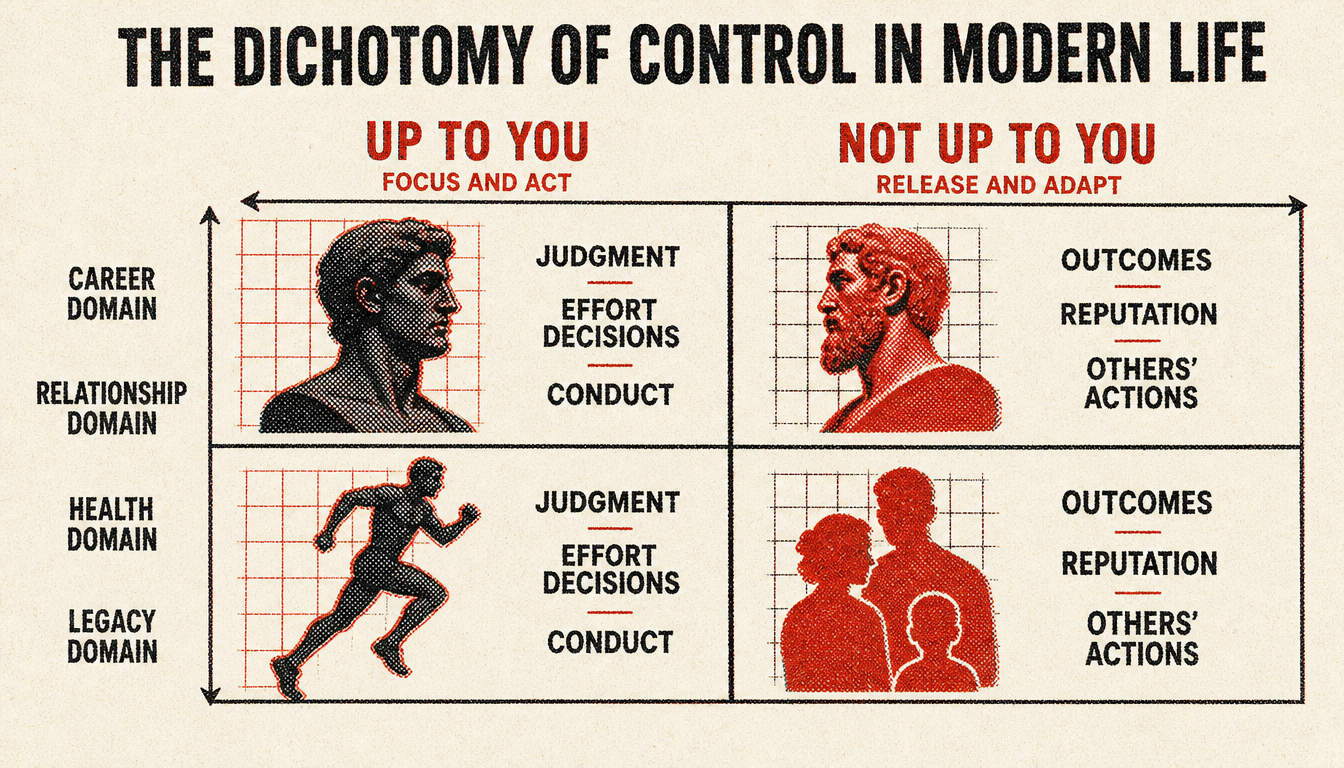
Epictetus opened his Enchiridion with the foundation: some things are up to us, others are not. Up to us are our judgments, intentions, and responses. Not up to us are our bodies, reputations, possessions, and the actions of others. Memorizing this is easy. Living it is brutal, because most of what men chase publicly, status, recognition, outcomes, sits in the second category.
The diagram below maps the dichotomy across domains where modern men typically get stuck.
Where the line actually falls
The mistake is drawing the line too generously on your side. You don't fully control your effort, because effort depends on energy, which depends on sleep, which depends on a thousand variables. What you control is the decision, in this moment, about what to do next. That's narrower than it sounds, and more powerful.
| Domain | Not up to you | Up to you |
|---|---|---|
| Career | Promotion, layoffs, market conditions | Quality of your work today, who you become through it |
| Relationships | Whether someone loves, respects, or stays | How you show up, what you offer, what you tolerate |
| Reputation | What others say about you | Whether their description matches reality |
| Health | Genetics, accidents, aging | Habits, recovery, what you put in your body |
| Legacy | How history remembers you | What you actually build and leave behind |
The discipline of withdrawal
When something punches you, status loss, betrayal, financial hit, the first move is withdrawal into the citadel. Not physical retreat. Mental relocation. You stop, name what just happened in plain language, and ask which column it falls in. If it's in the "not up to you" column, you grieve it if needed, then release it. If part of it is up to you, you address that part.
This sounds simple on paper. In practice, the first hundred times you try it, you'll forget. The hundred-and-first time, you'll catch yourself mid-spiral. That's the citadel coming online.
Training Judgment: The Gate of the Citadel
Judgment is where Stoicism does its most precise work. Every external event is, in itself, neutral. The story you tell about it determines whether it ruins your week. Marcus reminded himself constantly: "You have power over your mind, not outside events. Realize this, and you will find strength."
The practice has three movements.
1. Strip the impression to its facts
When something hits you, separate what happened from what you're saying about it. A colleague got the role you wanted. That's the fact. "They're a politician and I'm being passed over because I refuse to play games" is the story. The story may be partly true. It's also doing emotional work the facts alone wouldn't do.
Epictetus called this examining your impressions. Modern cognitive therapy rediscovered the same technique and renamed it. The Stoics had it first, and they used it under conditions, slavery, exile, execution, that make most modern stressors look mild.
2. Ask whether your judgment is accurate
Press on the story. Is the worst interpretation the most likely one? What would a fair, intelligent observer say? What are you ignoring because it doesn't fit the narrative? Most of what wounds men is not the event but the meaning they assigned to it in the first three seconds.
3. Choose the response that aligns with your principles
Once the impression is examined, the response becomes a decision rather than a reflex. You may still feel anger, disappointment, fear. The Stoics didn't deny emotions. They denied emotions the authority to govern action. Feel it, name it, then act from your principles instead of from the feeling.
The morning and evening review
Marcus and Seneca both practiced bracketed reflection. Morning: rehearse what you'll likely face, who you'll deal with, what could go wrong, and how a man of your principles would respond. Evening: review the day honestly, where did you act from the citadel, where did you abandon it, what would you do differently tomorrow.
Twenty minutes total. Skip it for a week and you'll feel the structure soften. It's the maintenance the architecture requires.
Voluntary Discomfort and the Walls of Desire

The walls of the citadel are built by ordering what you want and what you avoid. Most men are run by appetites they've never examined: comfort, approval, novelty, certainty. Each one is a breach in the wall waiting to be exploited.
Seneca, who was extraordinarily wealthy, wrote of deliberately living for a few days on the scantiest and cheapest food, wearing coarse clothing, and asking himself whether this was what he had feared. Not to perform virtue, but to confirm that he could lose his fortune without losing himself. The practice is called premeditatio malorum and voluntary discomfort, depending on which Stoic you're reading.
Why this matters now
You live in conditions of historically unusual comfort. Food, climate control, entertainment, and validation arrive on demand. Your nervous system, calibrated for harder conditions, registers small interruptions, slow Wi-Fi, a delayed flight, a cold meal, as genuine threats. You react out of proportion because your baseline is too soft.
Voluntary discomfort recalibrates the baseline. Cold showers, fasting, hard physical training, sleeping on the floor for a night, going a week without alcohol, taking a long walk in bad weather without your phone. The point is not the suffering. The point is proving to yourself, regularly, that you can lose the comfort and remain yourself.
How to practice it without theatrics
- Small and frequent beats large and rare. A thirty-second cold rinse three times a week builds more capacity than one ice bath you Instagram.
- Keep it private. The moment you perform discomfort for an audience, it stops training the citadel and starts feeding the appetite for approval, which is the breach you were trying to seal.
- Pair it with a real obligation. Voluntary discomfort that excuses you from showing up well at work or home is indulgence in disguise.
Premeditatio malorum
Before a high-stakes meeting, project, or conversation, spend ten minutes vividly imagining what could go wrong. The deal collapses. The presentation bombs. The person you love says no. Not to invite disaster, but to remove its capacity to shock you. When you've already met the loss in your imagination, the actual event arrives as a known quantity rather than an ambush.
Done daily, this practice quietly erases a category of anxiety most men carry permanently: the fear of an unrehearsed blow.
The Garrison: Action, Other People, and Social Presence
A citadel that never opens its gates is a tomb. The Stoics were emphatic about this. Marcus wrote that men exist for the sake of one another. Withdrawal into the self is for clarity, not exile. The garrison rides out.
This is where most modern Stoic content fails men. It teaches retreat without return. You end up with a man who has mastered his reactions in solitude and crumbles the moment a difficult conversation, a confrontation, or a public stand is required.
Handling insult and provocation
Marcus prepared each morning for difficult people: "I shall meet with the busybody, the ungrateful, arrogant, deceitful, envious, unsocial." Not as complaint, as forecast. When the rude driver, the dismissive client, or the sneering relative shows up, you've already accounted for them.
The Stoic response to insult has three parts. First, ask whether it's true. If it is, thank the messenger silently and correct yourself. If it isn't, why would you accept a description of yourself that doesn't match reality? Second, consider the source's condition. People who attack are usually in pain. Third, respond from principle, not pride. Sometimes that's silence. Sometimes it's a firm correction. Never is it escalation for its own sake.
Presence under pressure
Social presence, the quality of being fully where you are without leaking anxiety, is the citadel made visible. Men notice it in other men immediately. It cannot be faked for long. It comes from having done the interior work: knowing what you control, what you don't, what you'll tolerate, and what you won't.
Practical markers of presence:
- You speak at your own pace, not the room's nervous tempo
- You hold silence without rushing to fill it
- You can be disagreed with without needing to win
- You can be praised without becoming dependent on it
- You leave when it's time to leave, even when staying is easier
Justice as the operating principle
Of the four cardinal Stoic virtues, wisdom, courage, temperance, and justice, justice is the one that points outward. It means giving each situation and each person what they're actually owed. Honesty owed, debt owed, attention owed, correction owed, gratitude owed. Run your interactions through that filter and you stop drifting into the manipulations and small dishonesties that erode self-respect.
Self-respect, it turns out, is the inner condition that nothing external can grant or remove. The Stoics knew it was the real prize.
Legacy: What the Citadel Is Ultimately For
Marcus wrote his Meditations for himself, not for posterity. He expected to be forgotten. The fact that you're reading him eighteen centuries later is an accident of preservation, not a reward he chased. That detachment is the deepest layer of the citadel.
Most men, asked privately what they want, will eventually admit they want to matter. To be remembered. To leave a mark. The Stoics had a sharper question: what kind of man do you want to have been, regardless of whether anyone notices?
The two definitions of legacy
| Approach | External legacy | Stoic legacy |
|---|---|---|
| Goal | To be remembered | To have been worth remembering |
| Measured by | Reputation, monuments, recognition | Character, contribution, integrity |
| Dependent on | Others' attention and judgment | Your own conduct |
| Vulnerable to | Time, fashion, slander, forgetting | Only your own betrayal of it |
| Felt in life as | Anxiety about how you're perceived | Steadiness regardless of perception |
What you actually leave
You leave the people you raised or mentored, the work you did honestly, the standards you held when no one was watching, and the example of a man who didn't flinch. None of that requires a stage. Some of it actively resists one.
The men in your life, sons, brothers, colleagues, the young guy who works for you, are watching how you handle pressure. They're absorbing your operating system whether you intend it or not. That transmission is the legacy. It happens in the small hours, in the unphotographed moments, in the conversation you had at the kitchen table when you were tired and chose to be present anyway.
Memento mori without the merchandise
Remembering you will die is the keystone of the citadel. It clarifies priorities the way nothing else does. Not as a morbid hobby, as a working filter. Would this argument matter if you knew you had a year? Would this risk feel large if you knew you had a month? Would this grievance still own you on the last day?
The Stoics carried this awareness without theater. It made them braver, kinder, and harder to push around. It can do the same for you, provided you let it work on you instead of just decorating your desk with it.
Frequently Asked Questions
Isn't Stoicism just emotional suppression with extra steps?
No, and the confusion is worth clearing. Suppression denies the emotion and pushes it underground. Stoicism examines the emotion, traces it to the judgment that produced it, and either confirms or corrects the judgment. The feeling is acknowledged. It just doesn't get to drive. Done correctly, you feel more, not less, because you're no longer spending energy pretending you're fine.
How long before this actually works?
You'll notice small shifts within a few weeks: catching yourself mid-reaction, recovering from setbacks faster, sleeping better after hard days. Structural change, the kind where pressure no longer destabilizes you, takes years. The Stoics treated it as a lifelong practice, and they were right. Anyone selling you a thirty-day transformation is selling something else.
What if my situation is genuinely terrible?
The Stoics wrote from exile, prison, and the edge of execution. Epictetus was born a slave. Seneca was eventually ordered by Nero to kill himself, and did so calmly. The philosophy was forged for hard conditions, not comfortable ones. If your situation is bad, the citadel becomes more necessary, not less. Start with the smallest thing you control today and build from there.
Can I practice this without becoming insufferable to the people around me?
Yes, if you keep it private. The fastest way to ruin Stoic practice is to perform it: quoting Marcus at your wife, lecturing your friends about virtue, posting your cold-shower videos. The work is internal. People should notice the result, your steadiness, your reliability, your refusal to spiral, without ever hearing the framework. Marcus never published. Follow his lead.
Where does ambition fit in?
Ambition is fine. Attachment to outcomes is the problem. Pursue the work seriously, build the company, write the book, train for the goal, and remain unbroken if it doesn't land. The citadel doesn't kill ambition. It frees ambition from the fear that would otherwise corrupt it.
Next Steps
Reading about the citadel doesn't build it. The structure rises through repetition of small, unglamorous practices, most of which no one will see. Pick a starting point and run it for thirty days before adding the next one.
Week one through four
- Morning rehearsal (5 minutes). Name the likely friction of the day and how a man of your principles meets it.
- Evening review (10 minutes). Where did you act from the citadel? Where did you abandon it? What's the correction?
- One voluntary discomfort per week. Cold, hunger, silence, solitude. Small, private, repeatable.
Month two and beyond
- Read the Meditations slowly, one short passage a day, with a pen
- Read Epictetus's Enchiridion the same way
- Find one man whose steadiness you respect and study how he carries himself
- Notice which situations still breach your walls, and treat each one as the next training ground
The work is quiet. Nobody will throw you a parade for it. Years from now, when something arrives that would have destroyed an earlier version of you, you'll meet it from inside the citadel and keep walking. That's the only confirmation the practice ever offers. It's enough.