

The 5 Domains of Confidence Every Grounded Man Must Train
Most men chase confidence like a mood. They wait for the surge before the gym set, the presentation, the difficult conversation. When it doesn't come, they retreat and call themselves broken. This is the wrong model. Confidence is not a feeling that visits you. It is the residue of trained competence across specific domains of life, compounded over years of unglamorous work.
The men who move through the world with quiet certainty are not the loudest, the richest, or the most conventionally attractive. They are men who have systematically closed the gap between what they know they should do and what they actually do. That gap is where self-respect lives or dies. Everything in this article is about closing it.
If you have already read the popular material and found it hollow, that is because most of it treats confidence as a skill to be hacked. It is not. It is a byproduct. Train the five domains below and it arrives on its own, unannounced, and stops leaving.
The Verdict: Where Real Confidence Actually Comes From
Real confidence in a man is the earned belief that he can meet what life brings without collapsing, betraying his values, or needing external validation to steady himself. It is built in five domains: physical, mental, social, financial, and philosophical. Weakness in any one of them leaks into the others.
Confidence is competence made visible to yourself. You cannot argue yourself into it, and no one can gift it to you. You train it the way you train a body, through repeated resistance and progressive load.
If you only have bandwidth to focus on one domain right now, start with the physical. It is the most objective, the most immediately felt, and the domain where discipline is most easily transferred to the others. If you already train seriously, the highest leverage domain is usually the philosophical, because it determines whether the other four are aimed at anything worth building.
How These Five Domains Were Chosen

Countless frameworks exist for masculine self-development. Most are either too narrow (fitness-only, mindset-only) or too abstract to act on. The five domains below were selected against four criteria:
- Trainability. Each domain must respond to deliberate, repeated practice. Traits you cannot train are not part of the framework.
- Interdependence. Each domain must reinforce or expose the others. A man cannot be genuinely strong in one and hollow in the rest for long.
- Philosophical grounding. Each domain must connect to a serious tradition of thought, especially Stoic practice, not a marketing slogan.
- Observable output. Progress must be visible in behavior, not just self-reports. Confidence is what you do when the room gets quiet, not what you post.
Weighting matters. Physical and mental discipline are the load-bearing walls. Social and financial skill are the rooms you actually live in. Philosophy is the foundation everything else rests on. Skip the foundation and the building is decorative.
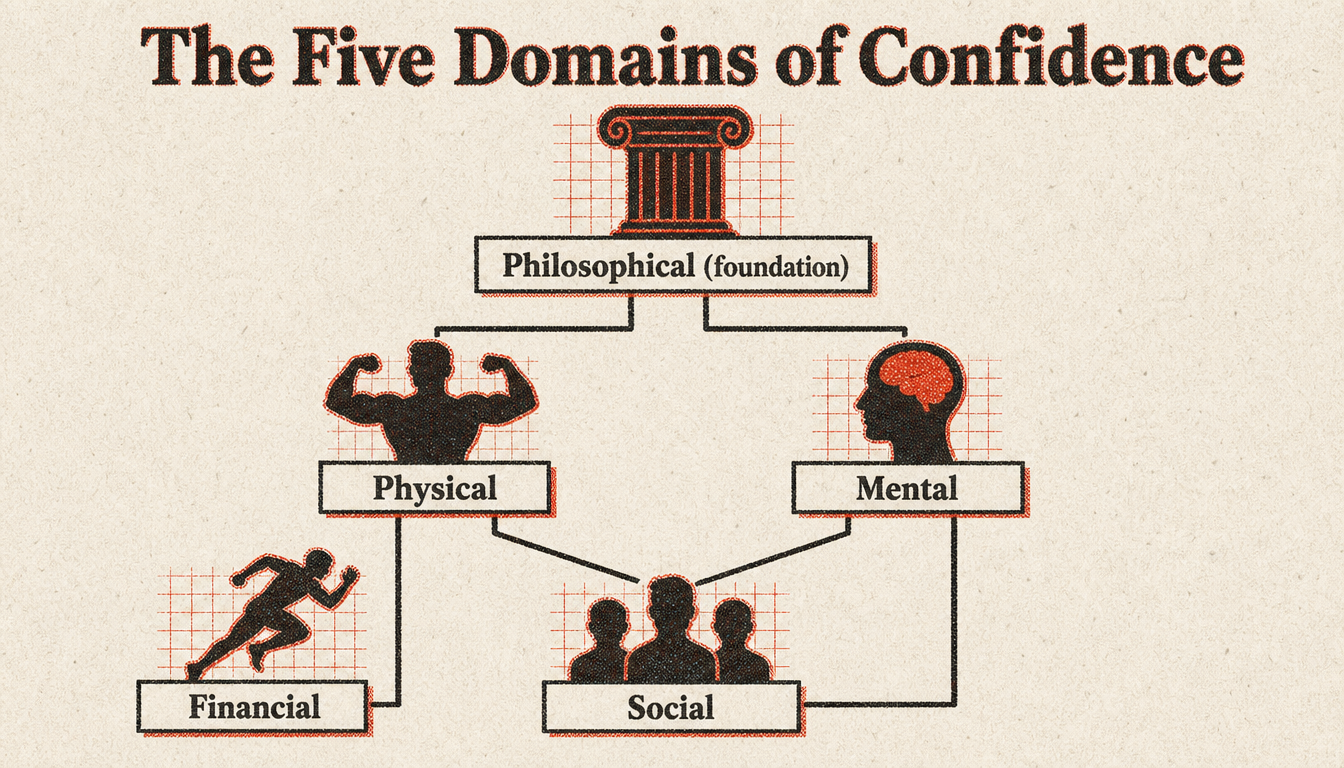
The Five Domains at a Glance

| Domain | What It Trains | Primary Practice | Priority |
|---|---|---|---|
| Physical | Bodily competence, pain tolerance, presence | Strength training, hard cardio, sleep discipline | Foundational |
| Mental | Focus, emotional regulation, decision quality | Journaling, cold exposure, deep work, meditation | Foundational |
| Social | Voice, eye contact, boundary-setting, leadership | Deliberate conversation, conflict, public speaking | High |
| Financial | Independence, options, long-horizon thinking | Skill capital, saving, deliberate spending | High |
| Philosophical | Values, mortality awareness, meaning | Daily reading, memento mori, written reflection | Foundational |
Read the columns horizontally. A man weak in the physical column often overcompensates in the social column with noise. A man strong financially but bankrupt philosophically becomes a hollow high performer who cannot answer the question of what he is actually for.
Domain One: The Physical Body as First Discipline

The body is the only domain where the truth cannot be negotiated. The weight moves or it does not. The mile is run or it is not. You showed up or you invented a reason. This is why the physical domain is where most men should begin their reconstruction. It teaches an honest relationship with effort, which every other domain requires.
What to actually train
- Strength. Compound lifts, progressive overload, three to five sessions per week. The specific program matters less than the years spent on it.
- Conditioning. Sustained aerobic work plus short, brutal intervals. A man who cannot climb four flights of stairs without heaving has surrendered ground he should hold.
- Recovery. Sleep is not a lifestyle preference. It is the substrate on which every other discipline runs. Guard it like income.
- Skill under fatigue. Combat sports, rucking, manual work. Anything that forces you to think clearly while tired.
Why it builds confidence
Strength training creates a repeatable ritual of meeting resistance, adapting, and returning stronger. This pattern imprints on the nervous system. When a hard conversation arrives, the body remembers that hard things can be worked through, not fled from. The gym is a laboratory for the soul, not a mirror for the ego.
The trap
Vanity metrics. A physique built for photographs, not for capability, produces a fragile confidence dependent on how you look under specific lighting. Train for what you can do, and how you look will take care of itself as a side effect.
Who should prioritize this domain: the man who feels an unspecified low-grade shame he cannot locate. Start here. It is almost always the body.
Domain Two: Mental Toughness and the Inner Citadel

The Stoics called it the inner citadel: the part of you no external event can reach without your permission. Modern men have surrendered this ground almost entirely. Notifications, outrage cycles, and dopamine loops have trained a generation to be governed from the outside. Rebuilding the citadel is the second domain.
What mental toughness is not
It is not suppression. It is not the grim-jawed refusal to feel anything. Men who perform stoicism as emotional shutdown are producing a caricature, not the tradition. Real mental toughness is the capacity to feel the full weight of an event, judge it accurately, and act well anyway.
What to train
- Attention. Extended blocks of undivided focus on difficult work. Ninety minutes at a time, without the phone in the room. This is the single most countercultural act available to modern men.
- Discomfort tolerance. Cold water, fasting windows, sitting with boredom instead of reaching for stimulation. The point is not the discomfort. It is proving to yourself that you can choose the harder thing when it does not matter, so you can choose it when it does.
- Reflection. Written journaling, evening review, morning intention. Marcus Aurelius wrote to himself for a reason. Thought that is not written stays vague, and vague thought is easily overrun.
- Judgment training. Reading serious books slowly. Arguing your own positions against their strongest counter. Refusing to hold opinions you have not earned.
The daily practice
Two questions every night, written on paper: What did I do today that a man I respect would have done? What did I do that he would not have? No performance, no audience. This single practice, sustained for a year, will change your character measurably.
Who should prioritize this domain: the man who is already physically disciplined but still feels reactive, scattered, or vaguely anxious. Your body is fine. Your attention is being stolen.

Domain Three: Social Presence and the Weight of Your Voice

A man can be strong, disciplined, and thoughtful, and still shrink in a room. Social presence is a distinct skill. It is trained the same way any other skill is trained: through repeated exposure to conditions that expose your weaknesses.
The components
- Voice. Speak from the chest, not the throat. Slow down. A man who rushes his sentences telegraphs that he expects to be interrupted.
- Eye contact. Hold it without staring. The man who looks away first in a friendly exchange is not weak. The man who cannot hold it at all has work to do.
- Physical stillness. Nervous energy leaks through fidgeting, over-nodding, filler laughter. Learn to be still. Stillness reads as certainty.
- Directness. Say what you mean in as few words as necessary. Do not soften every request into a question. Do not apologize for taking up space you are entitled to.
- The capacity to disagree. A man who cannot disagree in the room cannot be trusted, because his agreement means nothing.
How to train it
Put yourself in situations that require the skill. Join something that forces you to speak: a debate group, a toastmasters circuit, a martial arts class where you must ask for correction, a sales role, a leadership position at a volunteer organization. Reading about social skill is like reading about swimming. You will not learn it dry.
The trap
Performance. The internet is full of men performing dominance through curated body language and manufactured aggression. This is theater, and the audience knows. Real social weight comes from having something to say and not being afraid to say it plainly, from a settled body.
Who should prioritize this domain: the man who is competent in private and diminished in public. The gap between the two closes with reps, not reading.
Domain Four: Financial Sovereignty and the Long Horizon

A man who cannot walk away from a job, a relationship, or a city because of money is not free. Financial competence is not about accumulation for its own sake. It is about buying back your options and lengthening the horizon over which you can afford to think.
The principles
- Skill capital first. Your capacity to produce value is your primary asset for most of your life. Invest in becoming genuinely, unambiguously good at something the market rewards. Then negotiate accordingly.
- Live below your income. Lifestyle inflation is the mechanism by which raises become invisible. A man who spends everything he earns is one bad quarter from panic, regardless of the salary on his contract.
- Own your time in stages. Every unit of saved money is a unit of future time you have purchased back. Frame savings as freedom, not deprivation.
- Refuse status spending. Most luxury purchases are anxiety management dressed as reward. A confident man does not need his car to speak for him.
Why this builds confidence
The knowledge that you could quit tomorrow changes how you show up today. Not because you plan to quit, but because your presence is voluntary. Voluntary presence is the foundation of dignified work and dignified relationships. A man who stays because he cannot leave is a hostage. A man who stays because he chooses to is a partner.
The trap
Optimization theater. Endless research into the marginally better savings vehicle or investment product, while ignoring the two variables that actually matter: how much you earn and how much you spend. Master those first. The rest is decoration.
Who should prioritize this domain: the man who feels trapped by his current situation and cannot articulate why. The answer is almost always that his fixed costs have removed his optionality.
Domain Five: Philosophy, Mortality, and What You Are Actually For
A man can train the first four domains for a decade and end up a highly optimized instrument aimed at nothing. This is the modern condition: capable, disciplined, and quietly lost. Philosophy is not a luxury pursuit for the other domains. It is the domain that tells the others what they are for.
The core questions
- What kind of man do you want to have been at your funeral, and are your current weeks moving toward or away from that man?
- What would you do differently if you knew you had ten years left? Two? What does that tell you about what you are avoiding?
- Whose approval are you organizing your life around, and did you choose them, or did they simply happen to you?
- What virtues do you claim to hold, and where in the last month did you fail to act on them?
The practices
- Memento mori. A daily, honest acknowledgment that you will die and that the date is not negotiable. This is not morbidity. It is the sharpest available tool for cutting through the noise of what does not matter.
- Reading the serious dead. Marcus Aurelius, Seneca, Epictetus, and the tradition around them. Read slowly, with a pen. Aim for one page of real thought over fifty pages of skimming.
- Written examination. Regular, unflinching review of your own behavior against your stated values. Not to punish. To recalibrate.
- Selecting your influences. The men whose opinions you weight, whether alive or dead, shape your character silently. Choose them deliberately.
Why this is the load-bearing domain
Without philosophy, discipline becomes a treadmill with no destination. You get faster and more efficient at running toward nothing in particular, and eventually the exhaustion of that meaninglessness collapses the other domains one by one. The physical becomes vanity. The mental becomes anxiety management. The social becomes performance. The financial becomes hoarding.
Philosophy answers the only question that matters at the end: was any of it for something? A man who can answer that question honestly walks differently.
Who should prioritize this domain: the man who has already trained the others and feels the hollow at the center. The hollow is the shape of the missing foundation.
Which Domain to Train First, by Situation
Most men cannot train all five domains at full intensity at once. Choosing the correct entry point matters more than the theoretical ideal. Use the table below.
| Your Current Situation | Start With | Why |
|---|---|---|
| Low-grade shame you cannot locate | Physical | The body is almost always the honest answer |
| Physically fit but scattered and reactive | Mental | Your attention has been outsourced |
| Competent in private, diminished in public | Social | Presence is trained through exposure, not thought |
| Feel trapped, cannot articulate why | Financial | Fixed costs have removed your options |
| High-performing but hollow | Philosophical | Discipline without direction eventually collapses |
| Fully starting from zero | Physical + Philosophical together | Body gives you traction; philosophy gives you aim |
Notice that four of the six situations point to something other than the flashy answer. Most men who consume self-development content believe their problem is social or financial when it is actually physical or philosophical. Diagnose honestly.
How the Domains Reinforce Each Other
The domains are not silos. They are a system. Progress in one accelerates the others, and neglect in one drags the others down. A few examples of the mechanics:
- Physical to mental. Hard training teaches your nervous system that discomfort is survivable. This transfers directly to the capacity for deep work and difficult conversations.
- Mental to social. A regulated inner state produces stillness in the body. Stillness reads as presence. You do not have to perform confidence when you are actually calm.
- Social to financial. The capacity to negotiate, disagree, and speak plainly is worth more in career terms than most technical skills. Men who cannot ask for what they are worth do not receive it.
- Financial to philosophical. Enough saved money creates the space to think about what you actually want, rather than what your bills demand. Philosophy is hard to practice from panic.
- Philosophical to everything. Clear values simplify decisions. Simplified decisions preserve energy for the domains that need it.
This is why partial training fails. The man who lifts heavy but reads nothing eventually plateaus not in the gym, but in the meaning he can extract from what the gym is for. The man who reads everything but trains nothing eventually finds his ideas cannot survive contact with an uncooperative body.
The Timeline Nobody Tells You
Real confidence built through the five domains is not a thirty-day project. Set your expectations against the following honest timeline:
- First 90 days. You will feel worse before you feel better. Old identities die loudly. The discomfort is the work, not a sign the work is failing.
- Six months. The first observable changes in how you carry yourself. Other people notice before you do.
- Two years. The domains begin to interlock. You stop having to force the disciplines. They become defaults.
- Five years. You have become someone your former self would not recognize. The confidence is no longer something you are building. It is simply what you are made of.
- Twenty years. You are the man other men quietly measure themselves against, whether or not they say so.
Most men quit somewhere between month three and month nine, because the visible payoff has not yet caught up to the invisible work. The men who continue are not more talented. They have simply understood that the process is the point, and that no shortcut exists.
The Framework in Summary
Confidence in a man is not a mood, a mindset, or a marketable skill. It is the observable output of five trained domains: physical capability, mental discipline, social presence, financial sovereignty, and philosophical grounding. Weakness anywhere leaks everywhere. Strength in all five produces a man who is not easily moved.
The selection principles for building your own practice:
- Diagnose honestly. Start with the domain your current situation actually points to, not the one that flatters your existing strengths.
- Prioritize the load-bearing walls. Physical and mental discipline hold the structure up. Philosophy anchors it to something worth holding up.
- Train in reps, not in theory. Reading about a domain is not training the domain. Exposure to resistance is training.
- Measure in years. Anything meaningful takes longer than the internet has taught you to expect.
- Refuse performance. The moment your practice becomes something you display, it stops being practice and becomes theater. Do the work when no one is watching. That is the entire point.
The men who move through the world with weight did not find a secret. They chose the harder path, in five domains, for long enough that the choosing stopped feeling like effort and started feeling like character. That path is available to you starting today. Nothing about it is easy. Everything about it works.