

How to Develop Emotional Control Without Suppressing What You Feel

Emotional control is not the absence of feeling. It is the discipline to feel fully, think clearly, and act deliberately, all in the same breath. Most men are taught the opposite: swallow it, harden up, move on. That approach works for about a decade before the pressure finds another exit, usually through a wrecked marriage, a health scare, or a career built on avoidance.
This guide walks through a practical framework for building genuine emotional control. Not repression. Not performance. A working system you can rehearse until it becomes character.
Goal of this article: By the end, you will have a five-stage protocol for handling any emotional surge, a diagnostic to spot which stage you fail at, and a rehearsal method to install the habit over roughly 90 days.
- Reading time: about 18 minutes
- Difficulty: intermediate — assumes basic self-awareness and willingness to practice daily
- Time to internalize: roughly 60–90 days of consistent rehearsal
What You Need Before You Start
Before working through the protocol, gather the following. Skipping this section is the most common reason men bounce off frameworks like this one.
Tools and inputs:
- A pocket-sized notebook or a private notes app you will actually open
- A recurring 10-minute block, ideally morning and evening
- One trusted person who will tell you the truth when you ask
- A short list of the last three situations where you lost composure
Mental prerequisites:
- Willingness to distinguish between what you feel and what you do about it
- Acceptance that emotions carry information, not commands
- Tolerance for feeling clumsy for several weeks while the new pattern installs
Emotional control is a motor skill, not an insight. You do not think your way into it any more than you think your way into a clean deadlift. You rehearse it under load until the body knows the move.
The Difference Between Suppression and Control

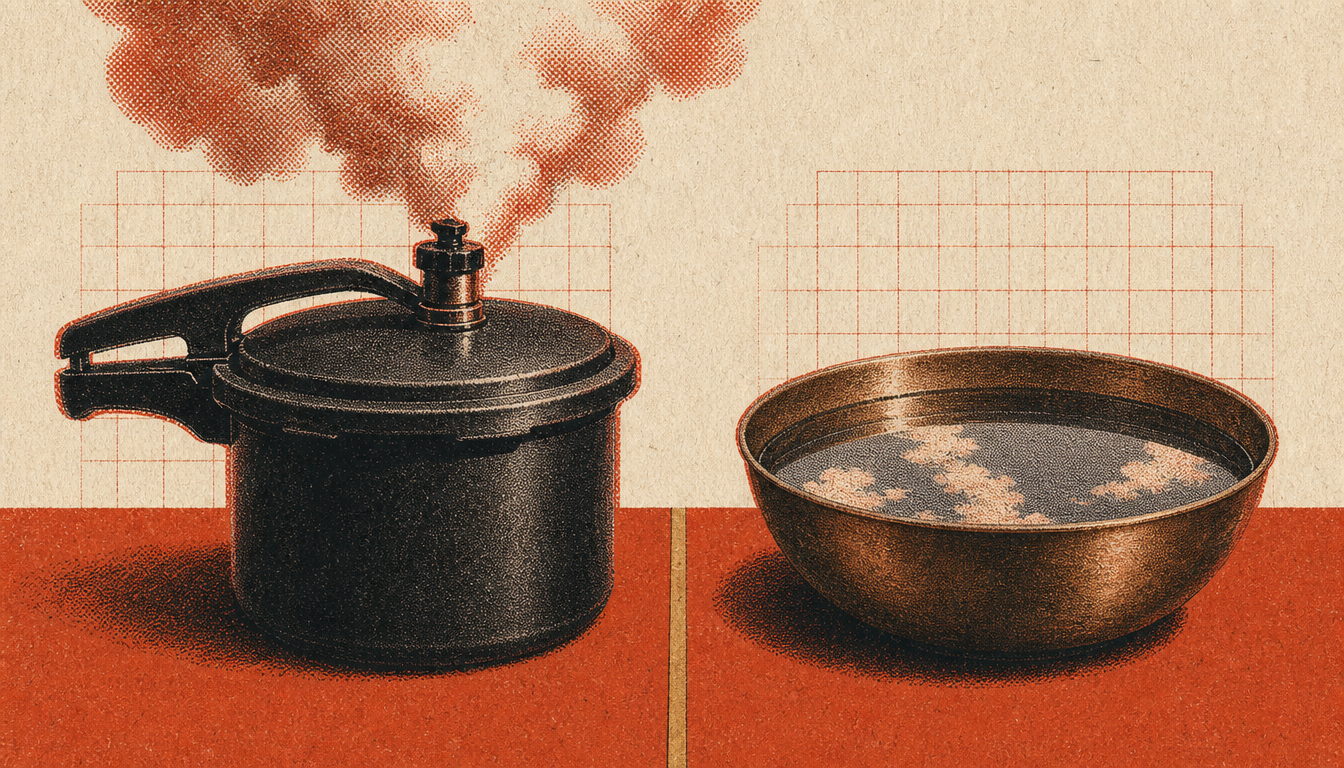
Suppression is the strategy most men default to because it looks like strength from the outside and requires no skill to execute. You feel something inconvenient, you clench, you carry on. The feeling goes underground. It does not disappear.
Control is different. Control means the emotion registers fully, gets named, gets weighed against your values, and then informs your action without dictating it. The Stoics did not teach men to feel nothing. They taught men to feel accurately and respond in accordance with reason. Marcus Aurelius wrote his private journal because he was rattled, not because he was serene.
Here is how the two approaches compare across the dimensions that matter.
| Dimension | Suppression | Emotional Control |
|---|---|---|
| What happens to the feeling | Pushed down, stored in the body | Acknowledged, named, examined |
| Physical cost over years | Tension, sleep disruption, chronic irritability | Baseline nervous system regulation |
| Effect on decisions | Emotions leak into unrelated choices | Emotions inform relevant choices |
| Effect on relationships | Distance, sudden explosions | Presence, calibrated honesty |
| Perceived from outside | Stoic mask | Actual composure |
| Trainable | No — it is avoidance | Yes — it is a skill |
The men who look calm and are calm have done the second thing. The men who look calm and detonate every eighteen months have done the first.
The Five-Stage Protocol

The protocol below is the core of the system. Each stage is a discrete skill. You will be better at some than others, and the diagnostic later in this article will show you where to focus. The diagram below shows how the five stages connect in real time when an emotional surge hits.
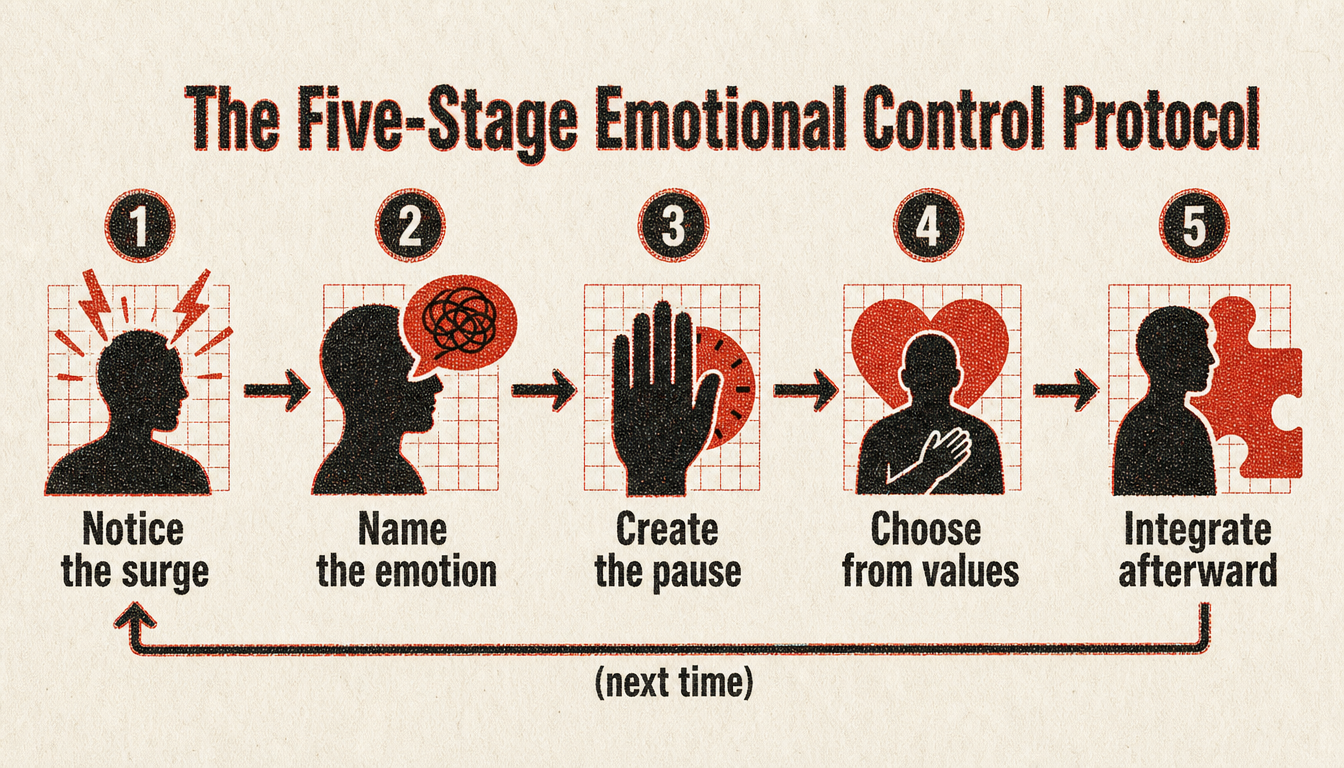
Step 1: Notice the surge before it becomes behavior
The window between feeling and action is often less than two seconds. If you cannot notice the surge inside that window, you cannot control what follows. Noticing is a body skill first, a mind skill second.
Learn your personal tells. For most men, one or more of these appear first:
- Jaw clench or tongue pressing against the roof of the mouth
- Shoulders rising toward the ears
- Breath moving into the upper chest and shortening
- A specific heat pattern — face, chest, or back of the neck
- An internal narrator getting loud and repetitive
For three days, do nothing but log which tell appears first in which situation. No behavior change yet. You are building the sensor before you build the response.
Confirmation: You should be able to say, out loud or in writing, "the jaw goes first when I feel disrespected" or "the chest heat goes first when I feel behind at work." If you can name your first tell in at least three recurring situations, this stage is functional.
Step 2: Name the emotion precisely
Vague labels produce vague responses. "I'm stressed" is not a diagnosis. It is a shrug. Naming forces the mind out of the limbic loop and into the prefrontal cortex, which is the part of you that can actually decide something.
Use a wider vocabulary. "Angry" might really be humiliated, threatened, disrespected, or grieving. "Anxious" might really be under-prepared, over-committed, or lonely. The precision matters because the correct response differs. Humiliation calls for a boundary. Under-preparation calls for work. You cannot mix them up without paying for it.
A useful shortcut is the two-word format: "I feel [primary emotion] because [specific stimulus]." Say it in the first person, in the present tense, without justifying or arguing with it.
Confirmation: The naming is working when you notice some reduction in intensity after accurate labeling — a sign that the prefrontal cortex has engaged. If the feeling does not shift at all, the label is probably wrong. Try again.
Step 3: Create the pause
The pause is where control lives. It is a deliberate gap between stimulus and response, long enough for reason to enter the room. For most situations, four to six seconds is enough. For high-stakes ones, minutes or hours may be required.
The physical anchor is breath. Not a yoga performance — one slow exhale, longer than the inhale. That single breath drops sympathetic arousal enough to think. If you need more, take three. The point is not relaxation. The point is bandwidth.
During the pause, ask one question: What outcome do I actually want here? Not what would feel good in the next ten seconds. What would you want to be true tomorrow morning, next week, in five years.
Confirmation: The pause is working when you can recall, mid-situation, the outcome you actually want. If you cannot, you skipped straight to reaction.
Step 4: Choose the response that fits your values
This is the stage most self-help content skips because it requires you to know what you value, in specific terms, before the surge happens. If your values are a vague cloud of "be a good man," they will not survive contact with a triggering email.
Write down four or five operating principles. Concrete ones. Examples of the shape:
- I do not raise my voice at people who cannot raise theirs back to me
- I do not send messages I would not sign in front of my father
- I address the person, not the audience
- I say the hard thing once, calmly, and let it land
In the pause, the response is whichever action honors the relevant principle. Sometimes that is speaking up. Sometimes it is walking away. Sometimes it is doing nothing visible and processing later. The action is not always the same, but the source is.
Confirmation: You should be able to name which principle you acted from within a minute of acting. If you cannot, you improvised, which is fine occasionally but not as a system.
Step 5: Integrate what happened afterward
The final stage is the one nobody does, which is why the same emotional patterns replay for decades. After the situation ends, spend two or three minutes reviewing it. Not ruminating. Reviewing.
Three questions, in writing when possible:
- What did I actually feel, and what was the stimulus?
- Where in the protocol did I do well, and where did I fail?
- What is the smallest adjustment for next time?
Integration is what turns episodes into learning. Without it, you have the same fight, the same overreaction, the same withdrawal on a loop, and you call it "who you are."
Confirmation: After 30 days of integration, you should see patterns. Specific stimuli, specific tells, specific failure points. The patterns are the map. You cannot navigate what you have not mapped.
Diagnosing Where You Fail

Nobody fails at all five stages equally. Most men have one or two collapse points that account for the majority of their lost composure. Identifying yours saves months of general effort.
Read the profiles below and find the one that describes you most accurately. There is no shame in any of them. Precision here is worth more than pride.
| Failure Stage | How It Looks | Primary Fix |
|---|---|---|
| Stage 1 — Noticing | You realize you were angry an hour after the argument ended | Body-based awareness practice; log tells daily |
| Stage 2 — Naming | Everything gets called "stress" or "fine" | Expand vocabulary; use the two-word format |
| Stage 3 — Pause | You react in under two seconds and regret it in ten | Breath drill; rehearse delay in low-stakes situations |
| Stage 4 — Choice | You pause, then still do the thing you did not want to do | Write and memorize operating principles |
| Stage 5 — Integration | Same fight, same outcome, for years | Nightly two-minute review, in writing |
Pick one stage. Work only on that stage for two weeks before touching the others. The temptation to fix everything at once is the reason most frameworks collapse in the first month.
Rehearsing the Protocol Under Load

Knowing the protocol and executing it under pressure are separate skills. The gap is closed by deliberate rehearsal, in graded difficulty, until the response is automatic. Below is a 90-day structure.
Weeks 1–2: Low-stakes reps
Practice the full five-stage sequence on minor irritations. Slow traffic. A dismissive email. A stubbed toe. The stakes are small on purpose. You are learning the choreography, not testing it.
Aim for five conscious reps per day. Log them briefly. By the end of week two, the sequence should feel less foreign, though still deliberate and clumsy. That is correct.
Weeks 3–6: Medium-stakes reps
Move to situations with real weight. A tense conversation with your partner. A disagreement at work. Feedback you did not want to hear. These will expose your collapse points clearly.
Expect to fail often in this phase. Failure that gets integrated is progress. Failure that gets hidden is not. Use the nightly review religiously.
Weeks 7–12: High-stakes and cold reps
By this phase, the protocol should engage without conscious effort in medium situations. Now test it under the conditions that used to break you — the family member who knows exactly what to say, the professional setback, the news that lands wrong.
Also introduce cold reps: situations you deliberately seek out that stretch your composure. Difficult conversations you have been avoiding. Feedback requests. Exposure to disagreement rather than curated agreement. The nervous system adapts to what you rehearse.
Common Errors and How to Correct Them
Predictable failure modes appear across almost every man who works this system. Knowing them in advance shortens the learning curve significantly.
| Symptom | Cause | Correction |
|---|---|---|
| Protocol works alone, fails in front of specific people | Identity is entangled with their approval or disapproval | Clarify which principle applies; rehearse the response in writing before the next encounter |
| Naming feels performative or fake | Using labels borrowed from therapy language rather than your own words | Use the plainest word you would say to a close friend, not the clinical one |
| Pause turns into avoidance | Delaying the response indefinitely rather than acting from values | Set a hard deadline — respond within 24 hours, even if the response is "I need more time" |
| Composure looks like coldness to others | Skipping the acknowledgment step in conversation | Name what you feel out loud before stating your position; warmth and control coexist |
| Progress plateaus around week five | Stopped doing the nightly integration once it felt boring | Reduce it to two lines if needed, but do not skip; integration is the compounding step |
| Emotions feel muted after a few weeks | Sliding back into suppression under the label of control | Check whether the naming step is actually happening or getting skipped for speed |
The last row is the most dangerous one. Suppression dressed up as control is worse than open suppression because it comes with the belief that you have solved the problem. If your emotional range is narrowing, you are not gaining control. You are numbing.
What Mastery Looks Like
After three months of consistent work, the protocol stops being a protocol. It becomes the way you process. You still feel everything — sometimes more than before, because you are no longer spending energy pushing it down. What changes is the distance between feeling and action.
You will notice specific shifts:
- Arguments end sooner, or do not start, because you are not defending against imagined attacks
- People start telling you things they used to keep from you, because you no longer punish them for honesty
- Decisions get faster and cleaner because emotions inform them instead of contaminating them
- Sleep improves, because unfinished emotional business is not stored in the body overnight
- Your sense of who you are gets narrower and more specific, which is what identity actually is
This is not the absence of struggle. It is a working relationship with your own inner life, one where you are neither the tyrant nor the hostage. That relationship is the foundation everything else in a serious life gets built on — the work, the marriage, the fatherhood, the legacy. Everything downstream of a man is shaped by how he handles what happens inside him.
Where to go next
Once the five-stage protocol is running reliably, the natural next domains are voluntary discomfort training, which strengthens the nervous system's baseline; structured reflection practices in the Stoic tradition, which sharpen the values layer; and social presence work, which extends emotional control from the private to the public arena. Each builds on the same core capacity: staying with what is happening long enough to respond as the man you have decided to become.
Start tonight. Pick your collapse stage. Do the two-minute review before bed. Do it again tomorrow. In 90 days the man reading this article will not be the same man executing the protocol under fire. That is the point.