

How to Build a Legacy That Outlives You as an Ordinary Man
Most men confuse legacy with fame. They assume it requires a statue, a fortune, or a name etched into a building. That assumption is convenient, because it lets them off the hook. If legacy belongs only to the exceptional, the ordinary man has permission to drift.
This article rejects that premise. Legacy is not what you leave behind in stone; it is what you install in the minds, habits, and character of those who knew you. Built correctly, it propagates without your name attached. Built poorly, it dies the day they bury you.
Goal of this article: By the end, you will have a working framework for how to build a legacy through deliberate daily action, regardless of your income, status, or starting point.
Estimated reading time: 16 minutes
Difficulty: Intermediate. Knowledge is easy; sustained execution is the cost.
What Legacy Actually Means for the Ordinary Man

The Stoics had no illusions about posthumous fame. Marcus Aurelius reminded himself, in private journals never intended for publication, that even the most celebrated names would dissolve into forgetfulness within a few generations. He was right. Yet his marginal notes shape men nearly two millennia later, not because he chased influence but because he disciplined himself to live by principles worth transmitting.
That is the operative distinction. Legacy, properly understood, is the residue of how you lived, carried forward by people who absorbed it whether they realized it or not. Your children inherit your tempers. Your friends inherit your standards. Your colleagues inherit your work ethic. None of this requires permission. It happens by default. The only question is whether the residue is worth inheriting.
The Three Inheritances You Leave
Strip away sentimentality and a man leaves behind three categories of inheritance:
- Material: assets, property, financial structures. The most visible, often the least durable.
- Behavioral: the habits, standards, and reactions you modeled for those around you. Inherited unconsciously.
- Philosophical: the framework for living you transmitted through conversation, example, and conflict. The most durable when done well.
Ordinary men tend to obsess over the first, ignore the second, and never attempt the third. The ranking should be inverted.
Why Fame Is a Distraction
Chasing recognition corrupts the work. The man who builds in order to be remembered builds for an audience, and audiences are fickle. The man who builds because the work is worth doing produces something durable as a byproduct. The diagram below illustrates the relationship between the inheritances and how they compound across generations.
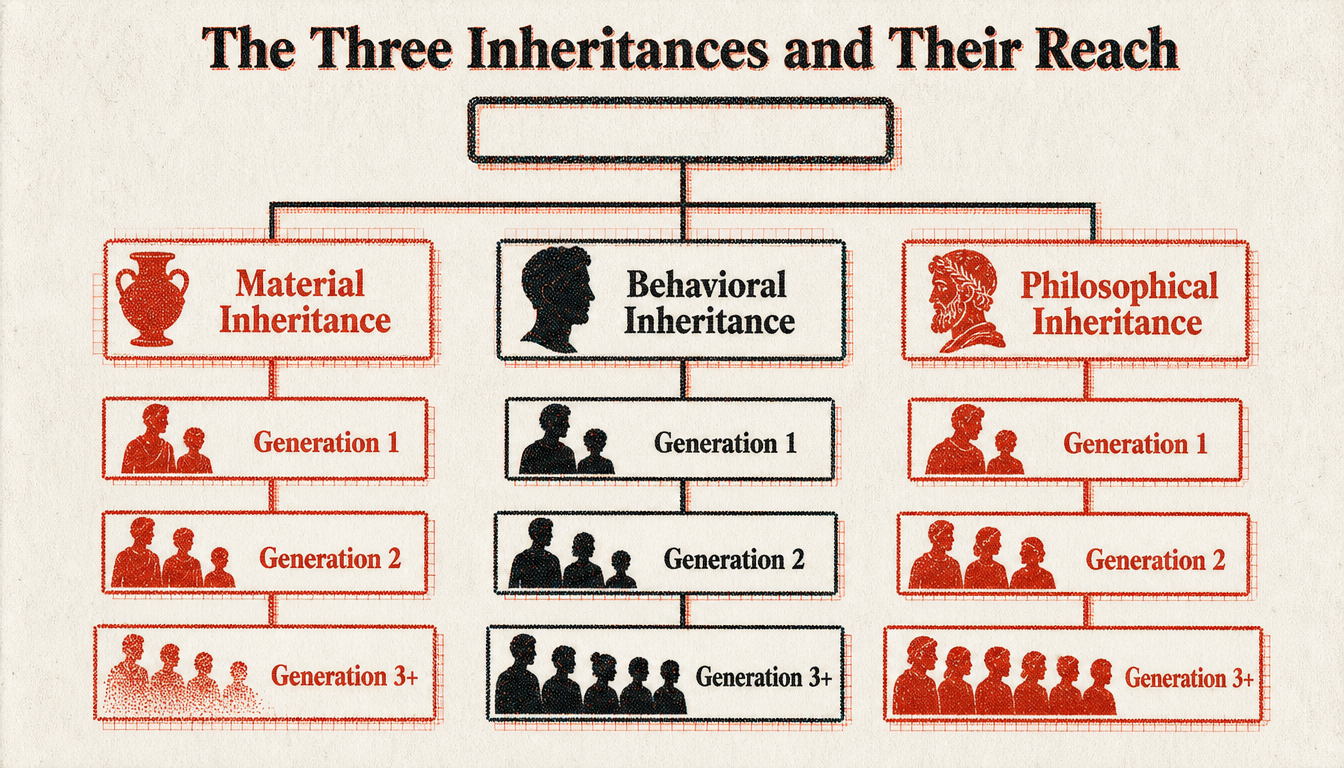
Notice that philosophical inheritance multiplies through the people you formed. They carry it into their relationships, and the signal degrades slowly. Material inheritance, by contrast, often dissipates within a generation or two regardless of size.
The Prerequisites: What You Need Before You Start

Building anything durable requires foundational pieces. Skip these and the structure collapses under its own weight.
Required internal conditions:
- An honest audit of who you currently are. Not who you intend to be.
- Acceptance that you will die, and probably sooner than you think.
- A willingness to be unremarkable in your own lifetime if the work demands it.
- Tolerance for delayed feedback. Most legacy work pays out posthumously, if at all.
Required external conditions:
- At least one relationship close enough to absorb your influence: a child, a sibling, a close friend, a mentee.
- A domain of competence, however modest, where your standards are visible.
- Enough financial stability to think beyond the next paycheck. Not wealth, just margin.
Prerequisite mindset shifts:
- From outcome-focused to process-focused thinking.
- From signaling virtue to embodying it without commentary.
- From treating your character as fixed to treating it as a daily construction project.
If any of these are absent, address them first. Skipping foundation work is the most common reason men who consume self-development material fail to convert it into anything real.
The Seven-Step Framework for Building a Legacy
What follows is a sequence, not a menu. Each step depends on the prior one. Skip ahead and the later steps lose their grounding.
Step 1: Define Your Operating Principles
Before you can transmit values, you have to know what they are. Most men have never written theirs down. They operate on inherited assumptions and react to circumstances. That is not a philosophy. That is drift.
Sit with a blank page. Write five to ten principles that govern how you intend to act when no one is watching. Be specific. "Be a good man" is not a principle. "I do not lie, even when it costs me" is a principle. "I do not raise my voice at people who cannot raise theirs back" is a principle.
→ You should finish this step with a written document, no longer than one page, that you can read in under two minutes.
Step 2: Audit the Gap Between Principle and Practice
Now compare your principles to your last thirty days. Where did you violate them? Not in theory, in fact. Be brutal. The point is not self-flagellation. The point is data.
Most men discover that their stated values and their actual conduct diverge sharply. That gap is the work. Closing it is the legacy.
→ You should produce a short list of specific, recurring violations. These are your priorities.
Step 3: Build a Daily Practice That Closes the Gap
Principles without practice are decoration. Choose two or three behaviors that, performed daily, narrow the gap identified in Step 2. The behaviors must be small enough to execute on your worst day.
| Violation Identified | Daily Practice | Frequency |
|---|---|---|
| Speak harshly under stress | Pause three seconds before responding when irritated | Every interaction |
| Avoid difficult conversations | Initiate one uncomfortable conversation per week | Weekly |
| Inconsistent physical discipline | 30 minutes of training, non-negotiable | Daily |
| Reactive media consumption | No phone for the first hour of the day | Daily |
→ You should have a practice short enough to recite from memory and concrete enough to score yes or no at day's end.
Step 4: Identify Your Transmission Targets
Legacy requires recipients. List the three to five people whose lives are most shaped by your example: children, spouse, close friends, direct reports, younger siblings. These are not abstract beneficiaries. They are specific humans absorbing your standards in real time.
Write their names. Next to each, write what you want them to inherit from you. Not what you want to give. What you want them to become because they knew you.
→ You should be uncomfortable with the specificity. That discomfort means you are no longer hiding behind abstractions.
Step 5: Engineer Visible Standards in Your Domain
People absorb what they observe. If your transmission targets never see your standards in action, they will not inherit them. This requires that your principles be visible, not preached.
Choose a domain where your conduct can be observed: your work, your home, your physical training, your handling of conflict. Make your standards legible there. Not by announcement. By repetition.
The man who trains every morning without comment teaches more about discipline than the man who lectures about it over dinner. Show, do not tell, and let the pattern speak across years.
→ You should be able to name the specific behaviors others can observe in you that demonstrate each principle.
Step 6: Document Your Thinking
Behavior transmits values, but writing transmits reasoning. Your descendants and the people you mentored will face situations you cannot anticipate. They need access to how you think, not just what you did.
Keep a journal. Not a feelings diary. A reasoning record. When you face a decision of consequence, write the principles you weighed, the trade-offs you considered, and what you chose. Date it. Do not edit for posterity.
Marcus Aurelius did this. So did Seneca. The form matters less than the consistency. A man's reasoning, preserved, is among the most durable inheritances he can leave.
→ You should have at least one entry per week, however brief, by the end of your first month.
Step 7: Mentor Deliberately
Identify at least one person younger or less experienced than you and invest in their development without expectation of return. This is the multiplier. Your behavioral and philosophical inheritance compounds through people you formed.
Mentorship does not require formality. It requires attention. Take the call. Answer the question seriously. Tell the truth when flattery would be easier. Be available across years, not weeks.
→ You should be able to name at least one person whose trajectory you have measurably altered through sustained attention.
What Completion Looks Like
If you have executed the seven steps faithfully, the result is not a finished product. Legacy is never finished. But certain markers will be present.
Your principles are written and known to you without consultation. Your daily practice is automatic enough that skipping it feels wrong. The people closest to you can articulate, when asked, what you stand for, even if they would describe it in their own words. Your written record is accumulating. At least one younger man considers you a stabilizing influence in his life.
None of this generates applause. Most of it generates nothing visible at all. That is correct. The man building a legacy worth inheriting is rarely celebrated in his own time, because the work is internal and the payoff is delayed.
Test for completion this way: if you died tomorrow, would the people closest to you be able to continue the standards you set without you present to enforce them? If yes, the transmission worked. If no, return to Step 5.
Common Failures and How to Correct Them

Men attempting this work tend to fail in predictable ways. Recognize the failure mode and the correction is usually straightforward.
| Symptom | Underlying Cause | Correction |
|---|---|---|
| Principles written but not followed | The principles are aspirational fantasy, not commitments | Rewrite them at a level you can actually meet, then raise the bar gradually |
| Daily practice abandoned within weeks | The practice was too ambitious for your worst days | Cut it in half. Consistency beats intensity |
| Family members do not absorb the standards | You are telling rather than showing, or your conduct is inconsistent | Stop preaching. Make the behavior visible and let years do the work |
| The work feels pointless because no one notices | You are still operating on a recognition reward loop | Reread Marcus Aurelius. The point was never to be noticed |
| Journal entries devolve into venting | You confused reasoning records with emotional release | Force yourself to write the principles weighed and the trade-offs considered, not the feelings |
| Mentorship relationships fade | You treated mentoring as an event rather than a sustained presence | Reduce the number of mentees and increase the duration of attention to each |
Advanced Considerations: When the Basics Are in Place
Once the framework is operational, the work shifts. The principles stop being a daily struggle and become the default. At that point, several advanced considerations become available.
Compounding Through Institutions
An individual can transmit values to a handful of people. An institution, even a small one, can transmit them to thousands across decades. If you have the means and the temperament, building or strengthening institutions that embody your principles extends the half-life of your legacy considerably. This does not require founding a company. Coaching a youth team for twenty years has shaped more men than most foundations.
Writing for Strangers
Most of what you write should be for the people who knew you. Occasionally, write for those who did not. A man's clearest thinking, set down honestly and made available, can reach people across distances he never traveled. The Stoics did this. Their reach was incidental, not strategic, but it was real.
Preparing Your Successor
If you have a son, a protégé, or a junior who will carry forward what you started, the final phase of legacy work is deliberate handoff. Most men do this poorly because they confuse handing over with letting go. The successor must be allowed to surpass you, depart from your methods, and revise your conclusions. The principles transmit; the implementations should evolve. A man who cannot tolerate his successor improving on him has built an ego, not a legacy.
The Long View
None of this is glamorous. Building a legacy as an ordinary man is the slow installation of standards in the people who happen to be near you, sustained over decades, with most of the payoff occurring after you are gone. There is no audience, no applause, no measurable return. The work is its own justification.
What you get in exchange is a life that is internally coherent. The principles you wrote down govern the practice you execute, which shapes the people you transmit to, who carry the residue forward into circumstances you will never see. That is the entire mechanism. It is unimpressive on any given day and undefeated over any sufficiently long timeline.
Start with Step 1 this week. Write the principles. Audit the gap. Build the practice. The rest follows from honest execution. The ordinary man who does this consistently for thirty years leaves a deeper mark than the celebrated man who optimized for applause and forgot to become the kind of person worth imitating.
The work is available. The only question is whether you will do it.