

Purpose vs. Passion: Why Stoics Chose the Harder, Better Path

Passion feels like fuel. Purpose acts like a keel. One pushes you forward in bursts; the other keeps you upright when the wind changes. The Stoics understood this distinction with brutal clarity, and they chose purpose every time, even though it was the harder, slower, less photogenic option.
The modern self-development industry has spent two decades selling the opposite. Find your passion. Follow your bliss. Quit the job that doesn't light you up. The pitch is intoxicating because it promises that meaning is a feeling you discover rather than a structure you build. Men in their late twenties through mid-forties have heard this script enough times to recognize its limits. The bliss-chasers are not, as a group, building lives anyone would envy at fifty.
This article argues that the purpose vs passion debate is not a matter of personal style. It is a question of what kind of man you intend to become, and which framework actually holds up when motivation collapses, which it always does.
The Modern Confusion: What We Mean When We Say These Words

Passion, in everyday usage, describes an intense feeling toward an activity, person, or idea. It is hot. It is volatile. It rises and falls. It tells you what you want to do in this moment.
Purpose is colder and more architectural. It describes a chosen direction tied to values you have decided are worth serving regardless of how you feel on a given Tuesday. Purpose asks what you are for, not what you crave.
The two get confused because they sometimes overlap. A man can feel passionate about his purpose. That is a gift, not a requirement. The problem starts when modern messaging treats passion as the gateway to purpose, as if you must first feel the lightning before you are allowed to commit. The Stoics inverted this. Commit first, then let any feeling that shows up be a bonus.
Consider the cultural script most men have absorbed:
- Discover what you love.
- Pursue it relentlessly.
- The money, meaning, and identity will follow.
This script has a fatal flaw. It assumes the discovery happens before the doing. In reality, most durable callings are forged through years of unglamorous repetition, often in fields the practitioner did not love at the start. Carpenters who love the craft did not begin by loving it. They began by being decent at it, then good, then excellent, and somewhere in that climb the love attached itself.
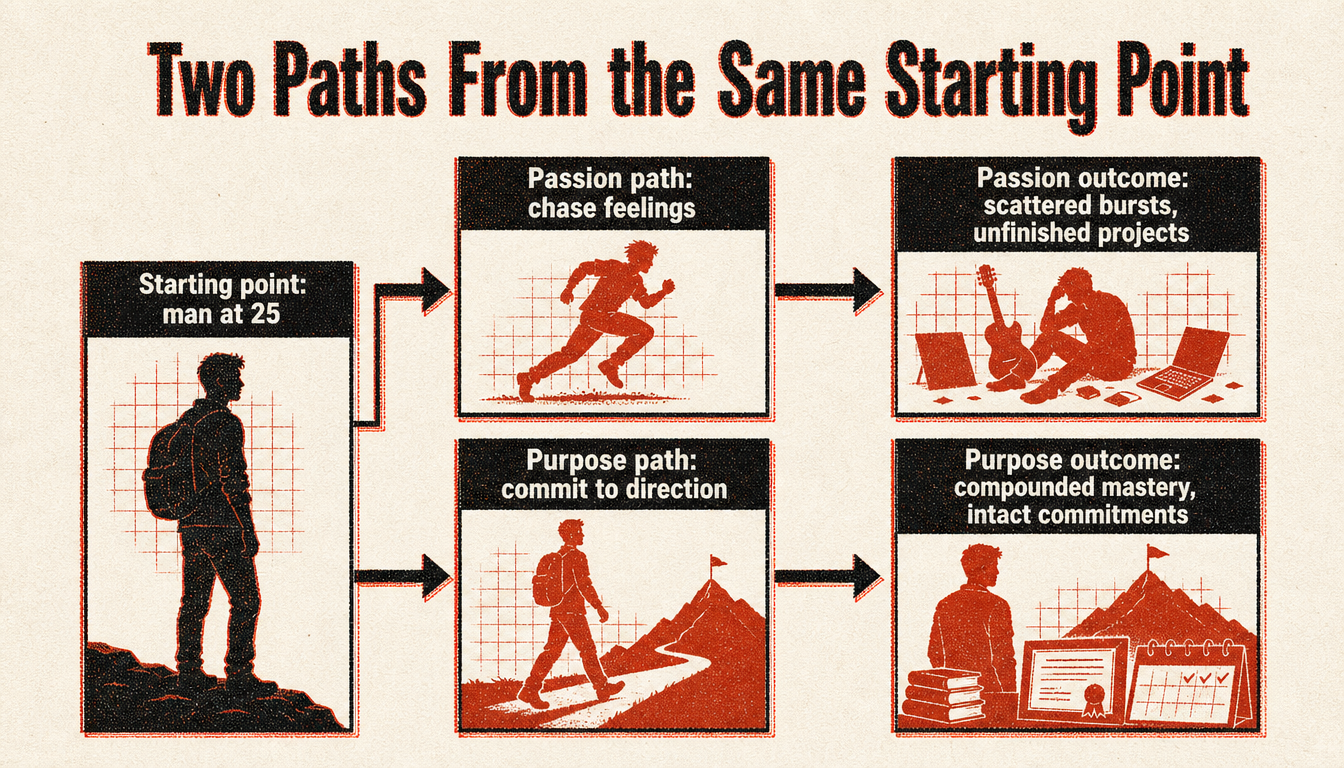
The diagram below shows how the two paths diverge from the same starting point.
The Stoic Position: Purpose as Architecture, Passion as Weather

Marcus Aurelius did not write the Meditations because he felt passionate about journaling. He wrote them because he had decided, in advance, what kind of emperor and man he intended to be, and the writing was a tool for staying aligned with that decision. Epictetus did not teach because teaching set his soul on fire on any particular morning. He taught because reason and virtue were, in his framework, the only things worth orienting a life around.
The Stoic move is to treat your emotional weather as data, not direction. Feelings tell you what is happening inside you; they do not tell you what to do. What to do is a question for your reasoned commitments, which you established when you were calm and which you refuse to renegotiate when you are tired, bored, or excited.
This is why purpose is the harder path. Passion outsources the work of deciding to your nervous system. Purpose makes you sit down and decide, then keep deciding, often in defiance of the nervous system's preferences.
What Purpose Actually Requires
A purpose worth having tends to share a few features:
- It is chosen, not discovered. You are not unearthing a hidden truth about yourself. You are committing to a direction because you have reasoned it is worth serving.
- It is tied to virtue. A purpose that requires you to become a worse man to fulfill it is not a purpose. It is an appetite wearing a suit.
- It outlasts your moods. If a bad week can end it, it was never structural. It was a mood you mistook for a calling.
- It serves something beyond your own pleasure. Family, craft, community, principle. Pure self-gratification cannot anchor a life because it has no horizon.
Notice that none of these features require the man to feel ecstatic about his purpose. Marcus Aurelius famously dreaded mornings. He got up anyway, because the dread was weather and his duty was architecture.
Why Passion Fails as a Life Strategy

Passion has three structural problems as an organizing principle for a man's life.
First, it is unreliable. Feelings have a half-life. The thing that thrilled you at twenty-three rarely thrills you the same way at thirty-eight, not because something is wrong with you, but because the human nervous system adapts to any stable input. If your reason for doing the work is the thrill, and the thrill fades, you now have no reason. You either manufacture artificial novelty, which is exhausting, or you quit and look for the next hit.
Second, it is easily mistaken. Passion and infatuation share a chemistry. The same surge that makes you feel called to start a business at midnight can make you feel called to text someone you should not text. Without a framework outside the feeling, you cannot tell which signals to follow and which to ignore. Stoic practice exists partly to give a man that framework.
Third, it cannot survive boredom. Every worthwhile pursuit contains long stretches of tedium. Writing a book is mostly grinding through the messy middle. Raising children is mostly the same small acts repeated for two decades. Building a body is mostly showing up to the same gym to do similar work. Passion-driven men hit these plateaus and conclude something is wrong. Purpose-driven men hit them and conclude this is the work.
The honest counterargument is that some men do build remarkable lives starting from intense passion. True. But examine those lives closely and you find that passion was the spark, not the engine. Somewhere early on, those men converted the spark into a structural commitment, and that commitment is what carried them through the years passion could not.
The Practical Comparison: Two Frameworks Side by Side

Theory is cheap. The question is how these two operating systems behave when you actually run them inside a man's life. The table below maps the differences across the dimensions that matter.
| Dimension | Passion-Driven Life | Purpose-Driven Life |
|---|---|---|
| Decision-making | What feels right today | What aligns with chosen principles |
| Response to boredom | Seek novelty, often quit | Recognize boredom as a stage of mastery |
| Response to failure | Identity crisis, retreat | Data for adjustment, continue |
| Time horizon | Weeks to months | Years to decades |
| Source of motivation | External and emotional | Internal and structural |
| Relationship to discipline | Discipline as constraint | Discipline as expression |
| What others see | Bursts of intensity, gaps | Consistent, quiet competence |
Read down the right column and you will recognize the men who actually compound across a lifetime. They are not the loudest in the room at thirty. They are the ones still standing at fifty-five with intact marriages, substantial work behind them, and a calm presence that younger men instinctively respect.
The Misread Stoic
A common misreading treats the Stoic as a man without passion, a stone-faced creature who has suppressed his appetites and feels nothing. That is not the doctrine. The Stoic feels everything. He simply does not let any single feeling cast a vote it has not earned. He has placed his feelings under the same scrutiny he gives any other input, and he acts on principles he established when his head was clear.
This is why Stoic men often appear, to outsiders, as quietly intense. The intensity is real. It is just channeled rather than splattered.
How to Translate Purpose Into Daily Practice

Knowing that purpose beats passion is worthless without a system to live it. Most men who read philosophy stop here. They nod, close the book, and resume drifting. The translation step is where the real work happens, and it is uncomfortable because it requires you to write things down and then be held to them by your own past self.
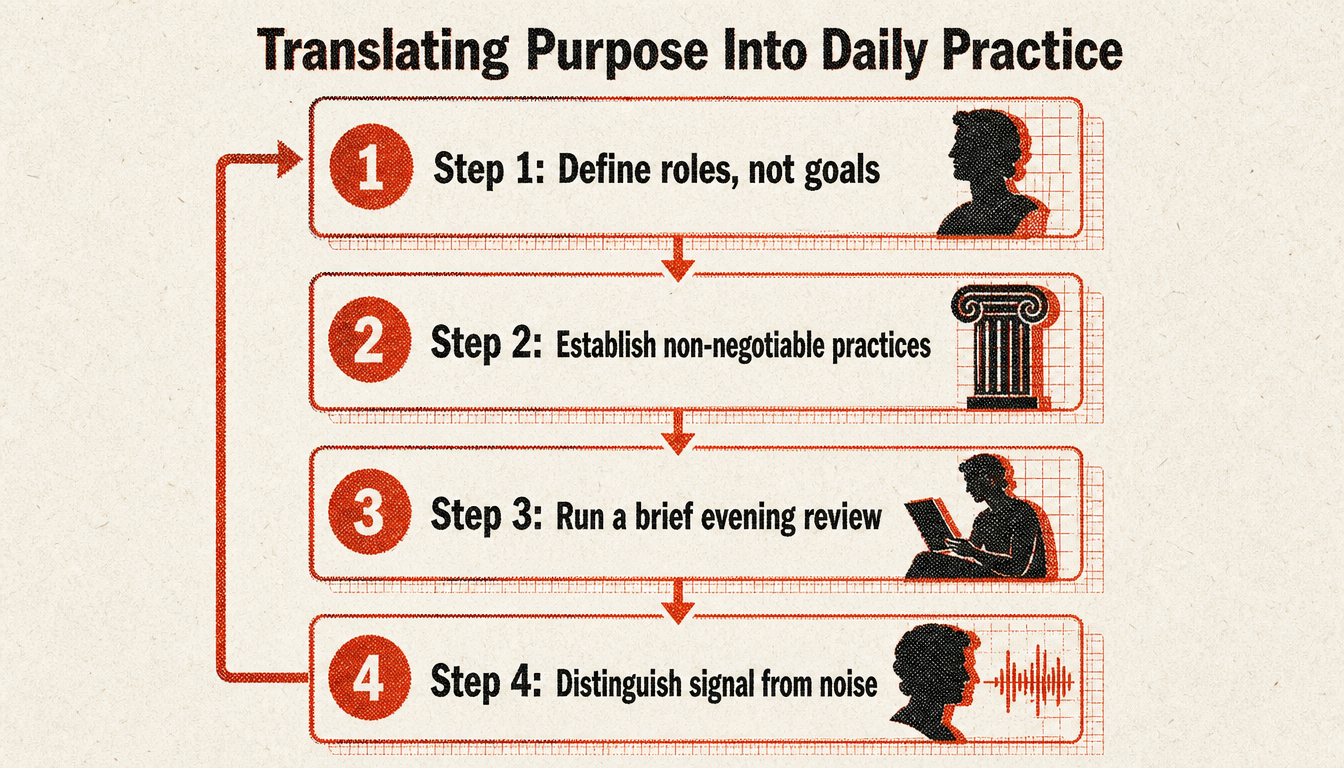
The process below is one practical structure. It is not the only one, but it has the virtue of being simple enough to actually execute.
Step One: Define the Roles, Not the Goals
Goals are brittle. Roles are durable. A goal of running a marathon ends the day after you run it. A role as a man who keeps his body capable lasts your entire life. Write down the four or five roles you intend to occupy seriously: husband, father, craftsman in your field, friend, citizen. Then define what excellent execution of each role looks like in concrete behavior, not vague aspiration.
Step Two: Establish Non-Negotiable Practices
For each role, identify two or three practices you will perform regardless of mood. These are your daily and weekly architecture. The point is not that these practices guarantee outcomes. The point is that they guarantee you are showing up as the man you said you would be, and outcomes tend to follow that posture over years.
Step Three: Run a Brief Evening Review
Seneca recommended a nightly self-examination. Five minutes is enough. Three questions:
- Where did I act in alignment with my roles today?
- Where did I drift, and what pulled me?
- What is the single most important action tomorrow?
This practice is unspectacular and that is precisely why it works. It builds a feedback loop between your stated purpose and your actual behavior, and it gives you a daily checkpoint that no passion-driven approach can match.
Step Four: Distinguish Signal From Noise
When a strong feeling arrives, whether enthusiasm for a new project or aversion toward an old commitment, do not act on it immediately. Wait. If the feeling persists after a week of normal life, it may be signal. If it evaporates, it was noise wearing the costume of insight. Most of what feels like a calling at 11 p.m. is forgotten by Thursday lunch.
The Legacy Question: What Compounds and What Doesn't
Step back and look at the men you actually admire when you are honest with yourself. Not the influencers, not the loud success stories of a single quarter, but the men whose lives, examined at sixty, you would want to have lived. They share a pattern. They picked a direction relatively early, committed to it through several stretches when they did not feel like continuing, and let the compounding do its quiet work.
Passion does not compound. It spikes and resets. A man who has organized his life around the next thrill arrives at fifty with a collection of unfinished chapters and a vague feeling that he was supposed to have built something by now. He often did not lack talent or opportunity. He lacked a framework that could survive his own boredom.
Purpose compounds because it is indifferent to your weather. The marriage you tended through the dull years is now twenty-five years deep. The craft you practiced when no one was watching is now skilled work that younger men seek you out for. The body you maintained through unremarkable workouts is still serviceable when your peers are breaking down. None of this happened because you felt passionate every day. It happened because you decided, then kept deciding.
What This Means for the Next Decade of Your Life
If you are reading this and you are somewhere between twenty-five and forty-five, you are inside the window where these decisions matter most. The choices you make in this decade about which framework to run will largely determine what you have built by the time you are sixty. Some practical implications:
- Stop waiting to feel ready. You will not feel ready. Readiness is a story passion tells to delay commitment.
- Choose your direction with a cool head. Pick something you can defend on principle, not just appetite. Then close the question and start working.
- Build the daily architecture before you need it. The practices that hold you up in your forties are the ones you installed in your thirties.
- Accept that the work will sometimes bore you. Boredom is not a sign you chose wrong. It is a sign you have entered the part of mastery where the romance has worn off and the real work begins.
- Treat your feelings with respect but not deference. They are weather. You are the architect of the house.
None of this is a prediction that purpose-driven men feel less. They often feel more, because they are not numbed by the constant churn of chasing the next high. They have the bandwidth to feel deeply because they have stopped letting feelings run the schedule.
Closing the Loop: Why the Harder Path Is Better
The Stoics chose purpose over passion because they had run the experiment in their own lives and watched it run in others. They saw what happens to men who organize a life around feelings, and they saw what happens to men who organize a life around chosen principles. The verdict was not close.
The harder path is better because it is the only one that holds up under the conditions a real life imposes. It works when you are tired. It works when the marriage is in a dry stretch. It works when the work is going badly. It works when no one is clapping. Passion cannot make any of those claims, which is why a life built on it tends to collapse exactly when a life should be holding firm.
None of this requires you to become humorless or grim. The cliché of the joyless Stoic is wrong. Men who have settled the question of what they are for tend to be lighter, not heavier, because they have stopped wasting energy relitigating their direction every Sunday night. The settled question frees the man.
So the question to sit with is not whether passion has a role in your life. It does, and it should. The question is which one of them gets to drive. If you let passion drive, you will go many places, fast, and most of them will not be where you intended to end up. If you let purpose drive, with passion as a welcome passenger when it shows up, you will go fewer places, slower, and arrive somewhere worth having gone.
The Stoics made their choice. The harder path, every time. The question now is what you are going to do with the next twenty years of yours.