Motivational content does not fail because it lacks intensity. It fails because it works exactly as designed: to produce a feeling, not a man. If you have ever watched a hype video at 6 a.m. and made no different decisions by Wednesday, you already know this. The fix is not louder motivation. The fix is a structured philosophy with daily mechanics attached.
The Comfortable Lie Men Keep Buying

The dominant story in modern self-help goes like this: if you can light the fire hot enough, the man will move. Find the right speaker, the right morning playlist, the right transformation story, and the rest takes care of itself. Discipline, the story implies, is a downstream effect of sufficient emotion.
This belief has become common for understandable reasons. Motivational content is cheap to produce, easy to consume, and pleasant to feel. It rewards the creator with views and the viewer with a dopamine hit that resembles progress. For a generation of men raised on highlight reels and pre-game speeches, it feels intuitively correct that the cure for a stalled life is a bigger emotional surge.
Most men reading this have already run the experiment. You bookmarked the videos. You wrote down the quotes. You felt, for a window of about forty-eight hours, that something had shifted. Then the week did what weeks do, and the new self quietly returned to the old defaults.
Why Motivational Content Stops Working After 72 Hours

The problem with motivation as a strategy is structural, not personal. You did not lack willpower. You were handed a tool designed for short bursts and asked to use it for long construction.
Three failure points show up in nearly every man who has lived on motivational content for more than a year:
Emotional dependency. Action becomes contingent on feeling fired up. On flat days, which are most days, nothing happens.
No decision framework. When a real conflict appears at work, in a relationship, with money, motivation gives you energy but no method. You feel ready, but you do not know what to choose.
No identity continuity. Each video resets you. There is no accumulating self, no code that survives the week, no standard you are answerable to when no one is watching.
The cost of staying in this loop is rarely dramatic. It is the slow version. Five years pass. Your body is roughly the same. Your craft has plateaued. Your social presence has not deepened. Your relationships run on the same scripts. You still consume the content. You still believe the next surge will be the one. Motivation is rented energy; philosophy is owned infrastructure.
What Structured Philosophy Actually Does Differently

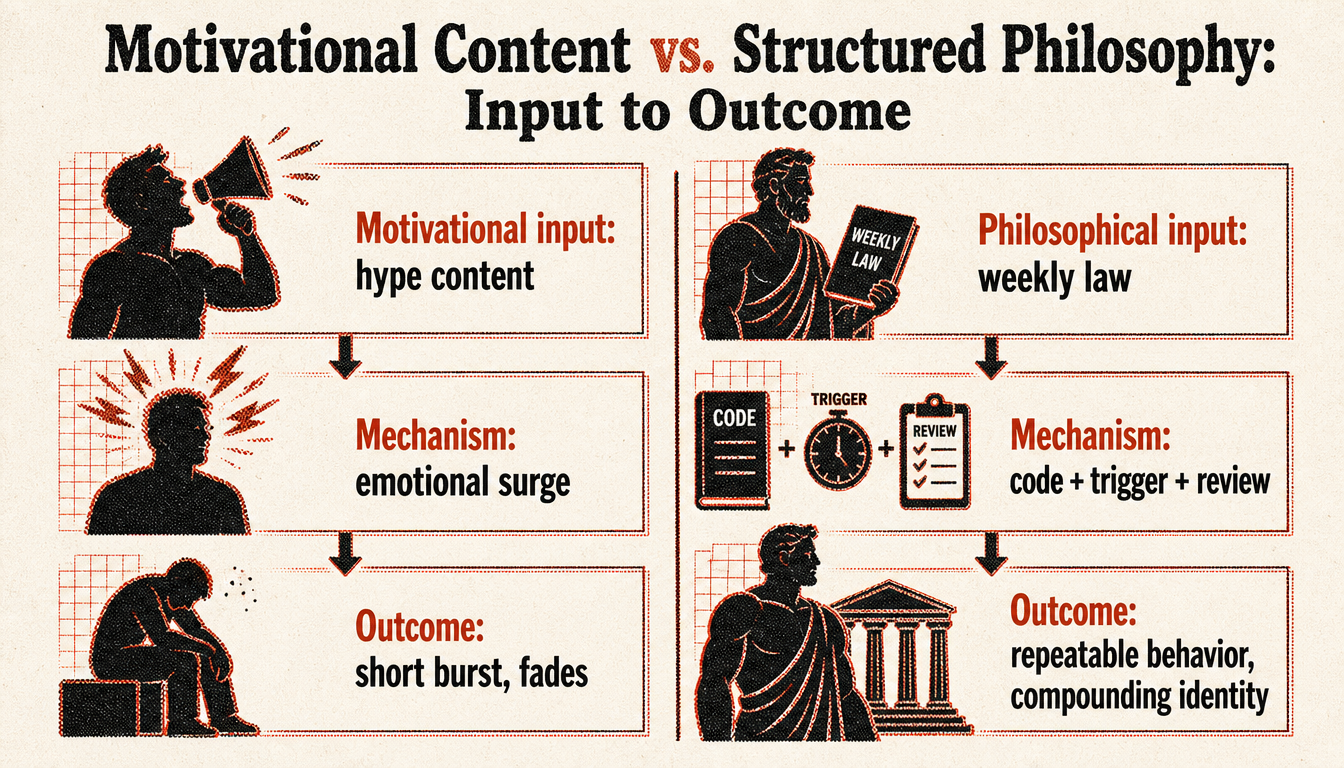
Stoicism, properly applied, is not a mood. It is an operating system for a man who has decided that his behavior should not be at the mercy of his feelings. The contrast with motivational content is sharper than most men realize. The diagram below illustrates how the two approaches route a man from input to outcome.
It separates action from emotion
The Stoic premise is brutally useful: your judgments, not external events, drive your suffering, and your behavior does not need permission from your mood. You train to act according to a standard whether you feel inspired, tired, insulted, or bored. Over months, this severs the dependency on hype. You stop needing to be moved. You move because that is what a man of your code does at this hour.
It gives you a decision framework, not a feeling
When a colleague undermines you in a meeting, motivation tells you to be a lion. Philosophy tells you which response is consistent with the man you are building: where to be silent, where to push back precisely, what to refuse to carry home. Marcus Aurelius, Epictetus, and Seneca were not writing pep talks. They were writing field manuals for men who had to make decisions under pressure with their reputations on the line.
Motivation vs. Structured Philosophy at a Glance

Side by side, the two approaches reveal what each is actually engineered to produce.
Dimension | Motivational Content | Structured Stoic Philosophy |
|---|---|---|
Primary output | Emotional surge | Repeatable behavior |
Time horizon | Hours to days | Years to a lifetime |
Triggered by | Mood, content consumption | Time of day, situation, code |
Failure mode | Fades when feelings fade | Slow drift if not practiced |
Decision-making | None provided | Explicit framework |
Identity effect | Resets each session | Accumulates over time |
Social presence | Performed confidence | Earned composure |
The point is not that emotion is the enemy. The point is that emotion is a poor foundation and a useful fuel. Philosophy lays the foundation. Emotion, when it shows up, becomes a tailwind rather than a requirement.
The Fair Objections, Answered Honestly

"Stoicism sounds cold. I do not want to suppress my feelings."
Stoicism is not emotional suppression. It is emotional sovereignty. The Stoics had wives they loved, friends they grieved, ambitions they pursued hard. What they refused was to be jerked around by impulses that had not been examined. A man who can feel anger fully and still choose his response is not cold. He is dangerous in the way a competent man is dangerous: predictable to allies, hard to manipulate for adversaries.
"I still need motivation sometimes. Are you saying it is useless?"
No. Motivational content is fine as a spark, terrible as a strategy. Use it the way you use coffee: occasionally, deliberately, with no illusion that it is building anything. The work of building is done by the code you keep when the coffee wears off.
"Ancient philosophy feels disconnected from my actual life."
It feels disconnected when it is delivered as quotes. It feels immediate when it is delivered as laws you practice this week. The reason daily-practice formats land harder than anthology reading is that the philosophy is being tested against your real Tuesday, not admired on your shelf. The body, mind, speech, power, craft, and legacy domains exist because those are the actual surfaces of a man's life where philosophy either shows up or does not.
How to Make the Shift Without Burning Down What Works
You do not need to delete every motivational channel you follow or stage a dramatic reset. The transition is quieter than that, and more durable.
Pick one domain to start. Body, mind, speech, power, craft, or legacy. The one where the gap between what you know and what you do is largest. That is your highest-leverage entry point.
Choose one law for the week. Not a goal. A standard. "This week I do not complain about things I will not act on." "This week I train before I check my phone." "This week I do not interrupt."
Define the trigger. Philosophy without a trigger evaporates. Tie the law to a time, a place, or a situation. A law that activates at 6 a.m. or every time a meeting starts has a chance. A law that floats has none.
Review honestly on Sunday. Where did you hold the line? Where did you collapse? No theater, no shame spiral. Just data on the man you currently are versus the man you are building.
Move to the next law. Do not stack five laws and watch them all rot. One law, one week. The discipline is in the restraint.
Keep the motivational content if you want, but demote it. Background music, not the soundtrack. The code is the soundtrack.
This is the mechanism the two-volume series is engineered around. The Iron Code handles the seven domains of personal discipline. The Stoic Magnetism Codex extends the same logic into social presence, the way a composed, principled man moves through rooms, conversations, and relationships without performing. One page per law is a deliberate constraint. It forces the philosophy to be practiced rather than admired.
The Quiet Transition Most Men Never Make
Somewhere in your twenties or thirties, a fork appears. One path keeps you in the loop of consumption: more videos, more quotes, more weekend resolutions, more flat Wednesdays. The other path asks you to accept something uncomfortable. The reason you have not changed is not that you have not been moved enough. It is that you have not been governed by anything.
Structured philosophy is the move from being moved to being governed, by a code you chose, in domains that matter, with mechanics that survive your moods. Motivational content will keep producing the feeling of becoming a man. Stoic practice produces the man.
The honest question is not which sounds more inspiring. It is which one you would bet the next ten years of your life on. What standard, practiced this week, would the man you intend to become already be keeping?