

Marcus Aurelius's Meditations: Lessons a Modern Man Can Use Today

A Roman emperor kept a private notebook. He never intended anyone to read it. Nearly two thousand years later, that notebook, known as Meditations, remains one of the most direct manuals on how to hold yourself together as a man under pressure. Not because it is old, but because the pressures haven't changed. The temptations toward laziness, resentment, vanity, and distraction were as loud in the imperial palace as they are in your inbox.
This guide translates Marcus Aurelius's core ideas into an operating framework you can actually run. If you have read the book and felt its weight but struggled to make it stick, that gap is the point. Wisdom without a system dissolves. What follows is a system.
What This Guide Gives You

This is written for men who already know self-improvement is not a mystery. You have watched the videos, saved the quotes, followed the accounts. You suspect most of it is packaging. You want something older, harder, and more honest.
Level: Intermediate. You do not need prior knowledge of Stoicism, but you do need the willingness to be uncomfortable with yourself.
Time to read: Around 20 minutes. Time to apply: the rest of your life.
By the end you will have:
- A working understanding of the four or five ideas from Meditations that carry the most operational weight
- Daily practices drawn directly from how Marcus used the text himself
- A frame for masculinity, discipline, social presence, and legacy that does not collapse the moment life turns hostile
- A way to read the book again and extract more each time
Prerequisites

Before going further, accept a few things:
- Marcus was not a self-help guru. He was a man writing to himself, often exhausted, often disappointed in his own performance.
- Stoicism is not the suppression of emotion. It is the training of judgment so that emotion does not run the man.
- No idea in this article works if you only agree with it. Agreement is the cheapest form of engagement.
The Core Lessons of Meditations, Translated for Modern Life

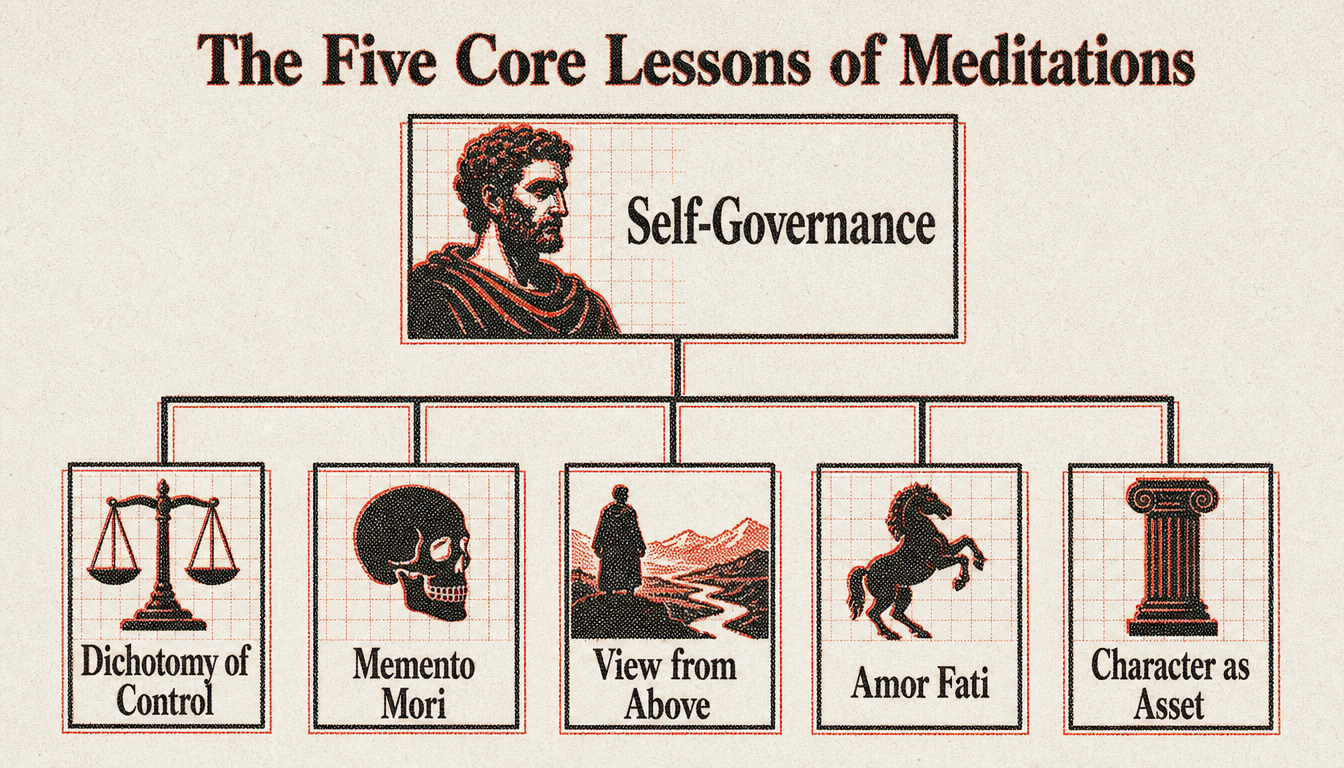
Marcus circles back to the same ideas throughout the twelve books of Meditations. He repeats them because he needed to hear them again. That itself is a lesson: wisdom is not learned once, it is rehearsed daily.
Below are the ideas that carry the most weight for a man trying to build a serious life.
1. The Dichotomy of Control
Marcus inherited this from Epictetus, but he applied it as a working ruler managing plague, war, and betrayal. Some things are up to you. Most things are not. Your job is to know the difference and stop wasting energy on the wrong column.
What is yours: your judgments, your intentions, your effort, your response. What is not: other people's opinions, outcomes, reputation, health, wealth, whether your work is recognized. Modern life inverts this. We are trained to obsess over metrics we do not control and neglect the interior work that we do.
The practical shift: before reacting to anything, ask which category it falls into. If it is outside your control, your only move is to shape your response. That is not resignation. That is where your leverage actually lives.
2. Memento Mori, Not as Aesthetic but as Filter
Marcus writes often about death. Not to be morbid, but to sharpen the value of the current hour. "You could leave life right now. Let that determine what you do and say and think."
The modern man has turned this into a tattoo, a coin, a hashtag. Marcus meant it as a decision filter. If this were your last day, would you send that petty message? Would you skip the workout? Would you keep the grudge? Would you keep postponing the conversation you owe your father?
Death does not make life meaningful by itself. Awareness of it forces you to stop treating time as infinite.
3. The View from Above
Marcus repeatedly zooms out. He pictures the city, then the empire, then the earth from above, then the sweep of centuries. From that altitude, his current worry shrinks. So does his ego.
This is a psychological maneuver, not a philosophical claim. When you are stuck in a resentment or an anxiety spiral, the emotion has you locked at ground level. Climbing mentally, seeing yourself as one man among billions across a long timeline, reduces the emotional voltage enough for judgment to return.
4. Amor Fati: Love What Happens
Nietzsche named it later, but Marcus lived it. The obstacle is not the interruption of your path. It is your path. Marcus was not saying enjoy suffering. He was saying stop demanding that reality apologize for being what it is.
When traffic ruins your commute, when your deal falls through, when your body ages, when a friend disappoints you, the Stoic response is not to celebrate the pain. It is to refuse the second layer of suffering that comes from resisting what has already happened. The first arrow you cannot always avoid. The second, you fire at yourself.
5. Character Is the Only Real Asset
Marcus reminds himself constantly that no one can take his character from him. Reputation can be smeared, wealth can vanish, health can fail, life itself is on loan. What remains, until the last moment, is the quality of the man doing the thinking.
This reframes ambition. If character is the asset, then every decision either compounds it or corrodes it. Every shortcut, every dishonest word, every avoided responsibility is a withdrawal. Every hard thing done well is a deposit.
How Marcus Actually Used the Text (And How You Should)

Meditations was not written for readers. It was a private discipline. Marcus wrote to himself in the second person, giving orders, correcting his own drift, rehearsing responses to failure before failure arrived. This is what makes the book different from every philosophy text that came before or after: it is philosophy as personal maintenance.
The Morning Rehearsal
Book Two opens with one of the most famous passages in the work. Marcus tells himself, before rising, that he will meet people today who are ungrateful, arrogant, dishonest, jealous, and unkind. He rehearses this so that when it happens, he is not ambushed.
Try it for one week. Before you check your phone, spend ninety seconds naming what will likely go wrong today. Not to invite it, but to remove its shock value. When it happens, you have already met it.
The Evening Audit
The Stoics before Marcus practiced an evening review. What did I do well today? Where did I fall short? What will I do differently tomorrow? Marcus's journal is essentially this practice made visible.
This is not journaling as feeling-download. It is a debrief, the way an operator debriefs a mission. Three questions, five minutes, on paper. Do it for thirty days and your behavior will shift more than any book will move it.
Repetition Over Novelty
Notice that Marcus repeats himself constantly across twelve books. He is not running out of material. He is admitting that the same lessons need re-inscribing. Modern self-improvement chases new frameworks weekly. Marcus's example says the opposite: master five ideas by returning to them, not fifty by skimming them.
Building a Stoic Operating System

Ideas without architecture become inspiration, and inspiration decays fast. To turn Marcus's lessons into a life, you need a structure. The frame below organizes his teaching into four domains a serious man has to manage: interior, body, relationships, and work.
The Four Domains
| Domain | Stoic Principle | Daily Practice |
|---|---|---|
| Interior (mind) | Dichotomy of control, view from above | Morning rehearsal, evening audit |
| Body | The body is on loan, use it well | Hard training, cold exposure, disciplined sleep |
| Relationships | Others are not obstacles, they are the work | Direct speech, kept promises, active listening |
| Work | Do the task in front of you with full attention | Single-tasking, refusal of shortcuts, craftsmanship |
Interior Discipline
Marcus was clear that the mind is the last territory a man controls. Everything external can be stripped. The interior can be defended if it is trained. This means noticing your own thoughts as they arrive, questioning the story you are telling yourself, and refusing to let impressions rule you without examination.
Practical version: when a strong emotion hits, name it out loud in your head. "This is anger. This is fear. This is envy." The naming creates a millimeter of distance. In that millimeter, choice returns.
Physical Discipline
The Stoics did not moralize about the body the way some modern movements do, but they treated it as a vehicle to be maintained. Marcus rose early, trained his body, ate simply, and refused to be enslaved by comfort. He was not chasing aesthetics. He was refusing softness because softness in the body predicts softness in the will.
The lesson is not a training program. It is a standard: do the hard physical thing you agreed to do, especially on the days you do not want to. The workout you finish when you would rather quit is worth more than the workout you finish when you feel great.
Social Presence
Marcus writes at length about other people, mostly because other people were his greatest test. He was surrounded by flatterers, rivals, and ambitious operators. His counsel to himself is striking: assume good faith when possible, do not be surprised by bad faith, do not perform, do not lie, and do not become bitter.
A man with Stoic presence does not need the room's approval. He listens more than he speaks. He does not fill silence with performance. He keeps his word in small things, which is why people trust him in large ones. This is not charisma. It is gravity.
Work as Craft
Marcus told himself repeatedly to focus on the task in front of him, done well, without concern for recognition. In an age of visible metrics and constant broadcast, this is the harder discipline. To do quiet, excellent work when no one is watching, and to refuse to inflate it when they are, is what separates the craftsman from the performer.
Masculinity Without the Performance
The current conversation about masculinity oscillates between two failures: apology and cartoon. Marcus offers a third path that predates both.
His model of a strong man is not the loudest, richest, or most dominant. It is the man who governs himself. Who does not flatter, does not flinch, does not chase applause, does not use others as instruments, and does not confuse aggression with strength.
Strength as Restraint
Marcus was the most powerful man alive during his rule. He commanded armies, controlled fortunes, and could have anyone silenced. The remarkable thing is how much of Meditations is about restraint. Do not lose your temper. Do not indulge your appetites. Do not use your position to satisfy your vanity.
Strength that cannot restrain itself is not strength. It is compulsion wearing armor. The men you actually respect in your own life, if you examine it, are the men whose power is visibly held back. That reserve is what makes it credible.
Duty Over Preference
Marcus rose before dawn not because he wanted to but because there was work to be done. He would rather have stayed under the blankets. He wrote about this openly. Then he got up anyway, because he had been born a man and men have work.
Modern masculinity has been sold the lie that authenticity means following preference. Marcus would call this the philosophy of an infant. A man is defined by what he does when preference and duty diverge. Choose duty enough times and something in you hardens in the right way.
The Refusal of Resentment
Marcus refuses, again and again, to be the kind of man who nurses grievances. He forgives, not out of weakness, but because carrying resentment is a waste of the finite time he has. Resentment is a slow poison a man administers to himself while imagining he is punishing someone else.
The Stoic move is to acknowledge the wrong, address it if possible, and then release your grip on it. Not for the other person's sake. For yours.
Legacy: What Marcus Meant by It
Marcus is skeptical of legacy in the way modern men usually mean it. He notes that everyone he admires as ancient is forgotten by most, and the few who remember them will themselves be forgotten. Fame is smoke.
So why bother? Because legacy in the Stoic sense is not being remembered. It is what you leave behind in the specific people whose lives you touched: your children, your friends, your team, the men you mentored, the woman you loved. That kind of legacy does not require monuments. It requires that you were, in the small daily interactions, the man you claimed to be.
The Question That Reorders Priorities
Marcus effectively asks: if you died today, what would the people closest to you honestly say about the man you were? Not at the funeral, where kindness rules, but in private a year later. That answer is your real legacy. Everything else is publicity.
Most men, honestly examined, would discover a gap between the man they think they are and the man they behave as. Closing that gap is the work. Not building a personal brand. Not accumulating status. Closing the gap.
Frequently Asked Questions
Do I need to read Meditations before applying these ideas?
No, but you should read it eventually. Start with any solid modern translation. Read a few passages a day rather than trying to consume it as a book. It was written in fragments and rewards being received in fragments.
Is Stoicism just repression with better branding?
No. Repression pretends emotion is not there. Stoicism examines emotion, questions the judgment underneath it, and then decides how to act. Marcus felt grief, anger, and desire. He wrote about all of it. He simply refused to let those states drive his behavior unexamined.
Isn't the dichotomy of control passive? Doesn't it excuse doing nothing?
The opposite. It forces you to act on what you control, which is your effort, judgment, and behavior, rather than obsessing over what you cannot control. Passive men fixate on outcomes and grievances. Stoics work the levers they actually have.
How long before this changes anything?
The morning rehearsal and evening audit produce noticeable changes within a few weeks if done daily. Deeper character shifts take years. Marcus was writing to himself in his fifties and still catching himself in the same failures. The point is not to arrive. The point is to keep training.
Is Stoicism compatible with ambition?
Yes, but it reorders it. You still work hard, build, lead, compete. You simply stop needing the applause, the outcome, or the comparison to make the work meaningful. Ambition without attachment to result is more sustainable than ambition driven by ego, because setbacks stop breaking you.
Next Steps
Reading this article changes nothing by itself. What changes things is the following sequence, if you actually do it.
- Start the two daily practices this week. Ninety seconds of morning rehearsal, five minutes of evening audit. On paper, not on a screen. Do it for thirty days before evaluating whether it works.
- Pick one domain from the four and tighten it. Interior, body, relationships, or work. Trying to fix all four at once is how men fix none. Choose the weakest one and treat it as the project for the next quarter.
- Read Meditations slowly. Not as content. As a private conversation with a man who was trying to hold himself together under harder pressure than you face. Read one passage in the morning. Sit with it. Return to the same passages repeatedly rather than chasing new ones.
- Find one man to walk this with. Not a group chat. One serious friend who will hold you to what you said you would do. Stoicism was never meant to be practiced in isolation. Marcus had teachers, mentors, and rivals. You need at least one.
- Audit yourself annually against the character question. If you died today, what would the three people closest to you honestly say? Write it down. Compare it next year. Adjust accordingly.
Marcus Aurelius died on a military campaign, in the cold, far from Rome. He never published the notebook that became Meditations. He wrote it to survive himself, and by surviving himself he left the rest of us a manual. The lessons are not complicated. Living them is the hard part. That has always been the hard part. It is also the only part that matters.