

How to Build Mental Toughness as a Man Without Faking Stoicism

Most men who ask how to build mental toughness as a man end up performing toughness instead of developing it. They suppress emotion, mistake silence for strength, and confuse rigidity with resilience. That version breaks under real pressure. Real mental toughness is quieter, more disciplined, and rooted in a coherent philosophy of how to live, act, and respond when circumstances turn hostile.
Goal of this article: By the end, you will have a structured framework to build genuine mental toughness, distinguishing it from performative stoicism, and a practical set of daily practices to install it.
Estimated read time: about 18 minutes.
Difficulty: Intermediate. You already know self-improvement vocabulary; now you need a system.
What Mental Toughness Actually Is (And What It Isn't)

Mental toughness is the trained capacity to hold your standards, your judgment, and your composure under conditions that push most men toward panic, avoidance, or collapse. It is not emotional suppression. It is not the absence of fear. It is not the ability to grind through anything with clenched teeth.
The confusion starts with pop culture stoicism. Cross-armed silhouettes, motivational quotes over black backgrounds, the idea that a real man simply feels nothing. That aesthetic sells because it is easy to imitate. You can look tough tomorrow morning. You cannot become tough tomorrow morning.
Genuine toughness has three properties that fake toughness lacks:
- It is responsive, not reactive. A tough man perceives clearly and chooses his response. A performer defends his image.
- It is voluntary, not compulsive. He can rest when rest is needed and push when pushing is warranted. He is not trapped in one mode.
- It is grounded in values, not appearance. His conduct is answerable to an internal standard, not to who might be watching.
The Stoic tradition gets misused here. Marcus Aurelius wept. Seneca wrote at length about grief, fear, and the difficulty of being disciplined. Stoicism was never about becoming a statue. It was about training judgment so that when hard things happen, you meet them with clarity instead of chaos.
Toughness is trained judgment under pressure, not the performance of indifference.
The Failure Mode of Motivational Content
You have probably consumed cold plunges, 4 a.m. wake-ups, and jaw-clenched monologues about mindset. Some of it is useful. Most of it fails because it targets behavior without touching the underlying operating system: what you believe about yourself, about hardship, and about your obligations. Behavior change without philosophy is theater. It lasts six weeks and then you drift back.
The Four Pillars of Genuine Mental Toughness

Instead of a list of hacks, work from a structured model. The diagram below outlines the four pillars that support real mental toughness in men.
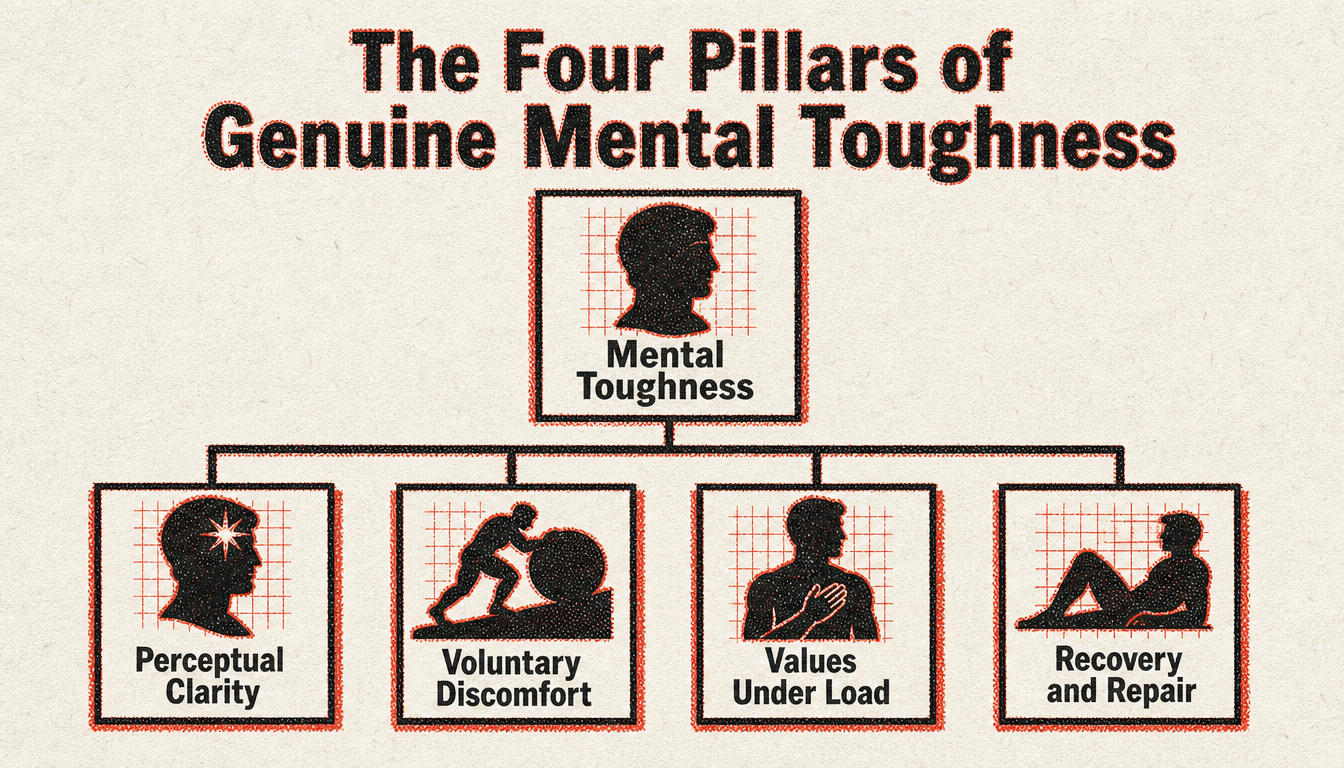
Each pillar depends on the others. Neglect one and the structure wobbles. Here is what each actually means in practice.
Pillar 1: Perceptual Clarity
Most suffering comes from a distorted read of reality, not from reality itself. You catastrophize a meeting, inflate a slight, imagine a future that is not coming. Perceptual clarity is the discipline of seeing the situation as it is, stripped of your projections.
Train it by writing down, in one sentence, what actually happened before you write down what it means. "My manager asked me to redo the report" is a fact. "My manager thinks I am incompetent" is a story. Toughness begins the moment you stop mistaking your commentary for the event.
Pillar 2: Voluntary Discomfort
You cannot develop a capacity you never load. Muscles need resistance, and so does character. Voluntary discomfort is the deliberate exposure to controlled hardship so that involuntary hardship, when it arrives, finds you already trained.
This does not mean daily ice baths. It means choosing the harder conversation, the earlier alarm, the fast you did not have to take, the workout you did not feel like doing. Small, consistent, and boring. The point is not the discomfort itself. The point is proving to yourself, over and over, that your comfort is not the master of your decisions.
Pillar 3: Values Under Load
Anyone can hold their values on a good day. The question is what you do when you are tired, angry, humiliated, or afraid. Values under load means naming the two or three principles you refuse to violate, and then practicing them in low-stakes situations so they hold in high-stakes ones.
Pick specifics. "Integrity" is too vague. "I do not lie to make myself look better" is trainable. "I do not talk about people who are not in the room" is trainable. Toughness is the ability to keep these commitments when breaking them would be easier and no one would know.
Pillar 4: Recovery and Repair
The pillar most men skip. Toughness without recovery is brittleness with a longer fuse. Sleep, sober reflection, honest conversation with people who know you, and the willingness to admit when you were wrong. Men who cannot repair themselves cannot sustain any of the other three pillars.

How to Build Mental Toughness as a Man: The Practical System

The framework only matters if it translates into daily practice. Below is a system built from the four pillars, designed for a man with a job, obligations, and no time for cinematic transformation.
Step 1: Install a Morning Anchor
Before you look at your phone, spend ten minutes on three things: read one page of something demanding, write three sentences on what could go wrong today and how you will respond, and identify the one hard task you will complete no matter what. This is not a routine for its own sake. It sets your judgment before the day sets it for you.
→ You should be able to state, in one sentence, the most important thing you will do today and the most likely obstacle to it.
Step 2: Choose Your Daily Load
Pick one voluntary discomfort per day. Rotate them so you do not adapt too quickly.
| Domain | Light Load | Moderate Load | Heavy Load |
|---|---|---|---|
| Physical | Cold shower finish | Fasted training session | Long ruck or full fast day |
| Social | Initiate one difficult conversation | Give honest feedback to a peer | Address an unresolved conflict |
| Cognitive | Read 20 pages of difficult material | Write for 45 minutes on a hard question | Teach or defend an idea publicly |
| Emotional | Sit with an uncomfortable feeling for 5 minutes | Journal on a fear you avoid | Apologize where you were wrong |
→ At the end of the day, you should be able to name the specific discomfort you chose and completed.
Step 3: Run an Evening Review
Spend five minutes answering three questions in writing:
- Where did I react instead of respond today?
- Where did I hold my standard when it was costly?
- What will I do differently tomorrow because of what I learned today?
This is the mechanism that converts experience into character. Without it, you accumulate years without accumulating wisdom.
→ Your journal should show a visible pattern of the same weaknesses being worked on across weeks, not vague affirmations.
Step 4: Build a Weekly Stress Test
Once a week, do something that meaningfully exceeds your comfort level. A long training session, an unfamiliar social situation, a project that risks failure. The purpose is to remind your nervous system that discomfort is survivable and even generative.
Step 5: Schedule Recovery Deliberately
One full day per week with no productivity agenda. Sleep uncompressed, walk without headphones, spend time with people who know you outside your work identity. Toughness that cannot rest is not toughness. It is a countdown to burnout.
Social Presence: Toughness That Others Can Feel

Mental toughness is not only an internal state. It shows up in how you occupy a room, hold a conversation, and handle disagreement. Men who have done the internal work carry themselves differently, and the difference is legible without being loud.
The Signals of Grounded Presence
- You speak at a normal volume. Insecure men either shout or mumble. A grounded man speaks to be understood, not to dominate or hide.
- You allow silence. You do not rush to fill pauses. Silence is not threatening if you are not afraid of what someone might think.
- You disagree without contempt. You can say "I see it differently" without treating the other person as an enemy or an idiot.
- You accept correction. When you are wrong, you say so plainly and move on. No spiral, no defensiveness.
- You do not seek approval. You are willing to be liked, but you are not organized around it.
What Undermines Presence
Three habits quietly destroy the presence you are trying to build. First, complaining, especially in groups. It signals that you experience yourself as acted upon rather than as an agent. Second, gossip, which trades short-term connection for long-term reputation. Third, over-explaining. If you find yourself justifying every decision, you are seeking permission you do not need.
Presence is what remains when you stop trying to be seen a certain way.
The Philosophy That Holds It Together

Systems fail without a coherent philosophy underneath them. You will hit weeks where the morning anchor slips, the discomfort feels pointless, and the review feels like a chore. What carries you through is not motivation. It is a settled view of why any of this matters.
Three ideas from the Stoic tradition are worth internalizing, not as quotes but as operating assumptions.
The Dichotomy of Control
Some things are up to you. Most things are not. Your effort, your responses, your attention, your standards, are up to you. Outcomes, other people's opinions, the economy, and the weather are not. Investing emotional energy in the second category is the primary cause of male frustration disguised as ambition. Investing it in the first is the source of durable strength.
Memento Mori
You are going to die. Not abstractly, but actually, and probably sooner than your planning assumes. This is not morbid; it is clarifying. A man who genuinely remembers his mortality stops wasting years on grievances, stops postponing the conversations that matter, and stops performing a life he does not want. Toughness gets easier when triviality gets thinner.
Amor Fati
Love your fate. Not passive resignation, but the active willingness to work with the situation you have rather than the one you wish you had. The term amor fati is most closely associated with Friedrich Nietzsche, though the underlying idea — accepting what cannot be changed while directing energy toward what can — resonates deeply with Stoic practice. The man who resents his circumstances burns fuel he needs for changing them. The man who accepts them, without pretending they are good, has the full tank available for the work.
Legacy: What Toughness Is Actually For
Mental toughness in isolation is a party trick. It matters because it lets you carry weight that others depend on, over years, without collapsing or becoming bitter. Legacy is the long-form output of a well-trained man.
Redefining Legacy
Legacy is not a monument, a fortune, or a public reputation. Most men who chase those end up hollow. Legacy is the compound effect of your character on the people who share your life: your family, the men you mentor, the colleagues who watched how you handled defeat, the children who observed which promises you kept.
Ask yourself, honestly, what people will remember about being around you. Not what you did professionally. What it felt like to depend on you. That answer, whatever it is right now, is the honest input to your development plan.
The Three Legacy Questions
- Whose life is measurably better because I am in it? Not vaguely, but with evidence you could point to.
- What am I building that will outlast my attention? A relationship, a body of work, a set of principles carried by others.
- What am I refusing to do, even when it costs me? Your refusals define you more than your achievements.
These questions are not answered once. They are answered continuously, by how you spend Tuesday afternoon.
Common Failure Modes and How to Correct Them
Most men who commit to building mental toughness fail in predictable ways. Recognizing them in advance is half the defense.
| Symptom | Underlying Cause | Correction |
|---|---|---|
| You feel tougher but people around you feel worse | Confusing hardness with strength; using discipline as a weapon | Add warmth as a deliberate practice; measure toughness by how safe others feel, not how impressive you seem |
| Streaks that collapse after a few weeks | Motivation-based practice with no philosophical anchor | Reduce the load by half and rebuild the identity underneath; consistency beats intensity |
| Constant fatigue and irritability | Recovery pillar neglected; toughness treated as pure output | Schedule rest with the same seriousness as training; sleep is a performance variable, not a luxury |
| Emotional numbness mistaken for progress | Suppression disguised as stoicism | Restart the evening review with emotional specificity; name what you felt, not just what you did |
| Isolation increasing over time | Confusing self-sufficiency with maturity | Rebuild two or three real friendships where you can be uncertain out loud |
The Trap of Performing Toughness Online
A special failure mode deserves its own warning. Broadcasting your discipline, posting your cold plunges, narrating your grind, quietly reroutes the work from character development to identity performance. The audience becomes the point. When that happens, you are no longer building toughness; you are marketing it. Do the work where no one is watching. That is the only version that compounds.
Confirming the System Is Working
After ninety days of consistent practice, you should notice specific, verifiable changes. Not a personality transplant. Small shifts that stack.
- You react less to minor provocations. The email that would have ruined your afternoon does not.
- You make faster decisions on things you used to overthink, because your values are clearer.
- You are less interested in arguments you used to enjoy, especially online.
- Your close relationships feel calmer, because you are bringing less unprocessed volatility into them.
- You have at least one hard thing in your week that you do voluntarily, and you no longer treat it as heroic.
If none of these are true after three months, the system is not the problem. Either the practice is inconsistent, or you are performing the framework rather than living it. Reduce the scope, increase the honesty, and restart.
Where to Go From Here
Mental toughness is a lifetime practice, not a project you finish. The four pillars, the daily system, the philosophical anchors, and the legacy questions form a complete framework, but the framework only works if you actually run it. Not for thirty days. For years.
Start smaller than you think you should. One voluntary discomfort per day, one evening review, one honest answer to the legacy questions per week. Add layers as the base holds. The men who become genuinely strong are almost never the ones who transformed themselves in a season. They are the ones who did modest, consistent, philosophically grounded work for a decade while other men were still shopping for the perfect morning routine.
The next step is not another article. It is closing this page and doing one thing today that your future self will be glad you did. Then doing it again tomorrow.